x





Dolly-style animal cloning underpins CRISPR livestock, but changes loom for the field.
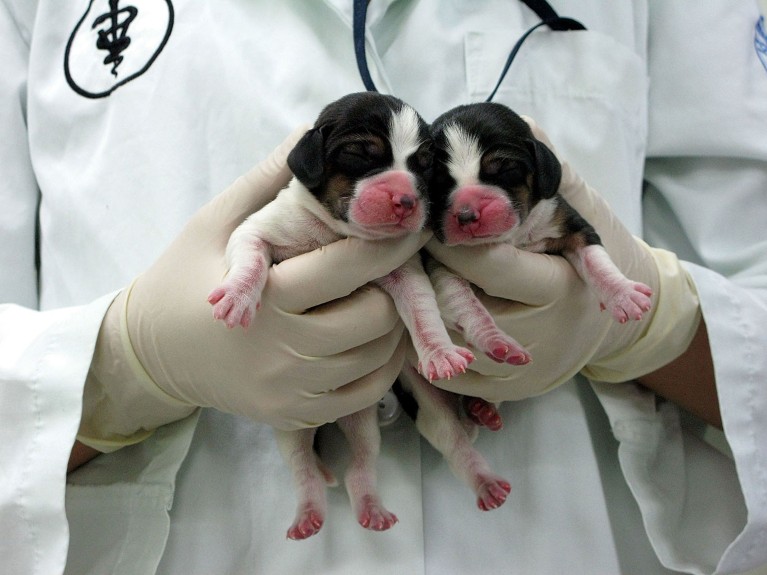
Cloned beagles: cloning can generate living animals from cells with complex genomic edits. Credit: RNL Bio Co. Ltd. via Getty
Irina Polejaeva and her team use the latest techniques to bioengineer animals. With CRISPR genome editing, they make sheep with conditions that mimic human genetic diseases, and goats carrying transplanted pieces of chromosomes that enable the animals to produce human antibodies.
But to bring her designs to life once she has applied these cutting-edge methods, Polejaeva, a developmental biologist at Utah State University in Logan, turns to a method that has been around for more than a quarter of a century: animal cloning carried out with essentially the same procedure used to produce Dolly the sheep in 1996.
The death on 10 September of Ian Wilmut, leader of the team that cloned Dolly, did not mark the end of cloning’s imprint on science. For a core cadre of scientists, Dolly’s legacy lives on in the techniques they use to edit the genomes of livestock, clone champion horses and camels, and generate models of human disease.
“Animal cloning is alive and kicking,” says Kevin Sinclair, a developmental biologist at the University of Nottingham, UK. “But it’s flying under the radar.”
Wilmut and his team produced Dolly with a technique called somatic cell nuclear transfer. It involves removing an egg cell’s nucleus, which holds the cell’s genetic material, and replacing it with the nucleus of a cell from the animal to be cloned. The modified egg cell gives rise to an embryo, which is implanted in the womb of a surrogate animal.
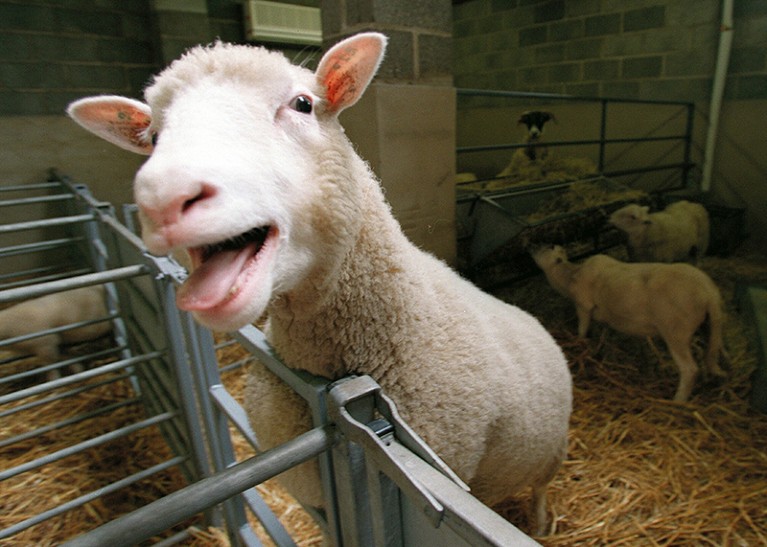
Dolly the sheep, born in 1996, was the first mammal to be cloned from an adult cell.Credit: The Asahi Shimbun via Getty
When Wilmut and his colleagues embarked on their project to clone the first mammal from an adult cell, one goal was to use the technique to generate livestock that would produce pharmaceuticals in their milk. The researchers hoped that this would make the drugs cheaper and easier to produce around the world, says Angelika Schnieke, who studies animal reproduction at the Technical University of Munich in Germany and was a member of Wilmut’s team. “That hasn’t turned out the way it was envisioned,” she says, noting that only a few such products have been developed.
But the goal of using nuclear transfer to engineer animals with new traits is very much alive. That’s particularly true among researchers hoping to make complex gene edits such as inserting a lengthy DNA sequence, or modifying multiple sites in the genome. In such cases, the modifications are made in individual cells in the laboratory. Nuclei from cells that contain the desired DNA changes are then implanted in egg cells to create cloned animals.
This approach allows researchers to ensure that the cells they use for cloning have all the desired changes before they implant an embryo into a surrogate womb. “If you’re making precise changes, it’s critical,” says Tad Sonstegard, chief executive of Acceligen, a biotechnology company in Eagan, Minnesota, that is developing genome-edited livestock.
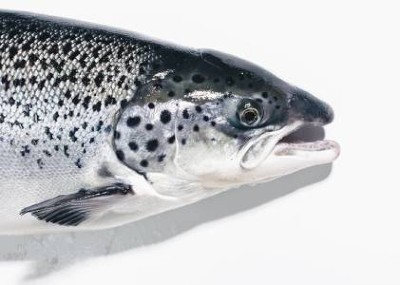
Gene-edited animal creators look beyond US market
Acceligen has used this approach to produce CRISPR-Cas9 gene-edited cattle that have enhanced resistance to heat and certain diseases or that lack horns. Other researchers are making multiple genome edits in the hope of generating animals with organs that can be transplanted into humans without triggering a catastrophic immune response. For experiments last year in which organs were transplanted into human recipients declared clinically dead, some organs came from animals with as many as ten genome edits. It’s crucial to generate clones from cells with all the necessary edits — otherwise researchers would have to screen vast numbers of animals to find one with all ten modifications, says Schnieke.
In addition to genome-edited livestock, an industry has sprung up around cloning beloved pets and champion show horses. Some researchers also use cloning in efforts to bolster the populations of endangered animals. And in a few high-profile cases, scientists are attempting to resurrect extinct species, most famously the woolly mammoth.
But cloning is too technically intensive and inefficient for widespread use in agriculture, says Sinclair. Polejaeva estimates that most companies that make clones have produced hundreds rather than thousands of animals. At a presentation in August, the US Department of Agriculture reported that in its database of about 7 million dairy cattle, only 530 are clones.
In the days since Dolly, researchers have improved methods of caring for embryos growing in laboratory dishes before transplant. Even so, Andrés Gambini, a veterinary physician who studies animal reproduction at The University of Queensland in Gatton, Australia, says that horse embryos cloned in his lab are about three times less likely to grow into healthy foals than are embryos that are transplanted as part of the usual in vitro fertilization procedure, without cloning.
“We have made a lot of progress,” he says. “But nothing has fundamentally changed the efficiency in large, domestic animals.”
Efforts are under way to improve that efficiency. Sinclair says researchers are seeking ways to modify how DNA is packaged in the donor nucleus so that it will more closely resemble sperm DNA. Scientists also hope to better synchronize the cell cycle between the egg cell and its new nucleus, he says.
Recent advances in stem-cell biology could eventually shake the field. Researchers are developing new ways of producing cloned embryos, such as making them entirely from stem cells from the animal to be cloned, without the need for eggs or sperm. And some have generated eggs from the cells of male mice and used them to produce pups with two fathers.
Such advances are still years away from being used to clone large, domestic animals, says Gambini. But he predicts that, eventually, such methods could finally pull researchers away from the Dolly method. “This will become, in the future, the new way of cloning.”