x






Despite what politicians say, Europeans have become more welcoming to people fleeing humanitarian crises.
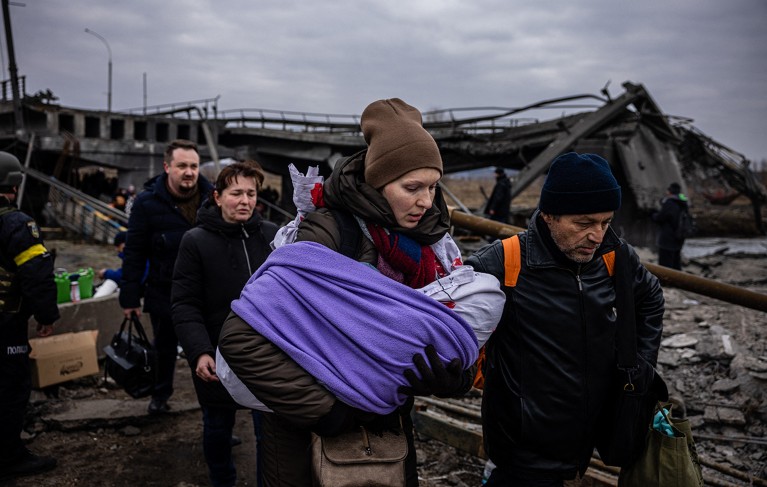
People fleeing Ukraine have been welcomed in many European countries. Credit: Dimitar Dilkoff/AFP via Getty
People in Europe are as supportive of refugees now as they were seven years ago, despite several humanitarian crises, finds a huge survey on attitudes. But they seem to favour certain demographics over others — often those that most closely mirror their own identities, the study found.
The research, reported in Nature on 9 August1, was prompted by the refugee crisis resulting from Russia’s war in Ukraine. The researchers had previously surveyed European attitudes towards asylum seekers in 2016, amid the Syrian refugee crisis. They wanted to see whether the influx of refugees with more cultural similarities to their host communities had changed “the views of the European public on who they want to accept”, says co-author Dominik Hangartner, who studies public policy at the Swiss Federal Institute of Technology in Zurich.
The researchers surveyed 18,000 participants in 15 countries in 2016, and 15,000 in the same 15 countries in 2022. They presented participants with pairs of randomly generated refugee profiles, which differed in traits such as age, religion, gender, occupation and reason for migration. The survey-takers assessed how likely they were to let each refugee stay in their country, and were asked pick only one from each pair to succeed.
In both years, participants were more likely to favour younger refugees over older ones, women over men, and Christians over agnostics and Muslims. Among the least favoured characteristics were being Muslim, moving for economic opportunities and lacking the language skills of the host country.
“There is an inherent bias in the manner in which people who are not used to otherness perceive other groups,” says Michelle Pace, who studies forced migration at Roskilde University in Denmark.
At the start of Ukraine’s refugee crisis in 2022, many critics noted that European politicians and asylum policies seemed to treat Ukrainian refugees more favourably than people fleeing other humanitarian crises, such as those in Syria and Afghanistan. Boris Johnson, then prime minister of the United Kingdom, said that the nation would be “very, very generous” towards Ukrainians seeking refuge. At the same time, he backed a heavily criticized plan to relocate most other people seeking asylum in Britain to Rwanda. Bulgaria’s prime minister at the time, Kiril Petkov, said, “These are not the refugees we are used to … these people are Europeans.”
The European Union activated its ‘temporary protection’ scheme for the first time in February 2022, giving Ukrainian refugees the ability to live, work and attend school in the EU without official asylum approval. Critics asked why the same rights hadn’t been granted to refugees from other countries, such as those in Africa and the Middle East.
Hangartner says that gathering data on public perceptions can inform policies by showing that most people do not have the extreme negative views reflected by certain European anti-asylum policies. “Those you hear in the political arena are sometimes the loudest voices and are not representative necessarily of their constituencies,” he says.
But Daniel Thym, a migration and asylum lawyer at the University of Konstanz in Germany, isn’t sure that the study will be useful in shaping asylum policy. Thym suggests that there is a difference between these findings, which deal with personal perceptions of refugees, and national attitudes towards the numbers of migrants entering a country, which are more relevant to policy decisions.
Pace says that it’s also an issue when studies “talk about asylum seekers and refugees but they’re not talking with them”. She says this reinforces a very important gap in the data; for example, the general attitude of support in these findings is not reflected in the experiences of refugees she works with in Denmark.
Hangartner says that he and his colleagues worked with several European refugee councils, but including the experiences of refugees and asylum seekers went beyond the scope of the study. “I still believe it’s better knowing about these sort of differences than ignoring them,” he says. “That’s exactly where I hope that additional research comes in.”