x




The Zoonomia Project is helping to pinpoint genes responsible for animal-brain size and for human disease.
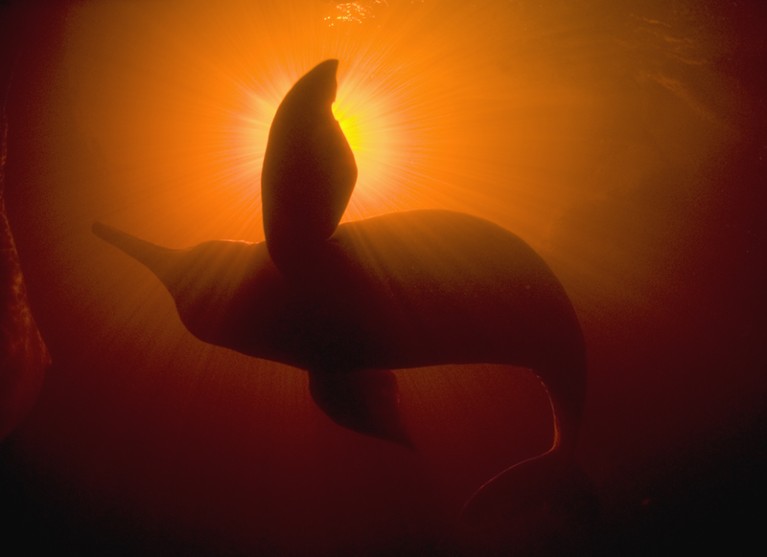
The Amazon river dolphin is one of 52 endangered species studied by the Zoonomia Project.Credit: Kevin Schafer/NPL
When they were first published in the early 2000s, the complete genomes of the mouse, human, rat and chimpanzee opened the door for geneticists to compare their sequences and learn more about how mammals evolved.

These cellular clocks help explain why elephants are bigger than mice
Now, about two decades later, researchers have amassed and compared the genomes of 240 mammals, showing how far the field has come. From this trove of data — the largest collection of mammalian genetic sequences yet — they have learnt more about why some mammals can smell particularly well, why others hibernate and why some have developed larger brains. The effort, called the Zoonomia Project, reported these and other findings in a series of 11 papers in Science on 27 April1.
The data highlight not only which areas of the genomes are similar, but also when, on the scale of millions of years, their genetic sequences diverged. “This really wasn’t possible without this scale of data set before,” says Katie Pollard, a data scientist at the University of California, San Francisco, who is part of the project.
Sequencing so many mammalian species is an enormous accomplishment, says David Haussler, scientific director of the Genomics Institute at the University of California, Santa Cruz. “We were always dreaming about that.” Haussler helped to sequence the first human genome in the early 2000s.
Those first mammalian genomes published long ago were a good start, says Kerstin Lindblad-Toh, a geneticist at Uppsala University in Sweden who is one of the leaders of Zoonomia. But she and her colleagues realized that they would need more than 200 genomes to offer a statistically significant glimpse at how mammalian species had changed over time — especially if they wanted to zoom in on genetic changes at the level of single DNA base pairs.
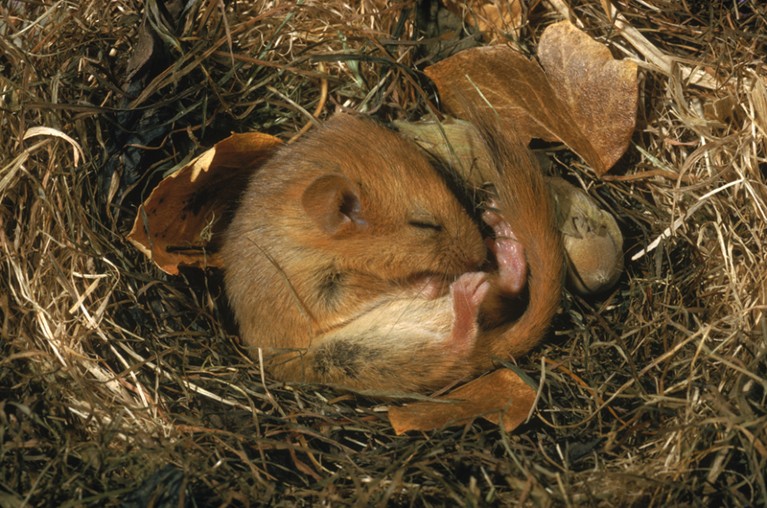
The Zoonomia Project has revealed new details about how animals, such as this hazel dormouse, evolved to hibernate.Credit: George McCarthy/NPL
The Zoonomia consortium, which includes more than 150 scientists and 30 research teams from around the world, made its 240 genomes available to the public for the first time in 20202. Since then, the researchers have looked for similarities among them. They hypothesized that if certain segments of the genomes were similar — and remained so over tens of millions of years across species — those segments must serve an important function for these animals. In one analysis, a team used this concept to estimate that at least 10.7% of the human genome is identical to those of almost all of the species the researchers studied3. Most of these ‘conserved’ areas are so-called regulatory genes, which modulate how and when other genes are transcribed and ultimately translated into proteins. The function of about half of these conserved genes were previously unknown.
Other analyses looked at how the genomes differ, highlighting the way that certain traits such as the sense of smell evolved, but also pointing researchers to which genes contribute to disease. Genome-wide association studies (GWAS) have already compared thousands of human genomes to identify variants that are linked with disease4. But finding the precise genes that aren’t just linked to, but cause a disease, has proved difficult, especially for conditions that have millions of associated genes. Seeing how those genes have evolved over time in all mammals can help to narrow the search “by an order of magnitude”, Lindblad-Toh says.
Using Zoonomia’s data, researchers have also constructed a phylogenetic tree that estimates when each mammalian species diverged from its ancestors5. This analysis lends support to the hypothesis that mammals had already started evolutionarily diverging before Earth was struck by the asteroid that killed the dinosaurs about 65 million years ago — but that they diverged much more rapidly afterwards.
The Zoonomia Project is just one of dozens of efforts to sequence animal genomes. Another large effort is the Vertebrate Genomes Project (VGP), which aims to generate genomes for roughly all 71,000 living vertebrate species, which include mammals, reptiles, fish, birds and amphibians. Although the two projects are independent of one another, many researchers are a part of both, says Haussler, who is a trustee of the VGP.
Every butterfly in the United States and Canada now has a genome sequence
Having so many mammalian genomes is a feat, says Walter Jetz, an ecologist at Yale University in New Haven, Connecticut, but Zoonomia’s database so far has a bias towards species with large bodies and those that are not from tropical regions. Sequencing a greater diversity of mammals will allow researchers to draw more authoritative conclusions about mammalian evolution, he says. Lindblad-Toh says the project aimed to select a wide range of species to sample, but that the more mammals added to this data set, the more powerful it will be. “We’re entering an exponential phase of genome sequencing with mammals and other groups,” says Nathan Upham, an evolutionary biologist at Arizona State University in Tempe who was not involved with the research.
Elinor Karlsson, a geneticist at the University of Massachusetts Chan Medical School in Worcester, who is one of the leaders of Zoonomia, points out that the data are publicly available on the project’s website. “We’re really hoping more people are going to start figuring out all the questions that could be asked with these data sets,” she says.
Zoonomia isn’t the culmination of research in mammal genomics — it’s only the beginning, Upham says. The past 20 years were about learning how to properly sequence genomes, he adds. “Now we’re just starting to really dive deep into the genomes.”