x





Samples of asteroid Bennu delivered by the OSIRIS-REx mission contain carbon, water and other ingredients from the primordial Solar System.
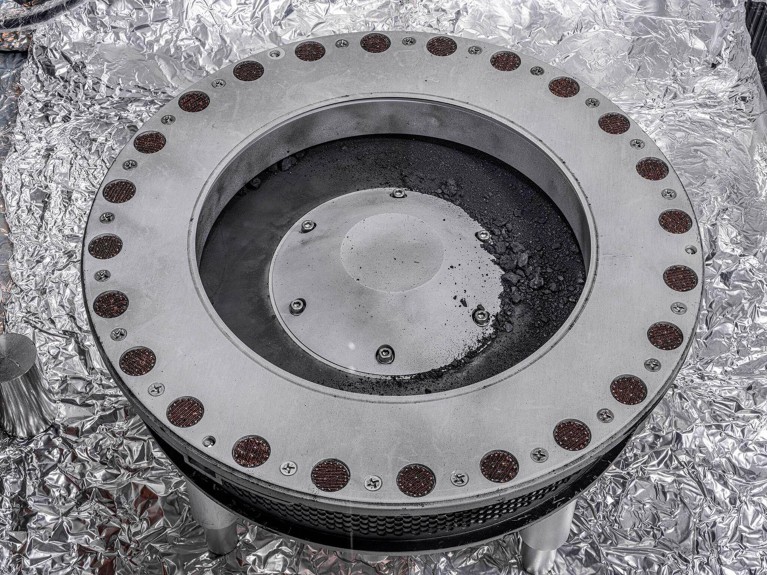
The sample-collection device from NASA’s OSIRIS-REx spacecraft includes material from asteroid Bennu (black grains, middle right).Credit: Erika Blumenfeld, Joseph Aebersold/NASA via AP/Alamy
Pieces of the asteroid Bennu, brought back to Earth in September by NASA’s OSIRIS-REx spacecraft, include crumbly rocks and dust that contain water and carbon — some of the building blocks of life on Earth. NASA provided a first glimpse of the rocks, which are the largest asteroid sample ever returned to Earth, on 11 October.
The Bennu sample includes clay minerals with water trapped inside their crystal structures, bright and dark dust grains that look like flecks of salt and pepper and sulfur-rich minerals such as those that might play a key part in planetary evolution. “The pristine sample material from Bennu represents a valuable resource providing a window into the early Solar System,” says Eileen Stansbery, an astromaterials researcher at NASA’s Johnson Space Center in Houston, Texas, and one of the leaders of the Bennu analysis.
This bounty comes from the outer surface of OSIRIS-REx’s sample canister. The biggest treasure trove will be revealed in the next few weeks, when mission curators open the canister itself. In the meantime, they have been carefully picking their way through the rocks and dust coating the outside of the canister, photographing and classifying them. Only 1.5 grams have been formally catalogued so far, of an anticipated 250 or more grams brought back by OSIRIS-REx (Origins, Spectral Interpretation, Resource Identification and Security–Regolith Explorer).
Researchers are particularly excited about the Bennu sample because the spacecraft’s heat shield kept the material cold on its journey back to Earth. Otherwise, the heat from passing through Earth’s atmosphere might have altered the sample’s chemistry, just as it can distort the chemical record contained in meteorites.

How space missions snatch pieces of other worlds and bring them back to Earth
Scientists had known that Bennu is a carbon-rich asteroid, but early analysis suggests that some of the sample is as much as 4.7% carbon — among the highest percentages of extraterrestrial carbon ever measured. Some of that carbon is bound up in carbonate minerals, which are made primarily of carbon and oxygen, and are common on Earth.
The samples also contain organic materials, compounds that incorporate carbon and hydrogen. On Earth, organic compounds are associated with life but can also be found in the absence of life. Under ultraviolet light, organic patches in the Bennu samples light up like a holiday tree. “This thing’s loaded with organics,” says Daniel Glavin, an astrobiologist at NASA’s Goddard Space Flight Center in Greenbelt, Maryland. “This is incredible material.”
Under an electron microscope, the clay samples from Bennu look like tiny fibres. Water locked inside those clay minerals might be ancient, originating from the dawn of the Solar System. Asteroids could have carried such water to the early Earth and helped to make it habitable.
Other microscopy images show hexagonal crystals that are probably rich in sulfur. Sulfur compounds play a crucial part in determining the rate at which rocks melt, as well as being involved in biologically interesting chemical reactions. The Bennu samples also contain iron-rich minerals with large flat surfaces, which might have helped to catalyse chemical reactions early in the asteroid’s history.
Next stop Earth: Hayabusa2 bids farewell to asteroid Ryugu
At least one of the rocks in the Bennu sample is crumbly and hummocky-looking, similar to the boulders that dominate Bennu’s rubbly surface. The mission’s principal investigator, Dante Lauretta, a planetary scientist at the University of Arizona in Tucson, calls it his “favourite grain” so far. There are also examples of both dark-coloured and light-coloured rocks, as scientists had suspected might be on Bennu. The light colours might represent areas altered by water early in Bennu’s history.
It will take another few weeks before researchers know exactly how much of Bennu they captured. When OSIRIS-REx stretched out its robotic arm in 2020 to collect material from the asteroid’s surface, it came away with so much material that the collecting apparatus overflowed.