x






The craft has performed a technically challenging descent at the lunar south pole.
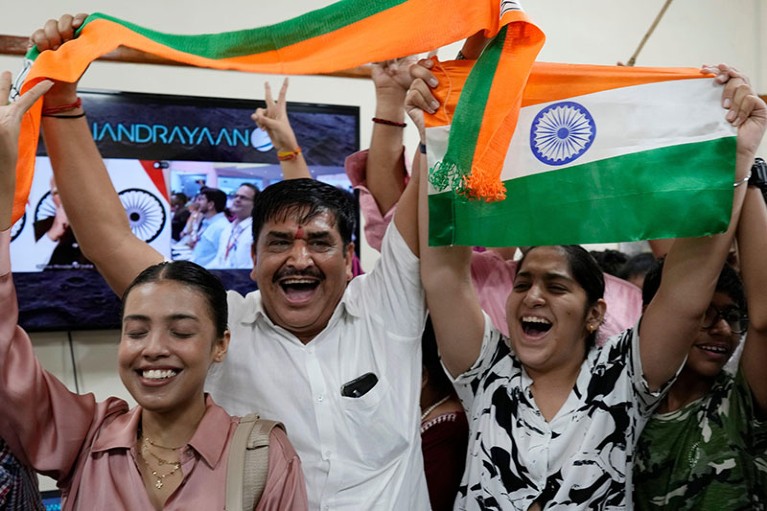
India’s lunar success has been celebrated around the country.Credit: Manish Swarup/AP via Alamy
An Indian spacecraft has become the first to land near the Moon’s rock- and crater-strewn south pole, making the country the world’s fourth to successfully perform a controlled landing on the body.
The landing by the spacecraft, called Chandrayaan-3, is a major success for the country’s Indian Space Research Organisation (ISRO), which made an unsuccessful attempt to land on the Moon in 2019 with predecessor mission Chandrayaan-2. ISRO tweeted that it has established a communication link with its lander and it telecast images of the ramp being deployed for the module’s rover to roll onto the lunar surface.
The accomplishment is a “powerful, emphatic restatement of India’s growing global stature and capability in science and technology”, says cosmologist Tarun Souradeep who directs the Raman Research Institute in Bengaluru, India. It will inspire Indian scientists “to step forward and play lead roles in the emergent and inevitable global quest for Moon-based scientific and technological enterprise”.
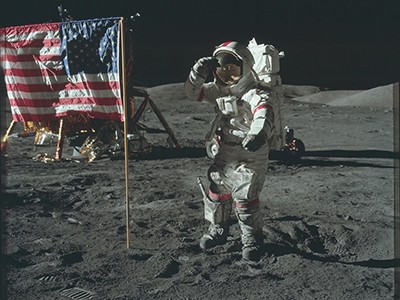
Fifty years after astronauts left the Moon, they are going back. Why?
The landing “gives confidence to configure missions to go to the Moon, Mars, Venus, maybe even asteroids”, ISRO chairman S. Somanath told a press briefing.
Chandrayaan-3, India’s third lunar mission, lifted off on 14 July. The launch propelled into orbit a 3.9-tonne spacecraft that carried a 1.75-tonne landing module called Vikram, which bore a six-wheeled robotic rover called Pragyan. Once deployed, Pragyan will ramble around the landing site for one lunar day, equivalent to 14 Earth days.
The Moon’s south pole — a challenging region to land in — has drawn interest from many nations because of the possibility that it contains water ice, and the large craters near it could offer clues about the composition of the early Solar System. Several missions are headed there in the coming years, and on 19 August, a Russian craft called Luna 25 crashed into the Moon just days before it was going to attempt a landing at the south pole.
“The recent crash of Russia’s Luna 25 spacecraft is a stark reminder of just how difficult it is to land successfully on the Moon,” says Marc Norman, planetary geochemist at the Australian National University in Canberra. Landers from Israel and Japan have also crashed while attempting controlled lunar landings. In recent years, only China’s Chang’e missions have landed successfully on the Moon and conducted surface operations. The United States and Soviet Union are the only other nations that have successfully put craft on the lunar surface.
India’s success instills confidence in the technological competence of India’s space industry, says Kavya Karampuri, a mission systems engineer at Bengaluru-based company KaleidEO, which specializes in Earth-observation-based space data analytics. It could attract global investments in the Indian private space sector, foster international collaboration, and innovation across universities, labs, start-ups, and research communities in India, says Karampuri.
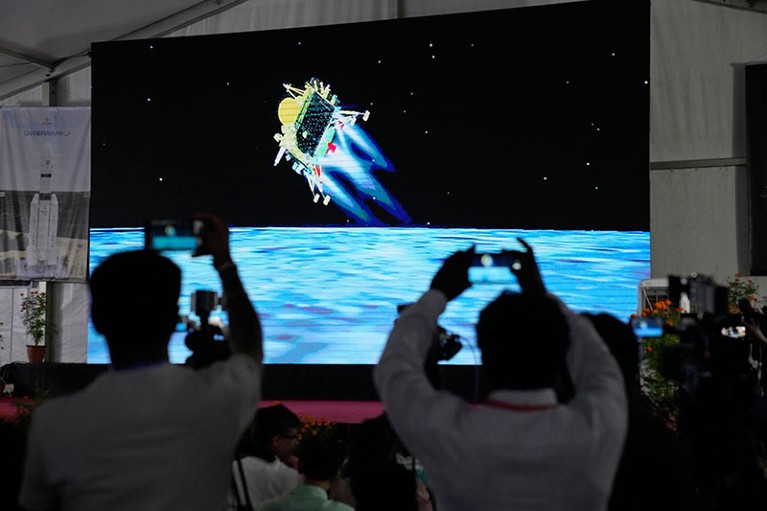
A live telecast of the Chandrayaan-3 landing at Indian Space Research Organisation in Bengaluru.Credit: Aijaz Rahi/AP via Alamy
Chandrayaan-3 follows India’s partially successful 2019 mission, which launched an orbiter with eight functioning instruments. But the lander carrying the Moon rover crashed into the lunar surface in the final moments of landing.
ISRO learnt from that failure and made several design changes to the lander-rover portion of the mission.
These include a new laser sensor to measure the real-time velocity of the spacecraft relative to the Moon, algorithms to handle unanticipated deviations in propulsion or trajectory and better judge the landing terrain, bigger and more solar panels, more fuel, a heavier lander equipped with four sturdier legs to handle a faster landing velocity. The craft also targeted a larger landing area that was 4 kilometres by 2.4 kilometres, compared with a 0.5 km by 0.5 km region for the previous mission.
Landing at the Moon’s south pole is difficult because it involves positioning the spacecraft at a different angle from previous landings, and the area has rough terrain.
In particular, it requires putting the spacecraft into a polar orbit that is at right angles to the Moon’s orbit, says Norman. “This requires additional energy to move the spacecraft into an ‘unnatural’ orbit, which introduces uncertainties on critical aspects such as velocity and location of the spacecraft.”
A lack of detailed data on the region’s gravity and surface characteristics compounds the problem, says Norman. “For example, if the spacecraft lands in a crater, on a slope, or the leg of the lander catches on a boulder, the mission could be compromised.”
Moon quakes near the area add complexity, says geologist Saumitra Mukherjee at the Jawaharlal Nehru University in New Delhi, whose team analysed images sent by India’s first lunar mission, Chandrayaan-1, which launched in 2008 and detected cliffs and signs of displaced underground rocks in two craters near the lunar south pole.
Poor lighting from the Sun is another challenge. “Some areas are completely in the dark, others are in the light, but with extreme sun angles, essentially blocking out any terrain features,” says Torin Clark, an aerospace engineer at University of Colorado Boulder. “This is in contrast to the Apollo landings, where the landing sites and timing were specifically chosen to ensure quality lighting of the lunar terrain” such as rocks and craters.
Chandrayaan-3’s success comes about a week before ISRO’s next major mission — its first to study the Sun — which is scheduled to launch in the first week of September.