x




Europe’s JUICE spacecraft will study three of Jupiter’s four Galilean moons: Ganymede, Callisto and Europa.
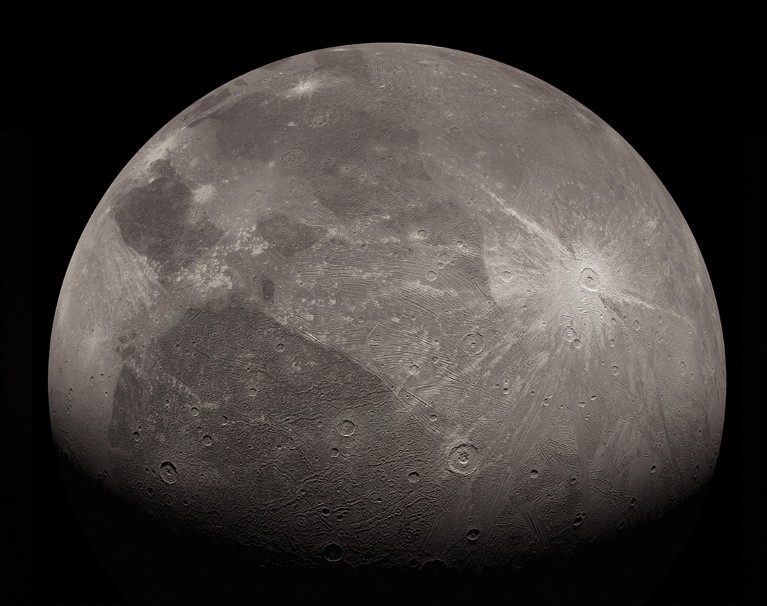
An image of the icy moon Ganymede taken by NASA’s Juno spacecraft during its 2021 fly-by.Credit: NASA/JPL-Caltech/SwRI/MSSS/Kalleheikki Kannisto (CC-BY)
Update: The JUICE mission launched successfully on 14 April, after being called off the day before due to a risk of lightning.
Europe’s space agency is preparing to launch a mission to Jupiter that would have made Galileo Galilei proud. The probe will get close to three of the four large moons Galileo discovered in 1610, and will eventually circle around the largest, Ganymede, and search for evidence of a hidden ocean beneath its icy surface. If successful, it will be the first time that any spacecraft has orbited a natural satellite other than Earth’s Moon.
The Jupiter Icy Moons Explorer (JUICE) craft is currently positioned atop an Ariane 5 rocket at the European spaceport in Kourou, French Guiana, and is set to launch at 9:15 local time (12:15 coordinated universal time) on 13 April. “There is no launch window, only one launch instant,” said programme director and launch operator Véronique Loisel at Arianespace, during a press briefing in Kourou last week.
Such a precise lift-off time is required to insert the spacecraft into the correct orbit around the Sun, explained Loisel, who is based in Évry, France. If the launch has to be postponed because of poor weather or other reasons, the next opportunity will come around 24 hours later.
If everything goes according to plan, the European Space Agency (ESA) probe will circle back and pass close to both Earth and the Moon in around one year’s time, which will help to slingshot the spacecraft towards the outer Solar System. This double fly-by will require “the most accurate gravity-assist manoeuvre ever done”, said ESA payload-system engineer Alessandro Atzei at the briefing. Atzei is based at the agency’s European Space Research and Technology Centre in Noordwijk, the Netherlands.
As is the case for all missions to the outer Solar System, JUICE’s trajectory will be anything but direct. It will first make a Venus fly-by, in 2025 — which will expose it to high temperatures — after which it will fly past Earth twice more, in 2026 and 2029. It will arrive at Jupiter in 2031, at which point its main engine will perform a long retro-burn to slow down and begin orbiting the planet.
Whereas JUICE is scheduled to do 21 fly-bys of Jupiter’s second-largest moon Callisto, it will only pass the smallest Galilean moon, Europa, twice. That’s because Europa will be studied closely by a NASA mission called Europa Clipper, which is due to launch in late 2024.
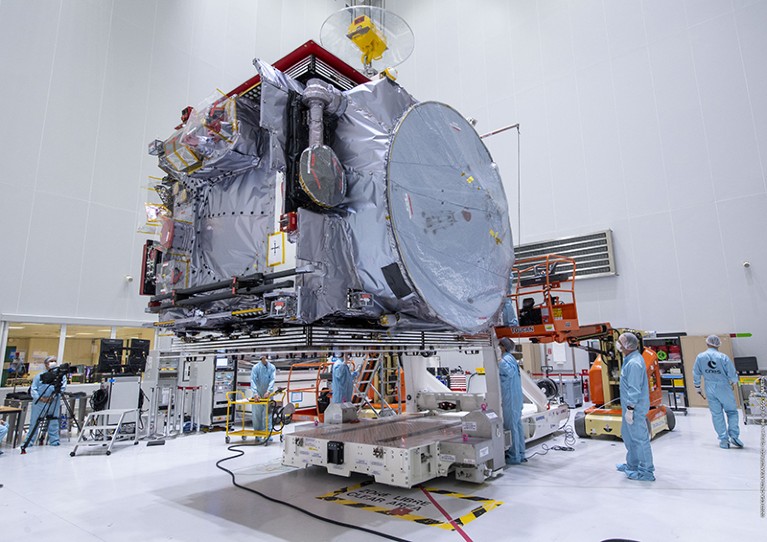
The JUICE spacecraft is unpacked at the spaceport in French Guiana in preparation for final checks and fuelling.Credit: ESA-CNES-Arianespace/Optique video du CSG/S. Martin
In 2035, JUICE will fire up its main engine again to enter orbit around Ganymede, at an altitude of 500 kilometres, for at least 9 months. This will be a delicate manoeuvre, says Scott Bolton, a planetary scientist at the Southwest Research Institute in San Antonio, Texas. “You have to really go slow around Ganymede and match its orbital speed, in order to get trapped,” says Bolton, who is the principal investigator for Juno, an ongoing NASA mission that has been orbiting Jupiter since 2016. “If you’re moving just a little bit too fast, Jupiter’s gravity pulls you away.”
Bigger than the planet Mercury, Ganymede is the largest moon in the Solar System, and the only one known to currently have its own magnetic field.
Although Juno was designed to study Jupiter, it has also conducted fly-bys of two of the planet’s icy moons, sending back spectacular images. “When we set out and designed Juno, I hadn’t imagined that some day we’d fly by really close to Europa and Ganymede,” says Bolton. The mission is also planning two fly-bys of Io — the rocky fourth moon discovered by Galileo that neither JUICE nor Europa Clipper is scheduled to visit — in December 2023 and February 2024.
Some of Jupiter’s icy moons are thought to harbour liquid water underneath their predominantly water-ice surfaces — potentially providing an environment for some form of life to have evolved. In the mid-1990s, NASA’s Galileo probe provided hints of such a water ocean on Ganymede and, more convincingly, Europa. Further evidence came in 2015 from Hubble Space Telescope observations of Ganymede’s aurorae1, which are created by its magnetic field similar to how Earth’s geomagnetism produces the aurorae borealis and australis.

Scientists made a new kind of ice that might exist on distant moons
One of the most conclusive tests of the ocean theory will come from topographical maps made by JUICE’s laser altimeter. Because Ganymede moves slightly closer to and farther from Jupiter during its weekly orbit, and because it experiences the gravitational pull of the other moons, it stretches and compresses under tidal forces. On a water world with an ice crust, such deformations might make the surface swing up and down by as much as 10 metres, says JUICE project scientist Olivier Witasse, who is based at the ESA in Noordwijk. “If it’s only a solid tide, it would be less than a metre,” he adds.
Loaded with 3.5 tonnes of propellant, JUICE weighs nearly 6 tonnes. On its journey, it will deploy 85 square metres of solar panels — the bare minimum for operating around Jupiter, where solar energy is only 4% as powerful as on Earth. JUICE will also deploy a plethora of booms and antennas for its ten onboard instruments, which were built by teams in France, Germany, Italy, the Netherlands, Sweden and the United States. As well as mapping the icy moons’ surfaces, these instruments will also study the chemistry of the satellites’ thin atmospheres, Jupiter’s strong magnetic field and radiation belts, and more.
By the time JUICE and Europa Clipper arrive, Juno will have long exhausted its propellant and ended its mission. But researchers are excited at the prospect of having two probes in the system at the same time, which could enable simultaneous measurements of Jupiter’s magnetic field at two locations, says Cynthia Phillips, a planetary geologist at NASA’s Jet Propulsion Laboratory in Pasadena, California, who is on the Europa Clipper team. “These and other synergistic observations are being studied by a joint JUICE–Clipper steering committee,” says Phillips. Both missions are scheduled to end with a controlled crash landing on Ganymede’s surface. The one that lasts the longest might observe the other’s impact up close.