x




Planets might be more common throughout the Universe than previously thought, suggest results from the James Webb Space Telescope.
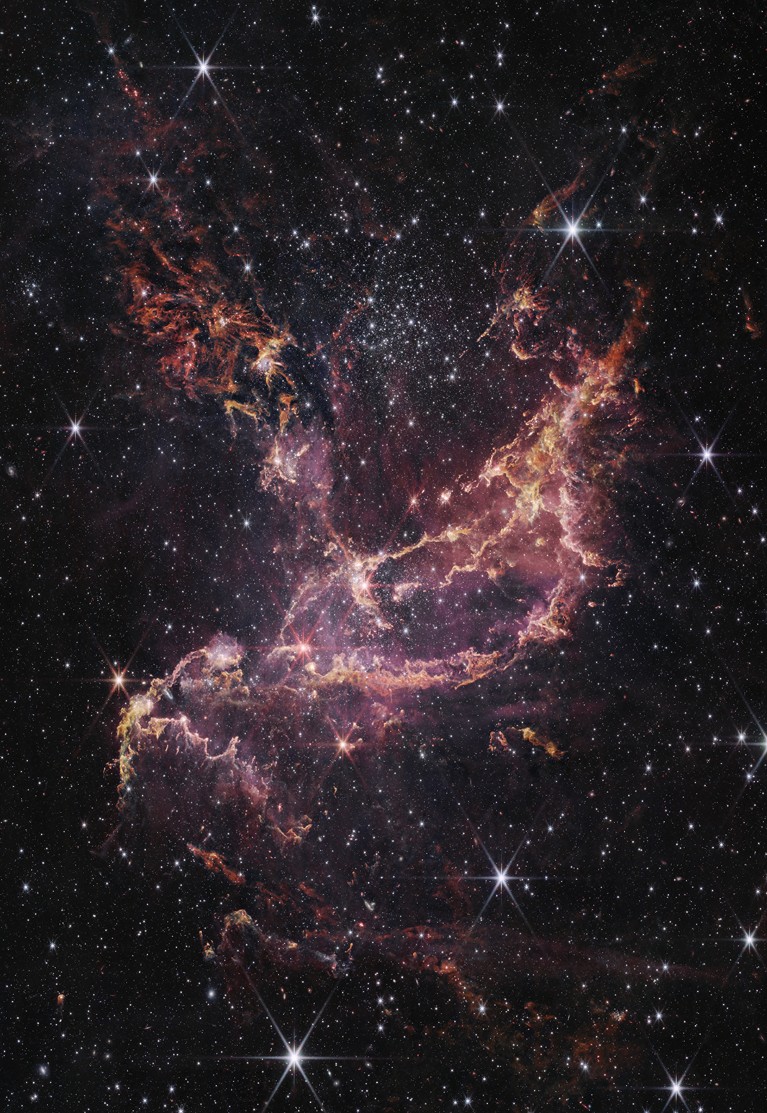
Scientists found the ingredients for planet formation in a star cluster called NGC 346, which lies in the Small Magellanic Cloud. Credit: NASA, ESA, CSA, O. Jones (UK ATC), G. De Marchi (ESTEC), and M. Meixner (USRA). Image processing: A. Pagan (STScI), N. Habel (USRA), L. Lenkic (USRA) and L. Chu (NASA/Ames)
The ingredients for planet formation have turned up in part of a nearby galaxy where it was thought planets might not emerge. The discovery, reported on 24 April in Nature Astronomy1 and made using NASA’s hugely powerful James Webb Space Telescope (JWST), suggests that planet formation may be more common throughout the Universe than previously thought.
“I’ve waited a long time to be able to do these observations,” says Olivia Jones, an astrophysicist at the UK Astronomy Technology Centre in Edinburgh and the lead author of the study. “It’s not been possible to do them before.”
The findings follow a flood of discoveries enabled by JWST, which launched in December 2021 and beamed back its first science images last July.
Researchers looked at NGC 346, a highly active star-forming region in a galaxy near the Milky Way called the Small Magellanic Cloud (SMC). They chose this place because it has a very low concentration of metals — which astronomers define as any element heavier than hydrogen and helium.
That makes it resemble the conditions during the ‘cosmic noon’, a period approximately ten billion years ago when stars formed in a flurry in nearly all the galaxies of the Universe. Furthermore, NGC 346 is much bigger than other star-forming regions nearby, allowing astronomers to see more clearly how stars interact with each other and how they take shape.
The researchers were mainly interested in studying low-mass stars because they are much more common in the Universe than high-mass stars. The Sun is a low-mass star, so understanding star formation in NGC 346 could also help explain the birth of the Solar System.
But it had been challenging to study the birth of low-mass stars because they emit a lot of dust as they form, which hides their light. The best way to see through the dust is by capturing infrared light, something JWST’s predecessor, the Hubble Space Telescope, wasn’t built to do. “With Webb, you can see these stars right at that moment of being born,” says Jones.
Dust, however, is also crucial to detecting planet formation. The dust released by a star when it’s born can collect into a disk that eventually turns into planets. It wasn’t known whether enough dust could survive for planets to form in NGC 346, because the low-metal conditions make such disks susceptible to fast evaporation by light.
The researchers used filters on JWST’s camera to find combinations of infrared wavelengths that allowed them to identify stars at various stages of their lives. They found enough dust, collecting in signature ways, to indicate planet formation was possible.
Spotting the ingredients for planets in NGC 346 broadens understanding of where planets can exist, says Stefanie Milam, deputy project scientist for JWST planetary science at NASA’s Goddard Space Flight Center in Greenbelt, Maryland. “It’s giving us a lot more area to start searching for planet formation and star formation beyond what we had originally presumed.”
Researchers understand how, once rocky planets begin to take shape in low-metal galaxies, they can collect more dust, says Jones. But how enough dust survives to foster planet formation in the first place is still a mystery, she says.
It’s too soon to say whether the existence of more planets increases the probability that there is life elsewhere in the Universe, says Jones. But she wants to look at NGC 346 more closely for signs of certain substances, including water and carbon dioxide.
Jones plans to use JWST to conduct follow-up observations in around six months, targeting the potential planetary systems reported in the latest study. Further in the future, investigating whether other unexpected galaxies can nurture planet formation will help to build a better picture of how the process works, says Milam.
“I think the discovery space is just infinite,” Milam says. “Hands down, we’re ready for the next generation of astrophysics.”