x






ProMED staff members look for rescue options, after going on strike and calling for new leadership and financing.
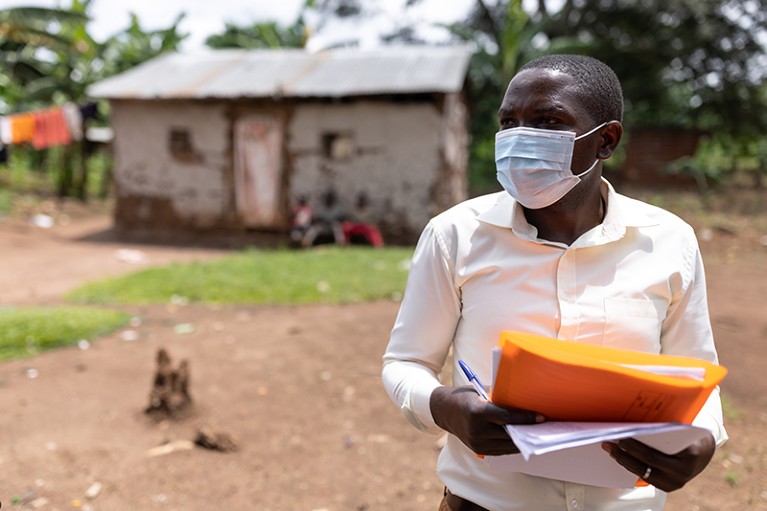
ProMED provides an early warning system for outbreaks of diseases such as Ebola. Here, a member of an emergency response team in Uganda looks for the contacts of people with Ebola during an outbreak in 2022.Credit: Luke Dray/Getty
Last week, nearly two-thirds of staff members who send out infectious-disease alerts for ProMED — an e-mail system responsible for sounding the alarm on outbreaks such as COVID-19 and Ebola — went on strike, leaving the future of the 29-year-old programme in limbo.
Global plan for dealing with next pandemic just got weaker, critics say
When announcing their strike in a 3 August e-mail to ProMED users, staff members called for more resources, transparency and independence from the International Society for Infectious Diseases (ISID), the non-profit organization in Brookline, Massachusetts, that operates ProMED. They are now looking to another entity — such as a university or a university consortium — to take over or share the service with ISID.
The disruption to ProMED has rattled the infectious-disease and public-health communities, which say that robust disease-surveillance systems are essential, because global warming increases the likelihood of more-frequent outbreaks. ProMED is “part of the fabric for how we identify emerging infectious diseases”, says John Brownstein, an epidemiologist at Harvard Medical School in Boston, Massachusetts. “Without it, we’ll have a real gap to find the next pandemic threat.”
Linda MacKinnon, chief executive of ISID, said in a 4 August statement that ProMED will continue to operate “in a limited capacity” with a “temporary reduction” in the number of alerts, while ISID works with the staff members to address their concerns.
Since 1994, ProMED has sent news of potential pathogen outbreaks around the world to its e-mail list, which today has tens of thousands of subscribers. ProMED employees filter through tips — some anonymous — and scan local newspapers for evidence of an outbreak. Once a subject-matter expert reviews the evidence and deems it credible, a bulletin with the available information is prepared, edited and disseminated to the e-mail list.
Has COVID taught us anything about pandemic preparedness?
For instance, a ProMED post on 30 December 2019 about a cluster of pneumonia-like infections of unknown origin in Wuhan, China, was the first warning the world received about COVID-19. The service was also the first to send out word about the coronavirus diseases severe acute respiratory syndrome (SARS) in 2003 and Middle East respiratory syndrome (MERS) in 2012. There are 8–10 posts on average daily, on topics ranging from foodborne illnesses to fungal pathogens.
Brownstein says that because staff members are adept at sifting through the countless tips they receive and at providing crucial context, “the essence of ProMED is the expertise of the people involved”. This manual system of reviewing submissions from around the world is also essential for holding governments accountable — they might not otherwise be forthcoming with up-to-date information about outbreaks — says Saskia Popescu, an infectious-disease epidemiologist at George Mason University in Fairfax, Virginia.
ISID says that the service costs about US$1 million to operate annually, and that the organization received only $20,000 in a fundraising drive meant to finance the programme. Therefore, ISID has told ProMED subscribers in a 14 July e-mail that it would need to implement a subscription model that would charge users to access ProMED’s archive, which had previously been free. The original written agreement between ProMED and ISID, signed when ISID took over the service in 1999, stipulated that the service would remain, “subject to available resources, freely accessible to all”, according to documents that Nature has reviewed. ProMED’s former editor-in-chief Lawrence Madoff says a paid model runs counter to the service’s mission and could hamper research and limit access, particularly in low- and middle-income countries.
Pandemic whistle-blower: we need a non-political way to track viruses
Although the 14 July e-mail was signed “The ProMED Team”, the programme’s 38 editors and moderators hadn’t been consulted or made aware of these changes, says Leo Liu, an associate editor at ProMED based near Boston, Massachusetts, and signatory of the message to users announcing the strike. ISID also told staff members in July that the modest stipends they normally receive for their work would be delayed by several months.
There have long been tensions over ISID’s ability to operate ProMED, Liu says. These flared in 2021 after Madoff was “forced out” by ISID leadership after nearly 20 years of service, Liu adds.
ProMED “requires proper corporate governance, a stable and adaptable IT infrastructure, and private and corporate fundraising capabilities”, the 3 August e-mail from staff members reads. “Unfortunately, such leadership and capabilities appear to be beyond the scope and mission of ISID alone.”
It’s still unclear what will happen to the service. One possibility is that ISID moves forward with the paid subscription model, which might generate enough revenue to sustain ProMED. Another is that the service receives donations or sponsorships from other organizations. But rather than “watching ProMED circle the drain and die a slow death under ISID”, Liu says that he and the other striking staff members are “pushing ISID to think outside the box and be open to co-hosting the service” or even finding it a “new administrative home”.
Will COVID force public health to confront America's epic inequality?
For now, “ISID has not received any proposals for funding partnerships, endowments, or revenue sharing,” MacKinnon said in her statement. In the meantime, Liu and his fellow signatories have been reaching out to universities and consortia to gauge their interest in co-hosting the service. But to do so, Liu says institutions would need ISID’s cooperation, because ProMED staff are not privy to the service’s financial details, which would be important to disclose to potential partners.
“That would require ISID being willing to give up their exclusivity and share the operation and control of ProMED with others,” says Madoff, who is an infectious-disease specialist at the University of Massachusetts Chan Medical School in Worcester.
The difficulty in finding resources and partnerships underscores the current dire situation in public-health funding, says Syra Madad, an infectious-disease epidemiologist at the Harvard Kennedy School in Cambridge, Massachusetts. Governments worldwide have found it harder to justify spending for pandemic preparedness after the World Health Organization’s announcement in May that COVID-19 is no longer a public-health emergency of the highest level. “We’re walking backwards in a time when we should be investing more in these types of tools,” Madad says.