x






Fifth National Climate Assessment says nowhere is safe from warming, but some communities are impacted harder than others.
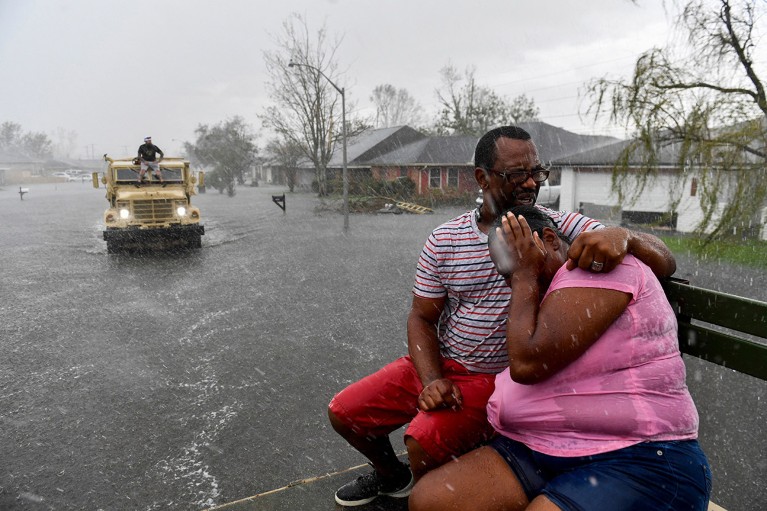
Trucks evacuate people from a neighbourhood in LaPlace, Louisiana, that was flooded by Hurricane Ida in 2021. Credit: Patrick T. Fallon/AFP via Getty
‘Unprecedented’: That’s how an assessment, released by the administration of President Joe Biden, describes the toll that climate change is taking on the United States.
Extreme weather events caused by global warming cost the country around US$150 billion in direct damages each year, says the climate report, released on 14 November. From 2018 to 2022, the United States experienced 89 climate disasters that each cost at least $1 billion in damages. That equates to one every three weeks, as compared with one every four months in the 1980s.
Influential US climate report moves ahead — under new leadership
This year, a wildfire in Maui killed at least 97 people — the deadliest US wildfire in more than a century — and the first-ever tropical storm watch was issued for southern California in the wake of Hurricane Hillary.
“Climate change is here,” says Arati Prabhakar, Biden’s chief science adviser and director of the White House Office of Science and Technology Policy. But Prabhakar says that the United States is stepping up to the challenge with significant new climate investments, “and this gives us hope that we can move at a scale that the climate notices”.
The fifth National Climate Assessment is technically a year overdue. By law, the US government must complete the report every four years, reviewing the latest climate science and offering guidance to state and local officials about how to adapt to global warming. The last one was issued in 2018, after which the administration of former president Donald Trump appointed an official with a history of criticizing climate research to head the process of drafting the next report. The Biden administration assembled a different team after taking charge in 2021, and roughly 500 authors worked on the final version.
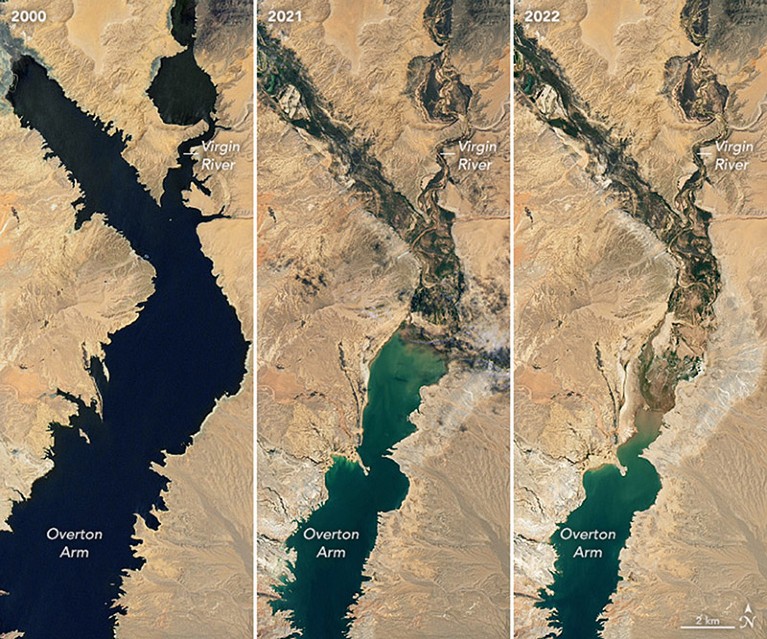
A drought that began in 2000 (left) has caused the Colorado River’s levels to drop steadily. Lake Mead, a reservoir along the river in Nevada and Arizona, was filled to just 27% capacity in 2022 (right). The reservoir supplies water to millions.Credit: NASA via Shutterstock
In parallel with the report’s release, the White House announced more than $6 billion in new investments, funded through a pair of landmark laws that provide historic boosts in funding for infrastructure, clean energy and climate resilience. That includes $3.9 billion to modernize the US electric grid, $2 billion for community grants focused on environmental justice and several hundred million targeted at helping communities to secure reliable water supplies and to become more resilient to flooding.
“This is not about curling up in a corner in despair,” says Rachel Cleetus, policy director and lead economist for the Climate and Energy Program at the Union of Concerned Scientists, an advocacy group based in Cambridge, Massachusetts. “There are very concrete steps we can take to cut our emissions and to promote climate resilience.”
After taking office, Biden had the United States rejoin the United Nations’ Paris climate agreement, which Trump had exited in 2019. Biden also committed to halving the country’s greenhouse-gas emissions by 2030, compared with 2005 levels, and to achieving net-zero emissions by mid-century. The latest climate assessment makes it clear that the United States is so far falling short on those goals.
Climate change is hitting the planet faster than scientists originally thought
The nation’s total greenhouse-gas emissions fell by around 17% between 2005 and 2021, according to the latest US emissions report to the United Nations climate convention. The pace of emissions reductions needs to increase from around 1% per year to roughly 6% to meet the country’s mid-century targets.
Released just weeks before the next big United Nations climate summit, where countries will come together to address the global-warming crisis, the report underscores the collective nature of the problem. Until the world stops pumping greenhouse gases into the atmosphere, the effects of climate change will continue to increase. At the same time, the authors also emphasize the idea that every fraction of a degree of warming matters, which also means that every action taken to reduce emissions will lower the risks and impacts of climate change going forward.
That’s a message that should ring loudly to the public and to policymakers, says Katherine Hayhoe, chief scientist at The Nature Conservancy, a conservation group based in Arlington, Virginia, and an author on the report. “Our actions matter,” Hayhoe says, “and that’s the science”.
The report also focuses on environmental and social justice, the quest to address pollution and climate impacts that disproportionately affect marginalized — and often minority — communities. In fact, for the first time, it includes a specific chapter on the topic, as well as a chapter on Indigenous peoples, which was led mostly by native scholars.
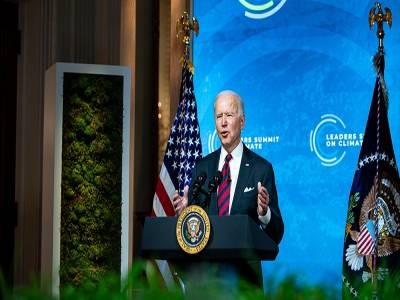
US pledges to dramatically slash greenhouse emissions over next decade
“It’s a breath of fresh air,” says Kyle Whyte, a member of the Citizen Potawatomi Nation who studies environmental justice at the University of Michigan in Ann Arbor. A lead author on the chapter on Indigenous peoples, Whyte says that the report highlights Indigenous rights alongside climate solutions. “In many native communities, our infrastructure is not up to the task of protecting our populations from the massive climate impacts that threaten us.”