x






Astrobotic, the firm that launched the Peregrine spacecraft, says it will learn from any missteps and look ahead to its next attempt.
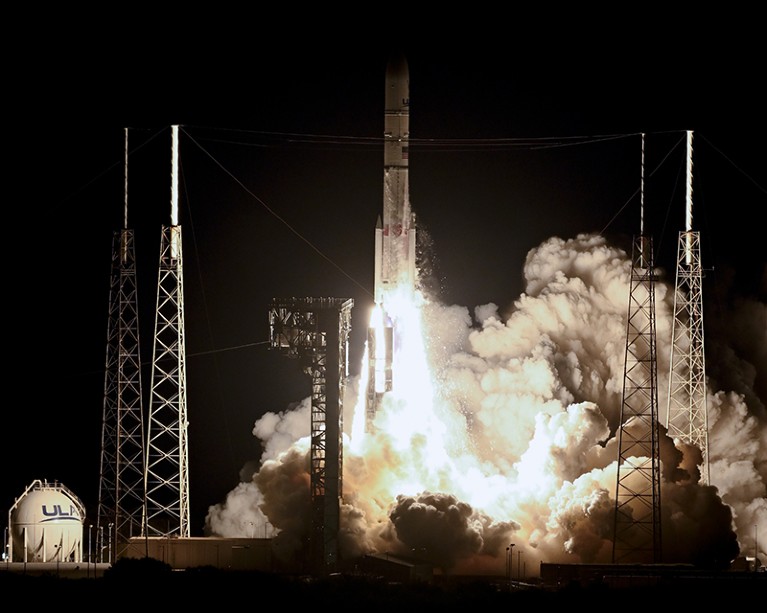
The launch of the Peregrine spacecraft from Florida on 8 January went almost perfectly — but then the craft got into difficulties.Credit: Joe Marino/UPI/Shutterstock
A commercial spacecraft that was making a bid to become the first US Moon lander in more than 50 years ran into trouble hours after its 8 January launch. The probe, known as Peregrine, made it off Earth and into deep space — but soon began to leak propellant and tumble out of control. Engineers managed to temporarily get it into a stable configuration that allowed sunlight to fall on its solar panels and charge its battery, but the mission probably won’t achieve its aim of landing on the Moon on 23 February.
Private companies are flocking to the Moon — what does that mean for science?
“At this time, the goal is to get Peregrine as close to lunar distance as we can before it loses the ability to maintain its sun-pointing position and subsequently loses power,” said Astrobotic, the company based in Pittsburgh, Pennsylvania, that built and is flying the spacecraft, in an update late on 8 January.
The leaking propellant means that the thrusters that maintain Peregrine’s orientation in space are working much harder than they were designed to. The spacecraft might be able to stay facing the correct direction for only about 40 hours from the time of the update, the company said.
Peregrine is the first of many Moon missions planned as partnerships between NASA and the US aerospace industry. Known as the Commercial Lunar Payload Services (CLPS) programme, the collaboration encourages small businesses to build and fly lunar landers, on which NASA will buy rides for scientific equipment. Five NASA research payloads, worth a total of US$108 million, are on board Peregrine, including instruments for studying water and other volatiles in the lunar soil. NASA has said it understands that these commercial missions come with a level of risk, given that they use brand-new equipment from companies that might not have flown space missions before.
If Peregrine had succeeded, it would have been the first private lunar mission to touch down successfully on the Moon. Only the space agencies of the Soviet Union, the United States, China and India have ever pulled off lunar landings, although other countries have made attempts in recent years. Most failures have come as probes attempted to descend to the Moon’s surface, under lower gravity and a much thinner atmosphere than on Earth.
Moon mission failure: why is it so hard to pull off a lunar landing?
The next CLPS launch is scheduled for no earlier than mid-February. The spacecraft involved is of a different design and built by another company, Intuitive Machines in Houston, Texas. It’s not clear what impact the Peregrine problems will have on that launch. Astrobotic is also slated to launch another CLPS mission — to send a large lander with an ice-drilling rover from NASA to the lunar south pole — no earlier than November 2024. That mission could also be affected.
In a statement, NASA said the difficulties with Peregrine provide a teachable moment. “We will use this lesson to propel our efforts to advance science, exploration and commercial development of the Moon,” said Joel Kearns, deputy associate administrator for exploration at the agency’s headquarters in Washington DC.
Before the launch, Astrobotic indicated its willingness to learn from problems. “If we have a bad day somewhere along the mission, we’re going to be gathering all of the data that we received up to that point, and we’re going to learn from it,” said chief executive John Thornton. “We’re going to get smarter, and we’re going to be ready for the next one.”
Until the propellant problems began, Peregrine’s launch went nearly perfectly. The mission was the first test flight of a rocket called Vulcan, built by United Launch Alliance in Centennial, Colorado, and of engines built by Blue Origin in Kent, Washington. This type of engine could reduce the US aerospace industry’s current reliance on Russian-built rocket engines. Vulcan is already slated to fly many future missions for customers including the US military and the tech behemoth Amazon, which aims to use the rocket to launch a constellation of broadband communications satellites.