x




A component of the milk consumed by newborn mice triggers a crucial shift in heart cells’ metabolism.
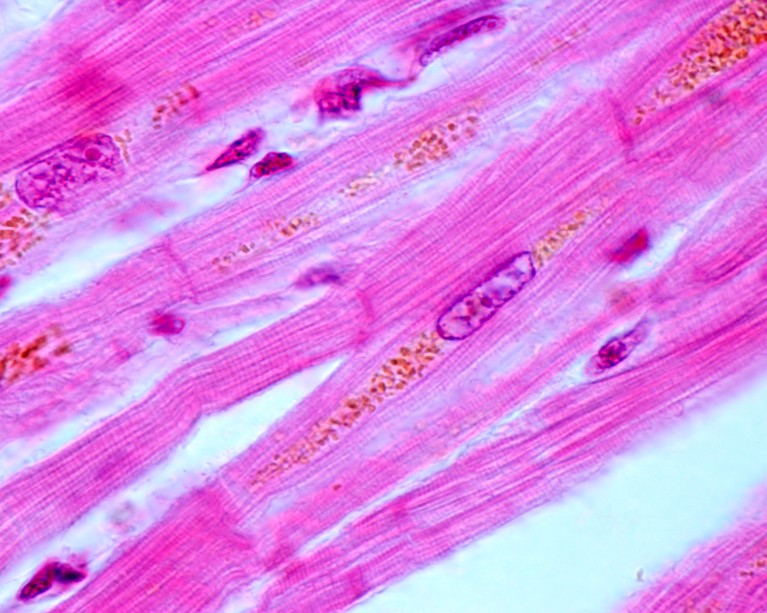
Heart-muscle cells develop a taste for lipids thanks to a fatty acid in mother’s milk, mouse experiments show.Credit: Jose Calvo/Science Photo Library
Heart-muscle cells are endurance athletes, capable of beating for a lifetime. Now, scientists studying mice have discovered how these cells reach their full powers: with the help of mother’s milk1.
The research shows that a molecule in milk prompts a newborn mouse’s heart-muscle cells to shift to a different food source, which then powers the cells through adulthood. This switch happens within the first 24 hours of birth, the authors found. The findings were published today in Nature.
The heart muscle is made up of cells called cardiomyocytes, which contract to make the heart beat. The embryo’s cardiomyocytes burn mostly glucose and lactic acid. But once these cells are mature, they burn fatty acids, the building blocks of fats. The steps leading to this transformation have been unknown.
How humans’ ability to digest milk evolved from famine and disease
Biologist Mercedes Ricote at the Spanish National Center for Cardiovascular Research in Madrid and her colleagues sought to determine how cardiomyocytes make the leap from immature sugar-eaters to fully developed fat-consumers. The researchers fed some mouse pups on milk from mothers that ate standard mouse chow; other pups consumed milk from mothers that ate fat-free chow. Pups that drank milk from the fat-deprived mothers had abnormal hearts — and most died within two days of birth.
To determine which molecules were responsible for this outcome, the researchers milked mother mice by hand and analysed the milk’s components. The team zeroed in on a fatty acid called ɣ-linolenic acid (GLA), which is also found in human breast milk. Neither mice nor humans can make GLA and must ingest it in the diet.
“It is an essential fatty acid that you need to eat: you cannot make it,” says co-author and biologist Ana Paredes, also at the Spanish National Center. Paredes notes that a precursor to GLA is found in baby formula.
The scientists gave GLA to mothers on a fat-free diet and fed the resulting milk to baby mice, which then “thrived”, the authors write. These pups also had increased activity of genes related to energy production from fats.
Pupating ants make milk — and scientists only just noticed
The team identified the receptor to which GLA binds in cardiomyocytes: retinoid X receptor (RXR). The linkage between GLA and RXR kicks off the transition to a new diet. The team also pinpointed the genes that become active after the receptor binds with GLA.
Working out this chain of events took more than seven years of effort, including the development of a new type of ‘knockout’ mice that lack the key RXR receptor to which GLA binds. Adding to the complexity was the need to work with newborn mice, which are challenging to study because of their small size and the uncertain timing of their birth, Paredes says.
Rong Tian at the University of Washington in Seattle, who studies cardiovascular disease, cautions that the results do not rule out the possibility that other molecules, such as Vitamin A, also bind to the receptor bound by GLA. Mother mice might store this nutrient in their bodies and transfer it to their pups, she says. Ricote acknowledges that this work does not exclude the possibility that other molecules are involved in the process.