x





Nature talks to experts about how messenger RNA is transforming medicine.
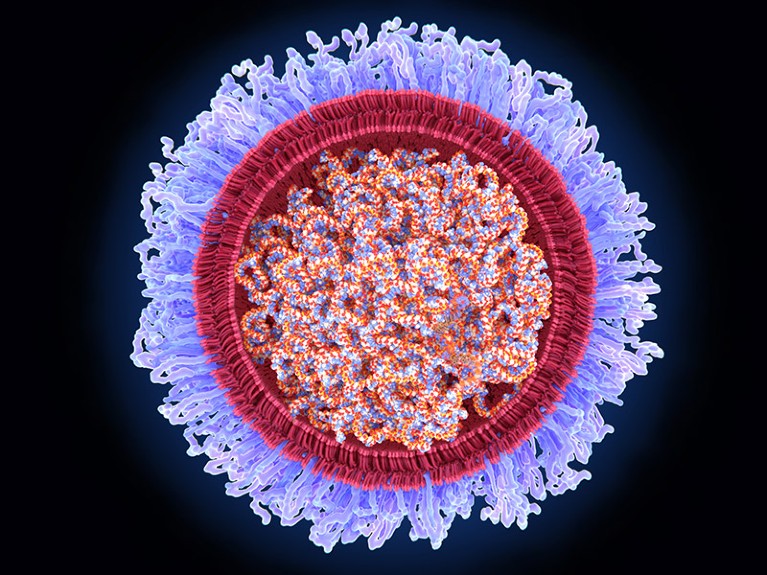
In some COVID-19 vaccines, mRNA snippets are packed inside lipid nanoparticles (cross-section shown here) that deliver the genetic instructions to cells.Credit: Juan Gaertner/Science Photo Library
In just three short years, mRNA vaccines have saved millions of lives, achieved household recognition and, as of this week, become the subject of a Nobel Prize. Yet the field shows no signs of slowing down.

Pioneers of mRNA COVID vaccines win medicine Nobel
In the wake of the technology’s dramatic success in generating quick-turnaround COVID-19 vaccines, investors have poured billions of dollars into expanding mRNA’s therapeutic reach.
This influx of cash promises to fuel the research and infrastructure needed to deploy mRNA medicines in ways that could transform public health by tackling hard-to-treat infectious diseases, cancers and rare genetic disorders.
“The sky’s the limit,” says Matthias Stephan, an immunologist at the Fred Hutchinson Cancer Center in Seattle, Washington. “For whatever you want to correct, or whatever you want to treat, there could be an mRNA medicine — that’s the excitement.”
Nature spoke to researchers about mRNA medicines that are on the horizon.
Vaccines based on mRNA rose to fame not only for their safety and efficacy, but also for the speed with which they were developed and rolled out during the COVID-19 pandemic.
The approach allows researchers to have “a very potently effective vaccine in arms within weeks”, says Barney Graham, who helped to develop one of the mRNA-based COVID-19 vaccines while at the US National Institutes of Health. (Graham now serves as senior adviser for global health equity at Morehouse School of Medicine in Atlanta, Georgia.)

How COVID unlocked the power of RNA vaccines
The vaccines deliver mRNA that instructs a person’s cells to create copies of viral protein, also known as antigens. This process stimulates the body to generate protective antibodies and virus-fighting immune cells.
Because synthetic mRNA can be designed and manufactured in days, the technology allows vaccines to be reformulated quickly each year to address the ever-evolving nature of viruses such as SARS-CoV-2 and influenza. Or it can be deployed as a rapid-response tool in the face of new infectious threats. For example, Moderna, a biotechnology company in Cambridge, Massachusetts, has trialled mRNA vaccines against the monkeypox, Zika and Nipah viruses.
“We can definitely take advantage of the flexibility and simplicity of mRNA vaccine production,” says Norbert Pardi, a vaccine scientist at the University of Pennsylvania (UPenn) in Philadelphia who has worked closely with the winners of this year’s Nobel Prize in Physiology or Medicine — immunologist Drew Weissman, also at UPenn, and biochemist Katalin Karikó at the University of Szeged in Hungary. In the mid-2000s, the two laureates developed some of the foundational technology used to create mRNA vaccines.
Companies already have mRNA vaccines moving through the pipeline that target familiar pathogens. For instance, Moderna has a jab to protect against respiratory syncytial virus (RSV) — which causes cold-like symptoms in most people but can be life-threatening to babies and older people — under review at the US Food and Drug Administration. Its public-health impact might be limited, however, because two protein-based vaccines beat it to approval.

The tangled history of mRNA vaccines
Where the technology could really make a difference is with pathogens that drug firms haven’t been able to crack. One is cytomegalovirus (CMV), a virus that has eluded vaccine developers for more than 50 years and that causes birth defects in infants, as well as potentially deadly infections in people with compromised immune systems. “This is where mRNA has been quite a game-changer,” says Sallie Permar, a paediatric infectious-disease researcher at Weill Cornell Medicine in New York City.
CMV uses a bundle of five proteins to enter and exit human cells, an antigen configuration that is difficult for protein-based vaccines to emulate. But with mRNA, researchers can simply provide the genetic instructions that a cell needs to produce the five proteins. The cell itself then does the heavy lifting of properly assembling the subunits into one antigen complex, just as happens during a natural infection.
Early results1 suggest that Moderna’s CMV vaccine, now in phase III trials, stimulates a stronger immune response in some tissues than do natural infections. “It’s an exciting time to end the most common cause of infectious disability,” says Permar, who has collaborated with Moderna to study the vaccine’s immune potential.
The future of mRNA vaccines is not limited to infectious disease. “The next big thing is cancer, for sure,” says Derrick Rossi, interim chief executive at the New York Stem Cell Foundation in New York City and a co-founder of Moderna.
The lightning-fast quest for COVID vaccines — and what it means for other diseases
Cancer researchers have long sought a vaccine that could be used to train the immune system to fight tumours — only to see promising candidates fail in clinical trials. Cancers have been a tough nut to crack because malignant cells mutate rapidly, weakening therapeutics’ power.
With mRNA, researchers can develop cancer vaccines that target dozens of antigens on tumour cells simultaneously. Hitting several targets at once could make it harder for cancer cells to evolve ways to evade immune responses elicited by a vaccine. Clinical trials of a new class of personalized cancer vaccine are under way: these vaccines use mRNA aimed at a collection of mutated proteins that are found in an individual’s own tumour.
But mRNA’s applications in cancer could have a wider reach, says Elad Sharon, an oncologist at the Dana-Farber Cancer Institute in Boston, Massachusetts. “This is broader than just vaccines.”
Moderna is testing therapies that deliver mRNA instructions for making immune-stimulating molecules, such as cytokines, in cells to see whether they can amplify the effects of existing cancer immunotherapies2. And BioNTech, a biotechnology company in Mainz, Germany, is developing similar mRNA therapies that coax cells to generate antibodies that can help to rouse an immune response.
When researchers began working with mRNA as a therapeutic, the fact that the molecule could degrade quickly made it difficult to work with.
Ways of generating longer-lasting mRNA molecules could help. Yet, in some cases, mRNA’s fleeting nature is an advantage. When it comes to genome-editing tools such as CRISPR-Cas9, researchers don’t want DNA-cutting enzymes to linger in the cell, because of the potential for unintended edits. mRNA represents a way to shuttle instructions for making the enzymes into cells and have them disappear after they’ve done their job.

COVID advances win US$3-million Breakthrough prizes
“This is a perfect use of mRNA,” says Rossi, who co-founded a company called Intellia Therapeutics in Cambridge, Massachusetts, that is using mRNA to deliver the gene-editing machinery needed to correct two rare diseases. “You want it around for a short while, you want it to do its job, and then you want it to go away.”
Other companies, including one that Weissman co-founded called Capstan Therapeutics, are deploying mRNA to equip immune cells with enhanced disease-fighting functions. In these applications, the amount of protein elicited from mRNA is just enough to allow efficient editing or reprogramming, but not enough to introduce unwanted effects.