x




Naturally freeze-dried leaf-eared mice found above 6,000 metres show mammals can dwell at extraordinary heights.

The leaf-eared mouse can live on Andean summits where no plants grow. Credit: Marcial Quiroga-Carmona
Towering kilometres above sea level, the tops of the Andean volcanoes are extremely hostile to life. Temperatures there never rise above freezing, the air is so thin that breathing is difficult and there is a constant barrage of wind.
But life has found a way: researchers who climbed to the peaks of three volcanoes in Chile and Argentina found more than a dozen naturally mummified leaf-eared mice (Phyllotis vaccarum), some of them possibly centuries old1. The presence of the freeze-dried creatures and analysis of their genomes suggest that leaf-eared mice spend extended periods in these hostile locations.
“This is truly surprising and challenges our previous assumptions about the adaptability of species to extreme environments,” says Emmanuel Fabián Ruperto, a behavioural ecologist at the Argentine Institute for Dryland Research in Mendoza.
The discovery is reported today in Current Biology.
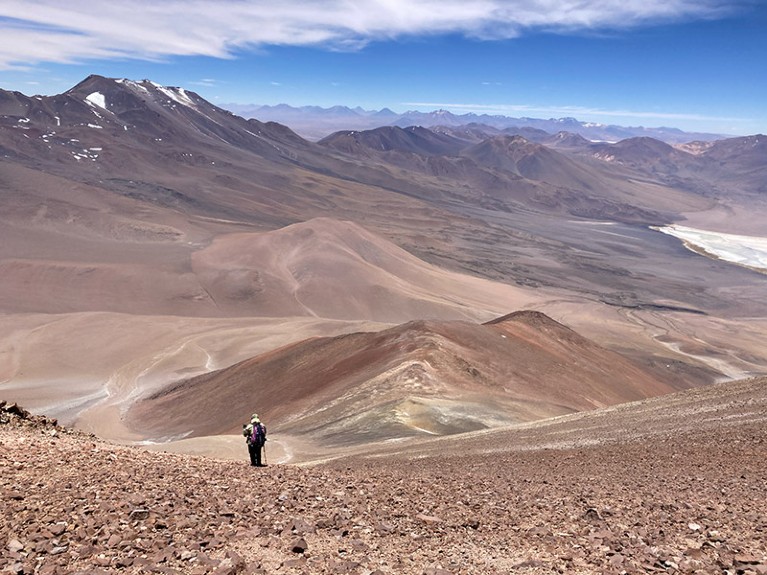
A researcher descends Salín Volcano near the Argentina–Chile border, where the team found the mummies of two pairs of closely related mice.Credit: Jay Storz
Study co-author Jay Storz, an evolutionary biologist at the University of Nebraska–Lincoln, and his colleagues had previously captured a live leaf-eared mouse at the summit of a fourth Andean volcano, 6,739 metres above sea level2. It remains the highest-altitude mammal ever reported. But the discovery of mummies from an extended time period shows that the lone mouse was not a “one-off” finding, says Storz.
Analysis of the mummies’ genomes showed that there were an equal number of males and females, and one summit hosted two pairs of closely related mice. That suggests that the mice didn’t just occasionally wander to the summits; rather, communities of mice made their homes at the tops of the volcanoes.
Like the live mouse, the mummies were found more than 6,000 metres above sea level — more than 1,000 metres above the highest-altitude plant life in the region.
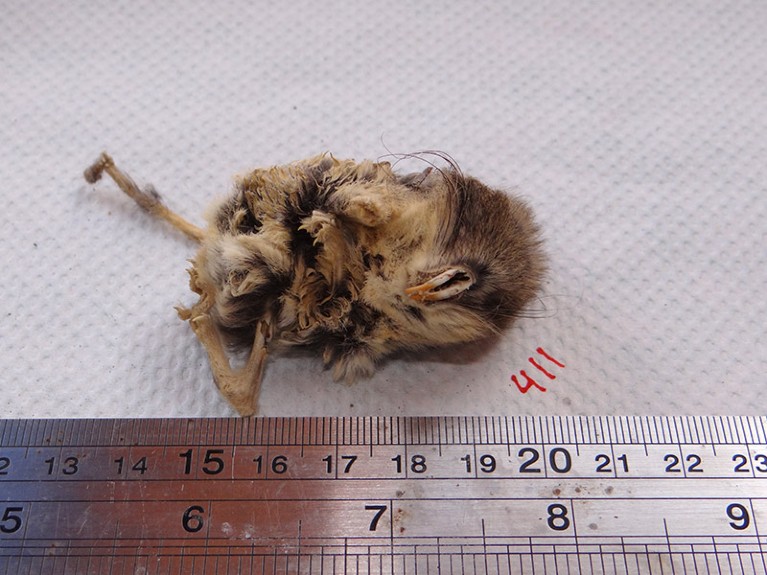
A mouse mummy excavated from the 6,029-metre summit of Salín Volcano.Credit: Marcial Quiroga-Carmona
“Food availability at such altitudes [is] virtually non-existent,” says Fabián-Ruperto. “So, what do these animals feed on?”
The authors hope to answer that by analysing the rodents’ stomach contents. Why the animals choose to live so high up might remain a mystery, but one thing is clear, Storz says: “We’ve underestimated the abilities of mammals to survive and function in those extreme conditions.”