x





After nine days in a state of suspension, the upside-down Moon lander has received enough sunlight to start operating again.
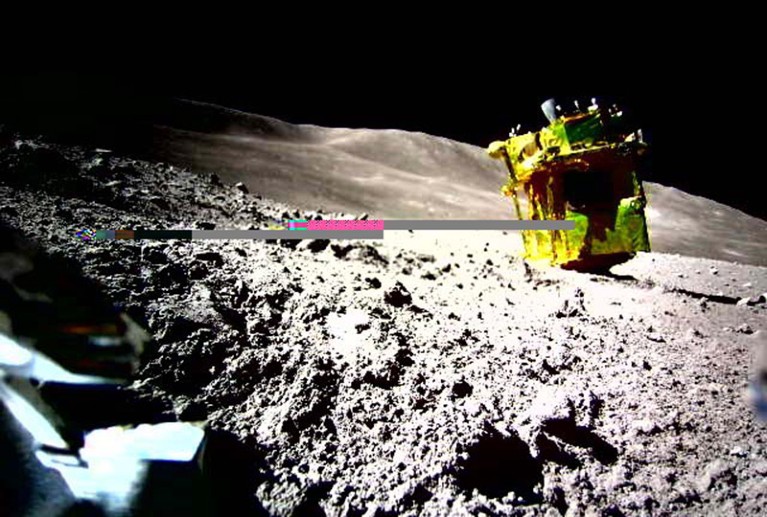
The lander was photographed upside down on the lunar surface. Credit: JAXA/TOMY Company/Sony Group Corporation/Doshisha
After being stuck without power for more than a week, Japan’s Moon lander has woken up and started snapping images of the lunar surface.
On 28 January, the Japan Aerospace Exploration Agency (JAXA) re-established contact with the Smart Lander for Investigating Moon (SLIM), which touched down on the slope of a crater near the Moon’s equator on 20 January. “Communication with SLIM was successfully established last night, and operations resumed,” JAXA announced in a post on X (formerly Twitter).
SLIM landed on the Moon’s surface roughly 55 metres away from its original target, making it the most precise landing ever accomplished. Days later, NASA’s Lunar Reconnaissance Orbiter spotted the lander on the Moon from 80 kilometres above.
But the landing wasn’t entirely smooth sailing, with one of the probe’s two engines probably losing thrust at just 50 metres above the surface, Jonathan McDowell, an astrophysicist at the Harvard–Smithsonian Center for Astrophysics in Cambridge, Massachusetts, says. “It started going sideways because the two engines were unbalanced.”
In an image captured by an instrument that SLIM managed to deploy during its descent — a baseball-sized robot with two cameras — the lander could be seen tipped upside down. Its solar cells were also pointing away from the Sun, which meant that they couldn’t generate enough power to run SLIM’s instruments and communications equipment. The lopsided lander was forced to run on battery power for almost three hours. When the lander’s battery reached 12%, JAXA shut off SLIM’s power to increase its chances of recharging when the Sun moved into a more favourable position.
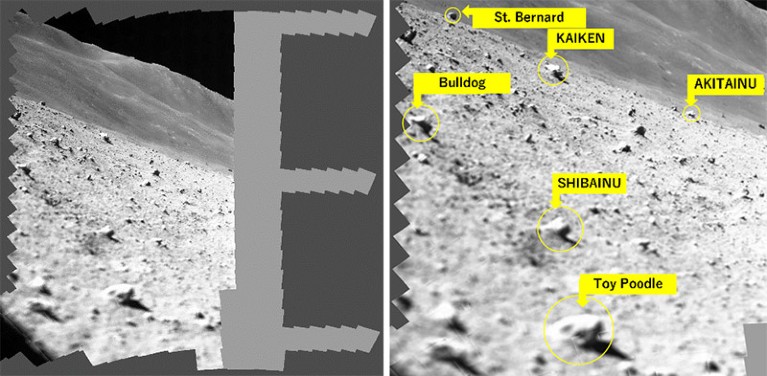
SLIM’s camera captured an image of a landscape strewn with rocks, which researchers named after dogs.Credit: JAXA, Ritsumeikan University, The University of Aizu
The lander’s charge-up was probably made possible because of the sunlight changing direction and beaming onto the lander’s solar cells, enabling them to start generating power, says McDowell. SLIM’s comeback demonstrates its technological resilience. “The systems are robust enough that they could power down and then wake up again once they got some sunlight.”
Shortly after it woke up, SLIM’s multi-band camera — its only scientific instrument — captured an image of a rock-strewn field. The SLIM team named the rocks after dog breeds, including one nearby that they tagged ‘toy poodle’ and a more distant one they called ‘shiba inu’, a Japanese breed. The camera will scan the lunar surface for traces of a mineral called olivine, which could help to answer questions about the Moon’s origins.
SLIM’s bumpy landing offers lessons for future missions, such as insights on how to better design propulsion systems, says McDowell. But landing inside 100 metres of its target site is an accomplishment all on its own, he adds. “Even if it hadn’t come back to life, I would have rated this as a super successful mission,” says McDowell.
A JAXA spokesperson said that SLIM will continue to snap images of the lunar surface until daylight on the Moon fades, at the end of January. As well as revealing more clues about the Moon’s chemical composition, the lander’s second wind allows the team to see how long SLIM can survive before lunar night falls, adds McDowell.