x






Frightened mice sleep poorly. Researchers have identified at least some of the neurons responsible.
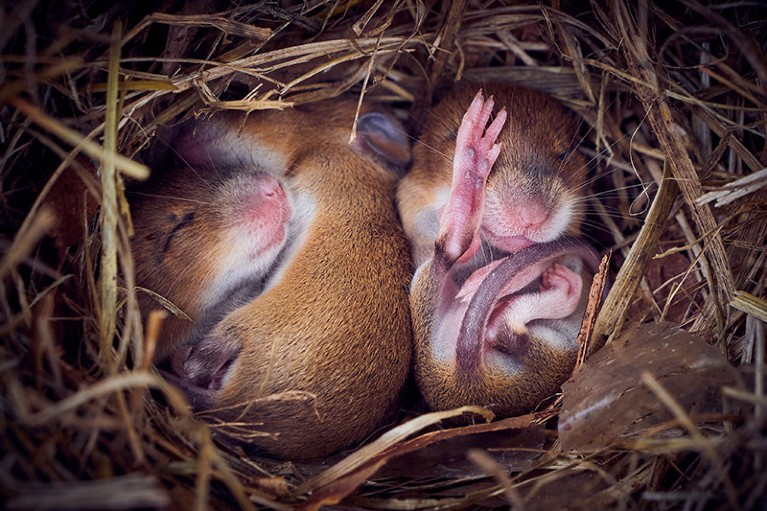
Like humans, mice sleep more deeply when they aren’t under stress.Credit: Adrian Eugen Ciobaniuc/Getty
Anyone who has ever tossed and turned through the night after a troubling day knows that stress can disrupt the rhythms of sleep. But how and why is not well understood.
Researchers have now identified a group of neurons in the brains of mice that are involved in regulating blips of wakefulness, called microarousals. The finding1 could help to explain how stress disrupts sleep, says Ketema Paul, a neuroscientist at the University of California, Los Angeles. “That is a very big step in the right direction as we look for targets to better treat sleep impairments that result from stress.”
Microarousals are a normal part of sleep for mice and humans. Throughout the course of a night’s rest, periods of brief waking are mixed in with stretches of deep sleep called non-rapid eye movement (non-REM) sleep. But when microarousals happen more frequently than normal, they lead to fragmented, poor-quality sleep or even sleep disorders such as insomnia, says study co-author Shinjae Chung, a neuroscientist at the University of Pennsylvania in Philadelphia.
Chung and her team were interested in which brain circuits regulate microarousals and how they are triggered by acute stress. Acute stress is caused by a sudden, big event, whereas chronic stress persists over time. In humans, acute stress might come from something such as experiencing a car crash, Chung says.
To create acute stress in mice, the researchers exposed the animals to repeated attacks from an aggressive mouse. Then they removed the unfriendly mouse, and partitioned the targeted animal to one half of its enclosure. The aggressive intruder was designed to induce a state called social defeat stress, and which continued to affect the targeted mouse as it fell asleep.
The researchers observed the stressed rodents’ brain activity using electroencephalography and electromyography, or EEG and EMG, to monitor when the mice were asleep or awake. At the same time, they used a type of brain imaging called fibre photometry to see how specific populations of neurons fired during sleep. Scientists know that the hypothalamus — a roughly almond-sized structure nestled at the top of the brainstem — is important for regulating sleep, so the team targeted several groups of cells in the preoptic area of the hypothalamus.
The stressed mice experienced more microarousals than before they had an unfriendly cage intruder, and so spent less time in non-REM rest.
The researchers found that a subpopulation of cells in the preoptic area of the hypothalamus were activated in non-REM sleep during normal, rhythmic micro-arousals — and that the same neurons, called glutamatergic neurons, were more active during sleep after acute stress. The researchers also experimented with inhibiting the glutamatergic neurons; when the neurons were switched off, the opposite effect happened and stressed mice slept for longer between microarousals. This is probably one of many pathways that help to regulate sleep quality, the team reports in Current Biology.
“These neurons are really important for regulating sleep stability, for sleep continuity, so that your sleep is not fragmented,” Chung says.
The findings run counter to those of some previous studies, which have found that stress can cause more sleep in mice, says Brittany Bush, a sleep scientist at Stanford University in California. But multiple factors could have played into the different results, she says, and the latest findings add to scientists’ understanding by “giving cause to wakefulness and stress”.
A key difference is that in previous studies, the mice were returned to their home cages to sleep, whereas in the latest experiment they fell asleep in the environment where the acute stress occurred, Chung explains. Future work could further tease apart why the results diverged, for example by exploring how individual mice differ in their resilience to stress.
The findings are unlikely to be used in treating human sleep disorders any time soon. But in the future, they could point to ways to answer questions around the relationship between human sleep and stress, and the various effects sleep and stress have on health, Paul says.