x






Nature talks to Monica Bertagnolli about hot-button issues and her top priorities for 2024.
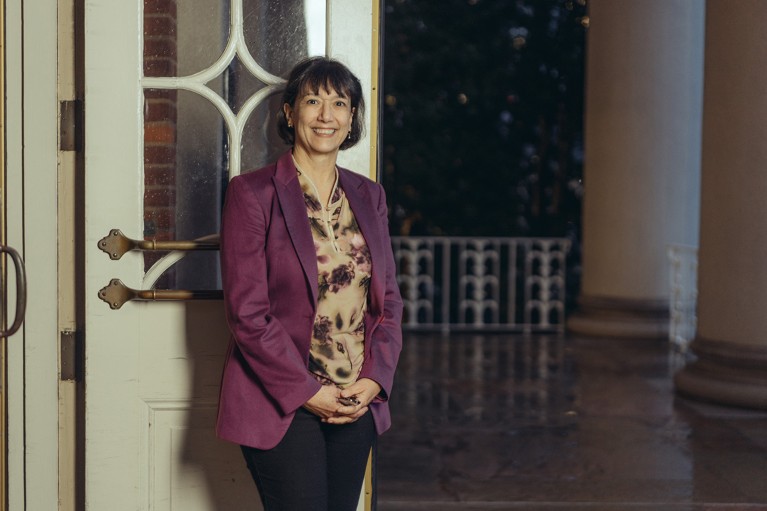
Nature visited US National Institutes of Health director Monica Bertagnolli on the agency’s campus in Bethesda, Maryland. Credit: Stephen Voss for Nature
Bethesda, Maryland
Monica Bertagnolli took charge of the US National Institutes of Health (NIH) — the world’s largest public funder of biomedical research — in November, giving the agency a permanent director for the first time in nearly two years. Her predecessor, Francis Collins, was known for his agency-wide initiatives on genomics and precision medicine, but Bertagnolli says she would like to make her mark by advancing health-care delivery and transforming how researchers use and share data, among other things.
However, the US presidential election this year could usher in a new government, meaning that Bertagnolli might have only a limited time to accomplish her goals. And researchers say she faces other challenges: trust in science took a hit during the COVID-19 pandemic, congressional investigations continue into the NIH’s response to the massive outbreak and the agency’s US$47-billion budget is likely to remain stagnant in 2024.
Bertagnolli sat down with Nature to talk about how she intends to make progress in a tough political environment.
I’m a very impatient person. Whether I have one year or whether I have ten, I’m always in a hurry. In a year, I would like to see us having built and put into action multiple user communities centred around innovative approaches to data sharing and analytics. I would also like to see us doing multiple studies across [the NIH’s various] institutes and centres that are being offered to patients through a primary-care research network that engages diverse communities. And I want to see both of those projects being viewed as something that can grow.
The director can pay attention to the things that bridge all of the different institutes and centres. Under my predecessor, there was a lot done about the genomics revolution and precision medicine.
There are two big areas of need that [we are] focusing on. One is data systems — the ability to build communities of researchers around data. For instance, we’ve instituted a data-sharing policy. Well, that’s great, but what we want to focus on is the data actually being used. The second [area] is more translational and clinical research, with this big emphasis on it reaching populations that have been left out.
It’s a time in biomedical research where everyone really wants to reach out to people to restore trust in science. It’s a time when everyone really values [communication], but also wants to do more to engage not only the extramural community [scientists funded but not employed by the NIH], but also regular people.
We’ve just been through this great trauma with COVID. It was a trauma for every community we know. It also — let’s face it — set up some dynamics where some people have lost trust in science. And I don’t blame anyone for that. That’s kind of a natural consequence. Everyone feels the need to re-engage and help get beyond all that.
There’s a real recognition that everyone wants to see [research that] gets translated faster into better results for people. There are some indicators now showing that the health of [people in the United States] is getting worse instead of better. That’s really redoubled everyone’s efforts to make that transition from fundamental science to actually improving health and longevity, and given it a much bigger urgency.
It’s a real tragedy if we have something that we know can help people, and it doesn’t get to the people who need it. Research is needed, especially if we’re going to get into communities of need or communities who don’t have trust or communities who are experiencing stigma — for example, people with substance-use disorders. We’ve got to have a whole special kind of researcher who knows how to work directly with those people.
Our research will always involve the major academic medical centres. But one of the things that I’m excited to start to build is a focus on expanding our research networks that are integrated deeply into communities of need.
I’m going to do my best to make the case for the funding we need to move forward as comprehensively and quickly as I would like. We have some initiatives that we are undertaking that are new and very expansive — that involve communities across the entire United States. To execute this vision, that’s going to take significant investment. We also need significant upgrades in our data technologies. And if we are to reverse this negative trend we have in health right now, it’s going to take being at a scale and a scope that we haven’t been before.
It’s very clear we need to support our postdocs better. To be fair, the NIH has been on a trajectory to do this for years already, but we’ve been going slowly. We need to go faster. But supporting our postdocs and supporting research proposed by new junior investigators, in a time when you have a flat budget, means you have to make cuts in other places. And that’s always very challenging.
It is never a bad thing to scrutinize, re-evaluate and reassess guidelines when it comes to things as serious as safety, when you’re dealing with potential pandemic pathogens. Those policies are being revisited, and we’re still waiting to see what the final new policies will reveal. From what I have seen, there is a real mandate to preserve health and produce what we know we need to keep people safe from the next pandemic, while at the same time having very careful biosafety rules.