x





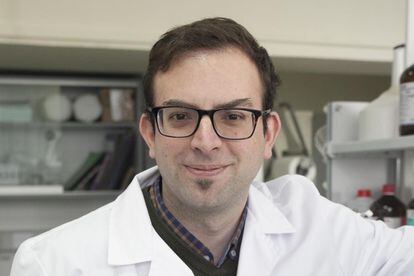
Chemist Rafael Luque, in a laboratory at the University of Cordoba.UNIVERSIDAD DE CÓRDOBA
One of the most cited scientists in the world, the Spanish chemist Rafael Luque, has been suspended without pay for the next 13 years, according to Luque himself and the institution where he worked until recently, the University of Córdoba in Spain. The university has sanctioned Luque for working as a researcher at other centers, such as the King Saud University in Riyadh and the Peoples’ Friendship University of Russia in Moscow, despite holding a full-time publicly funded contract with the Spanish institution.
Luque, 44, is one of the most prolific scientists in Spain. He has published some 700 studies, mainly in the field of so-called green chemistry, which aims to synthesize products such as drugs and fuels while generating less waste. So far this year, Luque has published 58 studies at a rate of one every 37 hours. He has featured on the list of the world’s most cited researchers, compiled by the specialist company Clarivate, for five years. Institutions all over the world compete to hire scientists like Luque, who can move a center up hundreds of positions in international academic rankings such as the influential Shanghai ranking, thusly attracting more students and more funding. “Without me, the University of Córdoba is going to drop 300 places [in the Shanghai ranking]. They have shot themselves in the foot,” said Luque, who attributed his suspension to “pure envy.”
Over a decade ago, leading Saudi universities launched aggressive programs to recruit the world’s most cited scientists. The King Abdulaziz University, for example, offered researchers around $76,000 per year, with the only stipulation being that spend just one week a year on its campus and, of course, add the name of the Saudi institution as a second affiliation, as revealed by industry journal Science.
In 2019, Luque signed on as a researcher at King Saud, in addition to being a professor at the University of Córdoba. The Spanish chemist claimed that he never received money “directly” from either the Saudi or Russian institutions, beyond funding for his analyses, business class travel and luxury hotels. “In my [bank] account, they would not have found a single cent from Russia or Saudi Arabia or anywhere else,” he said.
Without me, the University of Córdoba will drop 300 places in the Shanghai ranking. They have shot themselves in the foot
Rafael Luque, chemist
The current scientific system is governed by the “publish or perish” imperative. Researchers are evaluated by the number of studies they publish in peer-reviewed journals and by the number of times these papers are cited by other colleagues. The well-intentioned mechanism, however, has produced adverse effects, as explained by the British engineer Nick Wise, a researcher at Cambridge University who, in his spare time, seeks out fraud in science. Wise has uncovered shady “factories of scientific studies,” produced by copying and pasting other studies or by automatic text generators, and whose authorship is secretly sold for hundreds or thousands of dollars to inflate resumes. “I found a study by Rafael Luque whose authorship had previously been offered in a group on [the messaging platform] Telegram,” Wise said.
The Spanish researcher published that paper on the degradation of ibuprofen in wastewater five months ago, with six co-authors from the University of Bushehr and another from the University of Tabriz, both in Iran. Luque says that he has never paid to be added to someone else’s research, but admitted he does not know all the Iranian co-authors listed on the study and cannot rule out the possibility some of them did pay to appear. “I obviously don’t know that, but I’m amazed by this issue. Who pays to publish a study? Someone who needs it, maybe, I don’t know,” he said by videoconference from Dhahran, the heart of the Saudi oil industry, where he is considering a collaboration with a local university.
Luque is constantly publishing papers. Last year he authored some 110 articles. So far this year he has published 58. The chemist admitted that since December, he has been using the artificial intelligence program ChatGPT to “polish” his texts. “These months have been quite productive, because there are articles that used to require two or three days and now I do them in one day,” he said. ChatGPT, launched in December, is capable of generating in-depth texts in response to complex questions. Luque said he basically uses it to improve his written expression in English and strongly denies having any relationship with any wholesale research factory.
I found a study by Rafael Luque whose authorship had previously been offered in a group on Telegram