x






One year after the launch of ARPA-H, Nature talks to director Renee Wegrzyn about her vision for the agency.
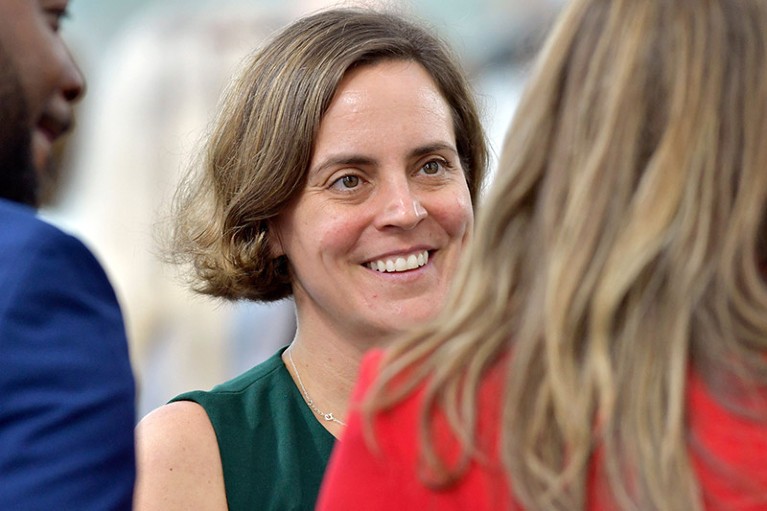
Renee Wegrzyn is the first director of ARPA-H.Credit: Josh Reynolds/AP/Shutterstock
Launched one year ago by the administration of US President Joe Biden, the Advanced Research Projects Agency for Health (ARPA-H) has announced its first call for research proposals. The agency, armed with a US$2.5 billion budget, aims to shake up the conventional model of funding biomedical research — which some deem too slow and conservative — by funding high-risk, high-reward projects.
ARPA-H is meant to follow in the footsteps of the US Defense Advanced Research Projects Agency (DARPA), whose work laid the foundation for the modern Internet and GPS. But critics have questioned whether such a risk-based model will work for the life sciences, especially after administration officials announced that the agency would be housed in the US National Institutes of Health (NIH), a more conventional funder of biomedical research.
All eyes have been on Renee Wegrzyn, a biologist and former DARPA programme manager who Biden selected as ARPA-H’s inaugural director, as she seeks to address these concerns and set the agency’s agenda. She announced last week that the agency would have offices in three locations across the United States — one in the Washington DC area, and two others to be announced later this year.
Wegrzyn spoke to Nature about what’s been going on behind the scenes and her vision for the future.
It’s a super exciting time for us. I am feeling really great about having what we like to think of as our business team in place. Now we’re bringing our technical team members [such as programme managers] on so that they can really hit the ground running. We finally have the critical mass that’s allowed us to be open for business.
The first, health-science futures, is about tools, technologies and platforms. [People often ask me] what diseases ARPA-H focuses on, and I remind them that we’re disease agnostic. We may advance the objectives of an initiative such as the Cancer Moonshot (Biden’s $1.8-billion cancer-research programme), but it will be done in the context of a tool or platform.

Billion-dollar US health agency gets new chief — but its direction remains in limbo
Scalable solutions is making sure that we can scale some of the therapies and diagnostics that we intend to pursue, and it is making sure that we reach the American people at scale. Many rural communities are now facing hospital closings, and so they’re farther from a centre of care. How do we reach the scale of getting technology and capability into people’s homes?
Proactive health is about keeping people from becoming patients in the first place. Think detection and diagnostics, but also behavioural and social-science innovations that help people doing things such as quitting smoking or avoiding things that we know lead to disease over the long term.
The final area, resilient systems, is thinking at a much broader systems level. What are the things that we can integrate to help us be resilient against the next pandemic, economic crisis or climate crisis. Those are the investments that we just haven’t seen at scale yet in other parts of government.
This isn’t just a resubmission of a grant from somewhere else that you didn’t get funded. These are milestone-based projects that end with a specific objective, whether that’s a device, deliverables or some key insight, if it’s a very fundamental project. But we really want to see boldness. How will your work actually affect people’s health outcomes in the long run? Also understand that ARPA-H wants to be part of the conversation — it’s not simply ‘submit your idea and we fund it as is’. There’s often a negotiation and discussion of what we want to move forward with.
The rise of ‘ARPA-everything’ and what it means for science
mRNA vaccines had initially been developed with research at and funding from the NIH. But DARPA was really able to drastically accelerate getting those to market and demonstrating their safety in humans [by funding vaccine makers Moderna and Pfizer]. It’s a really great example of how an ARPA might be a catalyst. It’s not meant to be the forever funder of these technologies, but that type of resourcing can really just quickly get a health advance to the public and into the hands of the people who need it most. I want to make clear, too, that under no circumstance does moving fast mean compromising on safety or efficacy — that is of utmost importance.
We’re not going to be a grant-based organization. These are cooperative agreements, contracts and other transactional authorities, so that ARPA-H has a seat at the table.
We’re not just a copy–paste of the DARPA model. [Like DARPA,] we’re not going to have a conventional peer-review process. The programme manager is going to be the decision-maker. (Programme managers at ARPA-based agencies help to set priorities and see projects through from idea to implementation.) We’ve also adopted the Heilmeier questions. George Heilmeier was an early director of DARPA, and he laid out eight questions that programme managers use to evaluate projects. We have adopted those, but we’ve adapted them to make them unique to us: we’ve added two more questions. One is focused on not only cost and accessibility, but also user experience — we want to make sure that we’re not creating the next device or the next diagnostic that sits on the shelf. The other question we’ve added is: how might your new technology be misinterpreted or misunderstood?