x






The synthetic fibre is an aerogel coated with polyurethane and is flexible, washable and wearable.
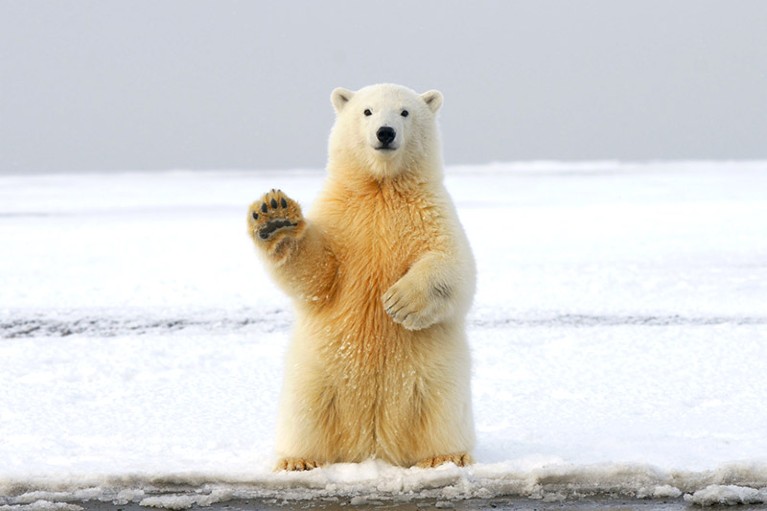
Chinese scientists have created a sweater as snuggly as this bear, using synthetic fibres.Credit: Belfalah Soufian/500px via Getty
A sweater knitted from a fibre that mimics polar bear fur offers as much warmth as a down jacket, despite being one-fifth as thick, according to a study published today in Science1. The fibre — made from a light, synthetic material known as an aerogel — maintains its heat-trapping properties even after being stretched, washed and dyed.
The proof-of-concept fibre might one day be used for clothing that need to be lightweight and durable — such as sportswear, military uniforms and spacesuits — without the need for animal fur or down, says study co-author Weiwei Gao, a materials scientist at Zhejiang University in China.
Studies have found that aerogels are among the best heat-locking materials around2, and they have been used as insulation in buildings3. But fibres made from aerogels are often too brittle and fragile to be weaved into wearable textiles, and they tend to lose their insulating properties after washing and in humid environments.
So the researchers looked to polar bear fur for inspiration. The core of each strand of this fur has dozens of tiny pockets of air that prevent heat from conducting away, keeping the bears warm in the harsh Arctic environment. This porous core is surrounded by a dense outer shell that is waterproof, flexible and tough.
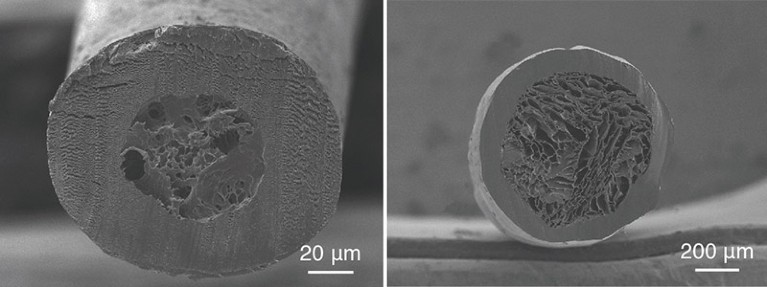
Cross section of polar bear fur (left), and the aerogel fibre (right).Credit: M. Wu et al./Science
Gao and her colleagues used an approach known as freeze-spinning — which they have previously used to make fibres out of a solution derived from silkworms — to make strings of aerogel fibre that mimicked the porous inner structure of polar bear fur. To replicate the outer shell, the researchers coated the aerogel with a thin layer of a stretchy material called thermoplastic polyurethane, which is often used in sports clothing and equipment.
Aerogel cannot be stretched beyond 2% of its existing length without being damaged, but the polar bear-inspired composite fibre bounced back to its original length after being pulled at 1,000% strain, indicating that it was stronger and more elastic than previous aerogel fibres, thanks to its stretchy coating. The fibre’s insulating properties also held up after it was stretched to twice its length 10,000 times, and it didn’t change its structure or shape when it was dunked in water, dried out or dyed.
Next, the researchers knitted a sweater out of the aerogel fibre and compared its thermal insulation performance against a down jacket, a wool sweater and a long-sleeved cotton top. The team enlisted a volunteer to wear each garment in a room that was cooled to a chilly −20 °C, and they measured the surface temperature of the four clothing items to assess how well they retained heat.
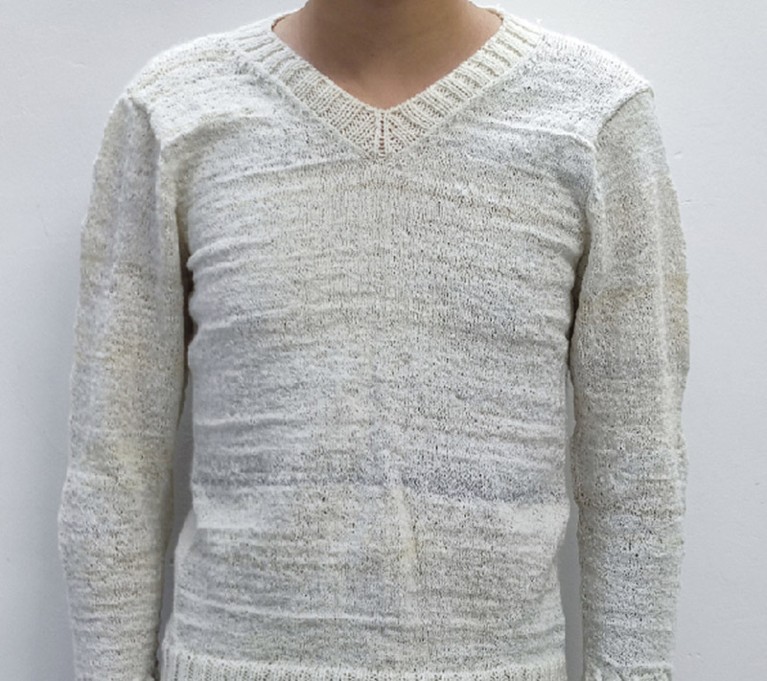
The synthetic polar bear fur knit, as modelled by one of the research team.Credit: M. Wu et al./Science
Although the polar bear-inspired sweater was one-fifth as thick as the down jacket, it had the best insulation of all the garments. Its average surface temperature was 3.5 °C, whereas the down jacket measured 3.8 °C, indicating that it released slightly more heat than the sweater. The cotton and wool shirts were the least insulating, with an average surface temperature of 10.8 °C and 7.2 °C, respectively. The aerogel sweater’s insulation didn’t degrade after a few spins in a washing machine, indicating that it could be durable enough to be worn frequently.
Shu-Hong Yu, a materials scientist at the University of Science and Technology of China in Hefei, says that although the study represents a step towards creating exciting new thin, thermal textiles, synthetic polar-bear fur clothing is a long way from appearing in a mainstream clothing outlet. The approach for creating the fibre is currently too slow and energy-intensive to be scaled up for mass production.