x






A raft of commercial lunar missions are taking off in 2023. The first lander is set to touch down this month, signalling a new era for Moon science and exploration.
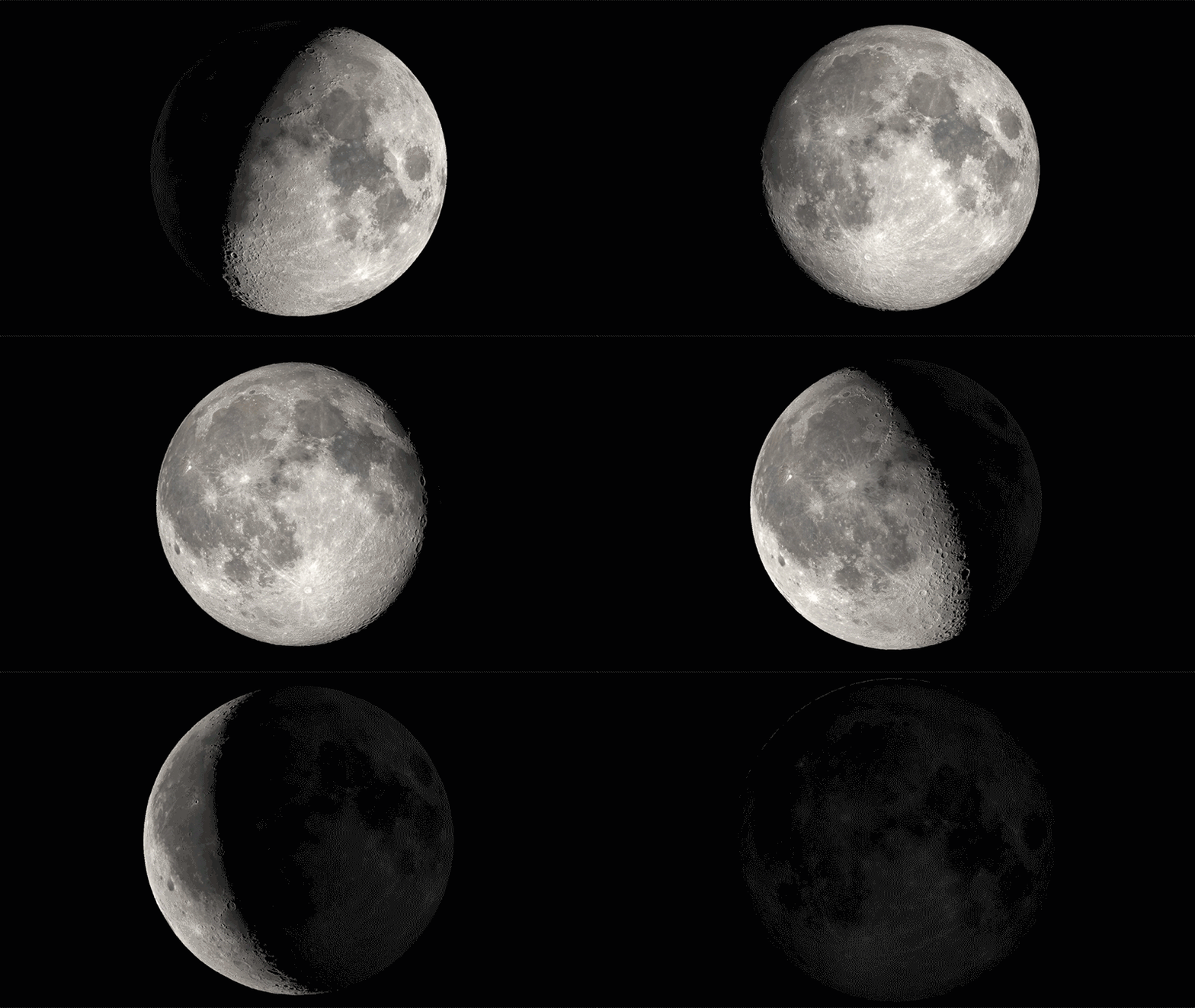
Images taken by NASA’s Lunar Reconnaissance Orbiter show different phases of the Moon. Credit: NASA's Scientific Visualization Studio
The Moon is about to get some visitors — and it won’t be the usual suspects.
As early as 25 April, the Tokyo-based firm ispace will attempt to become the first private company to land successfully on the lunar surface. If the spacecraft touches down safely, it will deliver rovers from the Japan Aerospace Exploration Agency and from the United Arab Emirates to the Moon.
That would mark the start of a new era in lunar exploration. A series of commercial missions to Earth’s closest neighbour are set to launch this year as part of a wave of projects by various companies and countries.
“A lot of people are looking at this optimistically, as the beginning of the furthering of expansion into space,” says Stephen Indyk, director of space systems at Honeybee Robotics in Greenbelt, Maryland, who chairs a commercial advisory board for a NASA lunar-science advisory committee.
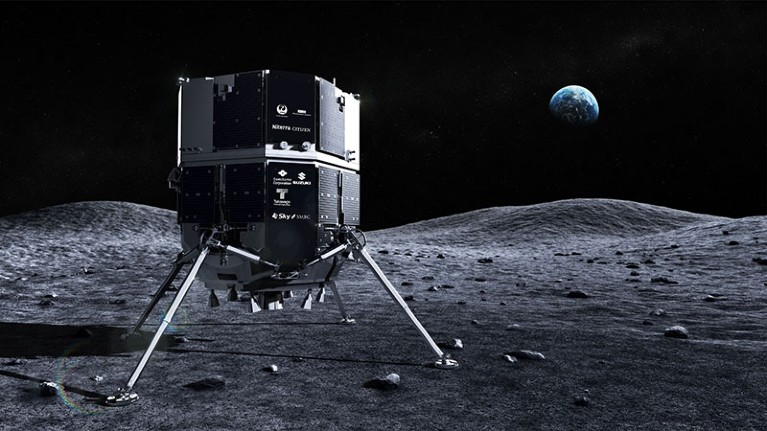
A computer-generated image of ispace’s M1 lander on the Moon.Credit: ispace, Inc.
Gustavo Medina Tanco is one of many researchers getting set to study the Moon. He has five autonomous rovers — each a little bigger than the palm of his hand — currently tucked inside a spacecraft in Pittsburgh, Pennsylvania, which is waiting to travel to a launch site in Florida in the coming weeks and then on to the Moon. Known as COLMENA (meaning hive), this will be the first Moon mission from Latin America.
One day, a swarm of these mini-rovers could roam across the lunar surface, harvesting water and minerals for space explorers, says Medina Tanco, an astrophysicist at the National Autonomous University of Mexico in Mexico City, who leads the project. “The future is there,” he says. “You can consider the Moon a new economy.”
COLMENA will probably launch later this year aboard one of the first flights of a NASA programme called Commercial Lunar Payload Services (CLPS), which buys rides to the Moon from aerospace companies. The goal is to kick off a series of trips to the Moon, made faster and cheaper by industry. A dozen or more CLPS missions might launch in the next decade, carrying scientific and other payloads to different lunar regions (see ‘Companies heading to the Moon’). They could open the door for nations that do not have substantial launch capabilities, such as Mexico, to reach the Moon for the first time.
But a lot could still go wrong as these companies race into space. Only the United States, the Soviet Union and China have successfully landed and operated craft on the Moon. The lunar surface is littered with debris from missions that didn’t make it, including a privately built Israeli spacecraft called Beresheet that crashed in 2019.
“I worry about — can these things land and operate?” asks Thomas Zurbuchen, the former head of science for NASA who started its commercial Moon programme. “The science still needs to prove itself.”
The latest wave of Moon landers emerged from the ashes of a privately funded competition, the Google Lunar X Prize, which ran between 2007 and 2018 and aimed to give US$20 million to the first company to land and operate a spacecraft on the Moon. No one won that prize, but it kick-started a fledgling lunar aerospace industry.
That includes ispace, whose spacecraft, known as the M1 lander, launched on 11 December last year and reached lunar orbit on 21 March. M1 is meant to descend and land in the Atlas crater on the Moon’s near side. If it does so, and if both rovers deploy successfully on to the surface, then Japan and the United Arab Emirates will become the fourth and fifth nations whose space agencies have operated craft on the Moon. The ultimate goal of ispace is to demonstrate ways to harvest water from the lunar soil for future explorers.
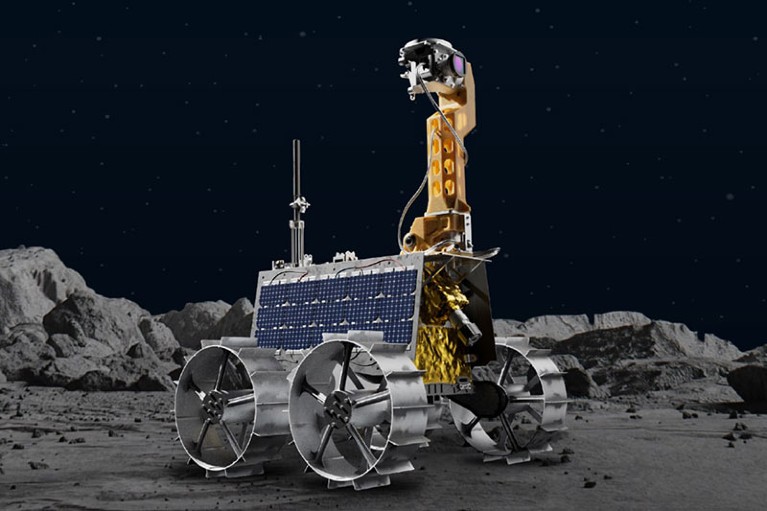
The ispace mission is carrying the United Arab Emirates’ Rashid rover, shown here in an artist’s impression.Credit: Mohammed Bin Rashid Space Centre
If M1 lands successfully, it will have beaten the very thing that inspired it — NASA’s CLPS programme.
CLPS began in 2018, as NASA began focusing its human exploration programme on the Moon, and Zurbuchen was looking for a way to get more science out of that. His idea was to incentivize industry to build robotic Moon landers while NASA focused on getting humans back to the lunar surface. In this plan, NASA could pay companies to deliver science and exploration projects to the lunar surface, much as the agency does to send astronauts and cargo to the International Space Station. NASA began doling out contracts through the $2.6-billion CLPS programme, aiming to create a regular cadence of flights by small companies every year.
But CLPS has been slower to get going than expected; when it announced the programme in 2018, NASA optimistically estimated that the first lunar payloads could fly the following year. Many companies struggled to develop the promised hardware, however; some have gone out of business. “My disappointment, frankly, was that it was not fast enough,” Zurbuchen says.
But many are still moving forwards (see ‘Companies heading to the Moon’). First up in the CLPS manifest are missions from Astrobotic in Pittsburgh and Intuitive Machines in Houston, Texas. Astrobotic’s spacecraft, which will carry the Mexican mini-rovers, is waiting for a ride aboard the first flight of the Vulcan rocket from United Launch Alliance (ULA) in Centennial, Colorado. Vulcan had been anticipated to launch in May, but encountered some problems during tests in March; ULA has not announced a new launch date. The Moon lander from Intuitive Machines will ride on a different rocket, built by SpaceX of Hawthorne, California, and could launch as early as June.
The ispace mission due to land in April is just the start of commercial trips to the Moon. All missions apart from those from ispace and SpaceIL are part of NASA’s Commercial Lunar Payload Services (CLPS) programme.
|
Company (lander, if chosen) |
Landing site |
Landing date |
|---|---|---|
|
ispace (M1) |
Atlas crater |
Late April 2023 |
|
Astrobotic (Peregrine) |
Sinus Viscositatis |
Delayed from May 2023 |
|
Intuitive Machines (Nova-C) |
Malapert A |
June 2023 |
|
Intuitive Machines (Nova-C) |
Shackleton Connecting Ridge |
Late 2023 |
|
Firefly Aerospace (Blue Ghost) |
Mare Crisium |
2024 |
|
Intuitive Machines (Nova-C) |
Reiner Gamma |
2024 |
|
ispace (M2) |
Not yet announced |
2024 |
|
Astrobotic (Griffin) |
Nobile crater |
November 2024 |
|
Draper |
Schrödinger Basin |
2025 |
|
SpaceIL (Beresheet 2) |
Not yet decided |
2025 |
|
Not yet decided |
Gruithuisen Domes |
2026 |
|
Firefly Aerospace |
Lunar far side |
2026 |
|
Not yet decided |
South pole region |
2026 |
Both carry science experiments as well as non-science payloads. Among other items, the Astrobotic mission has several NASA-built spectrometers to study the chemistry of the lunar surface, and Intuitive Machines carries a set of GPS-like beacons. Future CLPS flights will include a drill to probe beneath the surface and a rover to map ice deposits, both near the lunar south pole.
Every landing on the Moon provides a new opportunity for science, says Mahesh Anand, a planetary scientist at the Open University in Milton Keynes, UK. “We should have eyes and ears totally open,” he says.
But some scientists were initially unhappy that NASA, rather than researchers, was selecting the landing sites for CLPS flights. In response, NASA has now allowed researchers to choose the sites for all future landers. It also changed the landing site for the first Astrobotic flight from a bare-bones location, chosen for safety, to an ancient lava flow near the geologically intriguing Gruithuisen Domes. And the first Intuitive Machines mission landing site was moved to a spot near the lunar south pole, where NASA plans to send future human missions.
Being able to custom-build equipment to land at chosen sites enables more science, says Kerri Donaldson Hanna, a planetary scientist at the University of Central Florida in Orlando. She heads a second CLPS mission to the Gruithuisen Domes that will use a rover to further analyse the chemistry of the rocks and soil there. “Having these tailored instrument suites allows us to really address specific questions,” she says.
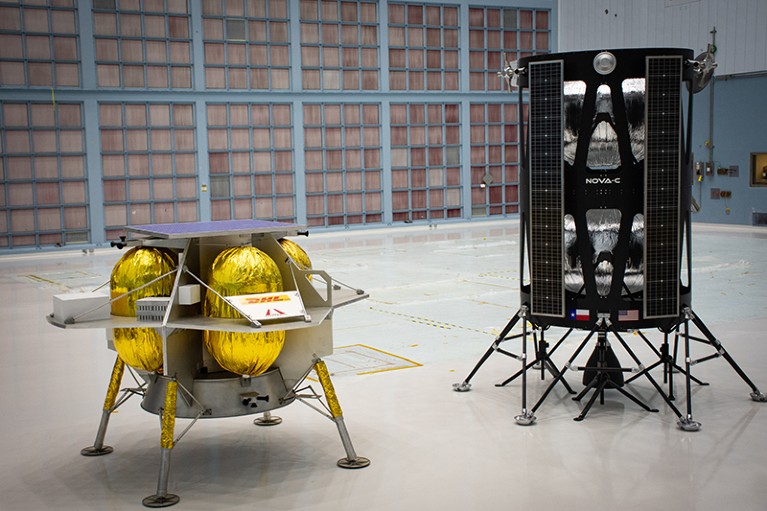
Two early missions from NASA’s Commercial Lunar Payload Services (CLPS) programme will send Astrobotic’s Peregrine lander (left) and Intuitive Machines’ Nova-C lander to the Moon.Credit: NASA/Goddard/Rebecca Roth
So far, the CLPS science payloads have mostly come from NASA and US institutions; other than the Mexican payload, the programme has yet to fulfil its promise to make the Moon accessible to many nations with emerging space programmes. There are some international collaborations, such as a radiation detector built by the German Aerospace Center in Cologne, that will be on board the first Astrobotic flight. It will become only the second radiation detector on the Moon, after one on China’s Chang’e-4 lander, and will provide important data about what future explorers might expect on the lunar surface, says its principal investigator Thomas Berger, a radiation physicist at the centre.
And a future Intuitive Machines lander will carry a pair of small South Korean telescopes to detect high-energy particles, built by the Korea Astronomy and Space Science Institute (KASI) in Daejeon. “As Koreans, we view the opportunity to access the lunar surface as a significant milestone,” says Chae Kyung Sim, an astronomer at KASI. South Korea already has a spacecraft, named Danuri, orbiting the Moon, but having access to the surface means that scientists can cross-check measurements of phenomena such as the Moon’s magnetic field, she says.
India is planning a Moon lander later this year, and the rising influence of private companies could eventually provide an entry for other nations and entities. Last month, the aerospace giant Lockheed Martin spun off a company called Crescent Space in Denver, Colorado, which, like the European Space Agency, aims to build a communications and navigation satellite network around the Moon to serve as infrastructure for the coming wave of missions.
Joe Landon, chief executive of Crescent Space, says his team has counted more than 100 proposed missions slated to go to the Moon over the next decade. Sparked in part by last November’s successful first flight in NASA’s Artemis human exploration programme to the Moon, he says, “we see this market developing”.
Like the Beresheet mission, some of these nascent efforts might not pan out, but commercial interest in the Moon seems likely to grow. In addition to future CLPS flights, ispace is already planning its next lunar lander, to launch next year. And the Israeli company SpaceIL is planning its second lunar landing attempt, Beresheet 2, in 2025.