x






Mission control was unable to re-establish contact with the M1 spacecraft, and early signs suggest it crash-landed on the lunar surface.
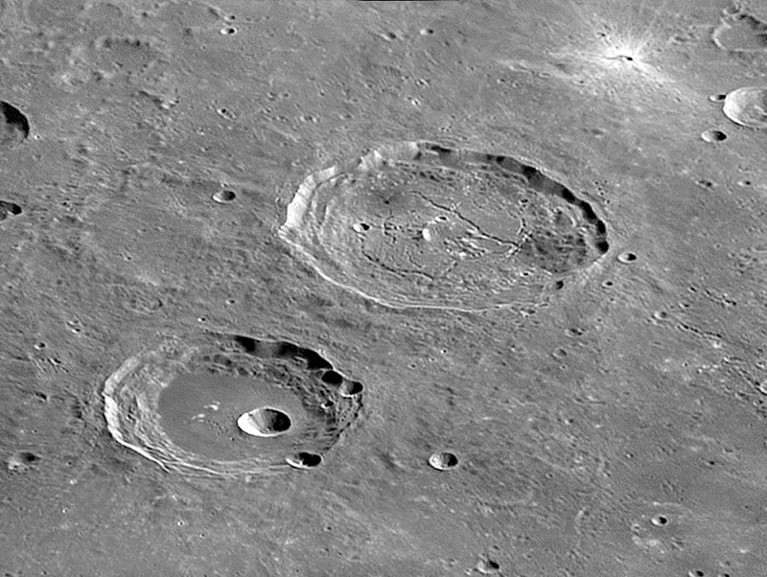
M1 was due to land in the previously unexplored Atlas Crater (right) in the Moon’s northern hemisphere.Credit: Damian Peach/Science Photo Library
A Japanese spacecraft has probably crashed during its attempt to land on the Moon.
The HAKUTO-R Mission 1 (M1) lander — developed by Tokyo-based company ispace — was due to touch down in the Moon’s Atlas crater on 25 April at around 16:40 universal time, which would have made it the first successful lunar landing accomplished by a commercial mission.
But the ispace team lost contact with the craft when it was around 90 metres above the lunar surface, and were unable to re-establish communication after the landing as planned. “We have to assume that we could not complete the landing,” announced ispace chief executive Takeshi Hakamada.
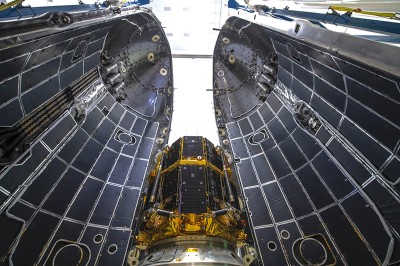
Private Moon mission prepares for historic landing attempt
Hours later, ispace said in a statement that there was a “high probability” M1 had made a crash-landing on the Moon. The company says its engineers are still investigating exactly what happened. The 2.3-metre-tall lander was in an upright position during its final approach but was running low on fuel. Data also show that the spacecraft picked up speed as it descended towards the lunar surface.
“It was doing what it should have done, which is descending vertically with its engines keeping it to the low velocity,” says Lionel Wilson, a geophysicist at Lancaster University, UK. But for the last few hundred metres, “it was in freefall”, he adds. “It just dropped like a stone.”
If the craft ran out of fuel before touchdown, there could have been a slight miscalculation of its fuel requirement that amounted to tens of seconds of flight, adds Wilson. Because M1 was not coming back to Earth, “you’d like to land with the very last drop of fuel being used, so you haven’t carried any wasted weight on the flight”, he says.
Simeon Barber, a lunar scientist at The Open University in Milton Keynes, UK, says that the failed attempt demonstrates how challenging it is to accomplish a lunar landing. “Everything has got to happen perfectly in order to get that signal back saying ‘we’ve landed on the Moon successfully’,” he says. “They were close.”
The lander was carrying the United Arab Emirates’ 50-centimetre-long Rashid rover, which was developed by the Mohammed bin Rashid Space Centre in Dubai. The rover’s aim was to study particles in the lunar soil and investigate the geological properties of the Moon’s surface with its cameras and probe. Also on board was a two-wheeled robot developed by the Japanese space agency, JAXA, and a multi-camera system built by Canadensys Aerospace, a space-systems company based in Toronto, Canada.
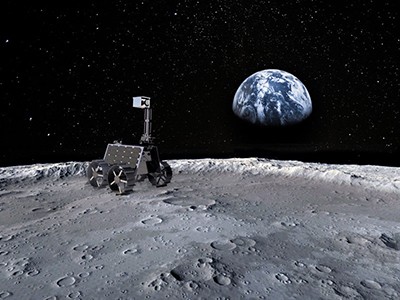
UAE ramps up space ambitions with Arab world’s first Moon mission
M1 launched on 11 December 2022 from Cape Canaveral, Florida, on board a SpaceX Falcon 9 rocket. On 21 March, it entered lunar orbit and reached 100 kilometres above the Moon’s surface three weeks later. The mission has accomplished eight of its ten objectives, ispace said in a statement. Hakamada added that data acquired during M1’s lunar orbit and landing sequence will offer insights for ispace’s second attempt to land on the Moon, planned for 2024.
“We believe that we have fully accomplished the significance of this mission, having acquired a great deal of data and experience by being able to execute the landing phase,” said Hakamada. “What is important is to feed this knowledge and learning back to Mission 2 and beyond.”
Barber agrees. “They will have learnt a huge amount about how to get to a certain point,” he says. “It puts them in such a strong position for next time.”