x






Including African Union in the G20 is a matter of ethics and fairness, researchers say.
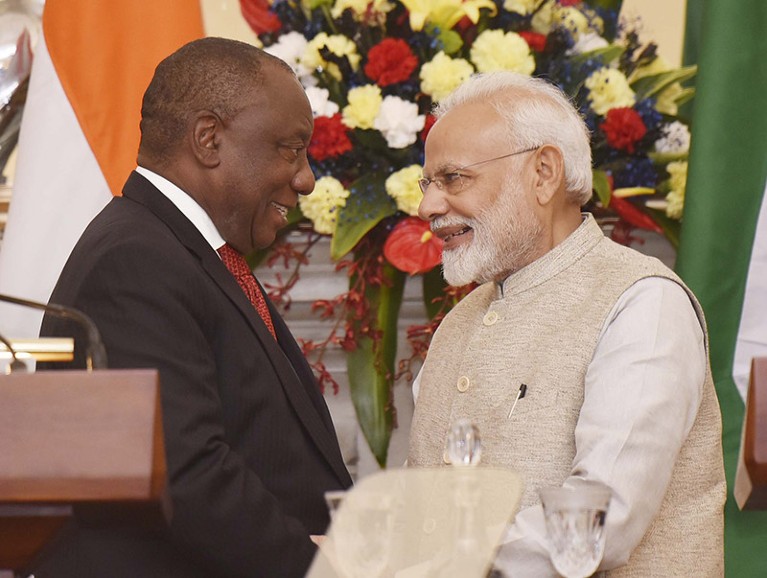
Indian Prime Minister Narendra Modi (right) with South African President Cyril Ramaphosa. India, the current chair of the G20, supports the inclusion of the African Union in the group.Credit: Vipin Kumar/Hindustan Times via Getty
Prominent researchers are backing the inclusion of the African Union (AU) in the G20, a forum in which most of the world’s largest economic powers discuss and propose solutions to pressing global issues. South Africa is the only African country in the group.
“Every country should have a seat at a decision-making table that discusses our common future and the most important world issues affecting us all,” say the researchers in an ethics-policy document called ‘Advocating for a G21’, launched today at a G20 side event in Kumarakom, India.
The report’s 11 authors include economist Jeffrey Sachs at Columbia University, New York City, and Michael Makanga, executive director of the European and Developing Countries Clinical Trials Partnership in Cape Town, South Africa. “The G20 is the top multilateral forum for international economic cooperation,” Makanga says. “For ethical and moral reasons it is critical that Africa is represented at the table.”
The G20 comprises 20 members. The United States and China are the largest economies among 19 individual countries; others include France, Germany, Italy and the United Kingdom. The European Union, representing its 27 member states, also has a seat at the table.
At various times, France, Japan and the United States have all backed the African Union’s inclusion, says report co-author Doris Schroeder, director of the Centre for Professional Ethics at the University of Central Lancashire in Preston, UK.
India, which currently holds the rotating presidency, is also on board. “India is pushing for a more inclusive world order,” and this includes supporting the inclusion of the African Union in the G20 discussions formally as a member, says co-author Sachin Chaturvedi, director-general of the New Delhi-based think tank Research and Information System for Developing Countries, which is supported by India’s Ministry of External Affairs.
“By design, the G20 is based on exclusive membership,” adds co-author Pamla Gopaul, programme manager at the African Union Development Agency, based in Johannesburg, South Africa. “While this limited membership can enable faster decision-making, many of the global challenges that fall within the mandate of the G20 require broader engagement,” especially if countries and regions are being harmed by the actions of wealthier nations. Climate change is a strong example, she says. “Africa is responsible for only around 3% of global carbon emissions yet loses about 5% to 15% of gross domestic product due to climate change.”
The responses of many G20 members to COVID-19 constitute another reason to include the African Union, the authors say. The body promised to “help protect and assist the most vulnerable and those most at-risk because of the pandemic”. However, this is not what happened in practice. “In 2021, G20 member countries received up to 15 times more COVID-19 vaccine doses per capita compared to those in sub-Saharan Africa,” Gopaul says, quoting data from United Nations children’s agency UNICEF.
Access to finance represents yet another example. During the pandemic, high-income countries have been able to borrow US$17 trillion with zero interest rates, which was used to shield their economies from the worst economic impacts of the pandemic, the authors write. By contrast, many low-income countries could not borrow to protect their populations in the same way because these countries are already highly indebted. Those that could were compelled to pay high interest rates.
In the past, the group has backed African initiatives, but without the majority of the continent’s representatives being present at G20 meetings. “Under the Chinese presidency (2016), the G20 started work on supporting industrialization in African countries. Under the German presidency (2017), the G20 Compact with Africa was created to increase private investment in African countries,” the authors say.
“G20 initiatives consign Africa to a passive, consultative, or at best diminutive role,” the authors write. They quote Mahatma Gandhi, one of the founders of modern India, who said: “Whatever you do for me but without me, you do against me.”
“The inclusion of the African Union would bring all 55 African countries into the G20, thus giving representation to 54 countries more than the status quo, at the cost of just one additional seat,” the authors say.
The ‘Advocating for a G21’ document is “a good model of how to include ethics in decision-making”, says Katherine Littler, co-lead of the World Health Organization’s Health Ethics and Governance Unit in Geneva, Switzerland.