x






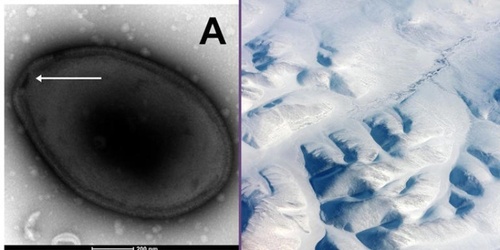
Researchers have resurrected a "zombie" virus that has lain dormant in Siberian permafrost for tens of thousands of years -- and it's still infectious.
Researchers Revive 48,500-Year-Old "Zombie Virus"© mdpi.com; iStockphoto.com; Collage: heute.at
Climate change and global warming are thawing the Arctic region's permafrost—a frozen layer of soil beneath the earth—and possibly revealing viruses that, after lying dormant for tens of thousands of years, could become dangerous to animals and humans. A pandemic triggered by a disease from the distant past may sound like something out of science fiction, but it shouldn't be underestimated.
Neither vaccination nor medicine - The 10 deadliest viruses
Permafrost covers a quarter of the northern hemisphere and has formed the basis of the arctic tundra and forests of Alaska, Canada and Russia for millennia. It serves as a sort of time capsule, housing the mummified remains of a number of extinct animals along with ancient viruses. Permafrost is a good storage medium because it is cold and it is an oxygen-free environment that is not penetrated by light.
Secret chamber discovered in Cheops pyramid
Related video: "Zombie" viruses discovered again in permafrost (ProSieben)
In order to better understand the dangers posed by frozen viruses, Jean-Michel Claverie, Professor Emeritus of Medicine and Genomics at the Medical Faculty of the University of Aix-Marseille in Marseille (France), examined soil samples from the Siberian permafrost to determine whether the virus particles contained in them are still infectious. He is looking for so-called "zombie viruses" - and he has found some.

In his latest research, published in the journal Viruses, Claverie and his team isolated 13 new strains of ancient viruses from multiple permafrost samples taken from seven different locations in Siberia that can still infect amoeba cells. The oldest sample was almost 48,500 years old and is called Pandoravirus yedoma. So large that it can be detected with a standard light microscope, it came from a soil sample taken 16 meters below an arctic lake. The most recent samples found in the stomach contents and fur of the remains of a woolly mammoth were 27,000 years old.
Back in 2014, he and his team managed to revive a virus isolated from permafrost, making it infectious again for the first time in 30,000 years by introducing it into cultured cells. For safety reasons, he decided to study a virus that can only affect unicellular amoebas, but not animals or humans. In 2015, another type of virus was isolated that also affects amoebas.
The fact that amoebaviruses are still infectious after such a long time points to a potentially bigger problem, Claverie said. He worries that people don't see ancient viruses that can come back to life as a serious public health threat. The problem: If there is a virus hidden in the permafrost that we have not come into contact with for thousands of years, it could be that our immune defenses are not sufficient. Because the structure of such millennia-old viruses does not resemble any against which modern mankind has developed immunity or science could not fall back on any basic knowledge for medicines .
New corona variant is increasing rapidly in Austria
In the real world, scientists don't know how long these viruses could remain infectious when exposed to today's conditions, or how likely the virus is to encounter a suitable host. Not all viruses are pathogens that can cause disease. Some are benign or even beneficial to their hosts. And although the Arctic is home to 3.6 million people, it's still a sparsely populated place, making the risk of humans being exposed to ancient viruses very low.
Still, "the risk is bound to increase," said Claverie, "related to global warming, where permafrost thawing will continue to accelerate and more people will populate the Arctic for industrial endeavors."
Traces of viruses and bacteria that can infect humans have already been found in the permafrost. A woman's lung sample recovered from permafrost in Alaska in 1997 contained genomic material from the flu strain responsible for the 1918 Spanish flu pandemic. In 2012, the 300-year-old mummified remains of a woman buried in Siberia contained the genetic signatures of the smallpox virus, now thought to be eradicated.