x





Vivian Cheung sued after her funding was cut, alleging discrimination, but the institute said her science no longer met its expectations.
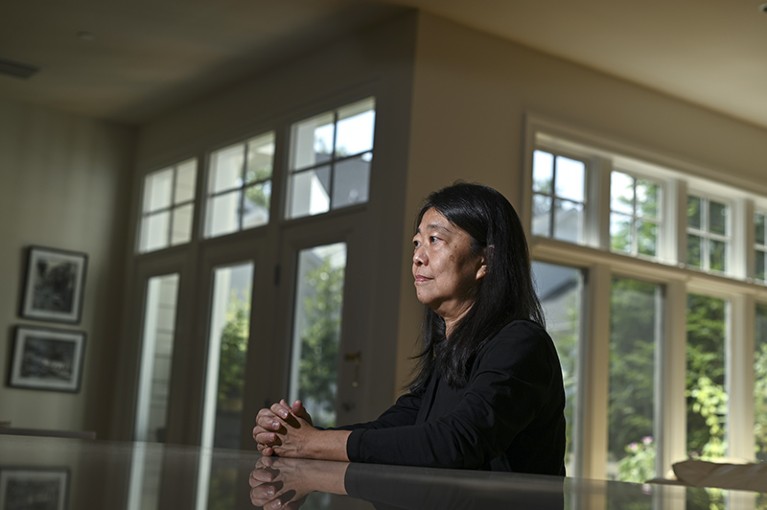
Vivian Cheung filed a lawsuit against the Howard Hughes Medical Institute in 2020.Credit: Ricky Carioti/The Washington Post via Getty
Rockville, Maryland
After deliberating for just over three hours, a jury at a courthouse in Rockville, Maryland, has found that the Howard Hughes Medical Institute (HHMI) did not use the disability of former employee Vivian Cheung, a paediatric neurologist and RNA biologist, as a basis for terminating her funding. Some researchers hoping to shine a light on disability in the scientific workplace say they are disappointed with the outcome, given that US disability law has lagged behind legislation that addresses other types of discrimination.
Disability lawsuit lands Howard Hughes Medical Institute in court
For its part, “HHMI is pleased that a Montgomery County jury has agreed that Dr. Cheung’s allegations are without merit,” Erin O’Shea, president of HHMI in Chevy Chase, Maryland, said in a statement. “We look forward to putting this matter behind us”.
“This goes to show that the power of large private science institutions and peer-review systems are hard to challenge,” David Oppenheimer, director of the Berkeley Center on Comparative Equality and Anti-Discrimination Law in California and Cheung’s attorney, told Nature. “Vivian Cheung is a remarkably courageous person to take on such a powerful institution.”
Cheung, who studies rare genetic diseases at the University of Michigan in Ann Arbor, was diagnosed with a rare disorder in 2014 herself that impaired her vision and mobility. During the eight-day trial, Cheung’s legal team alleged that her disability spurred HHMI to terminate her funding in 2018 and that she was entitled to more than US$2.7 million in compensation stemming from lost wages and the emotional toll of reputational damage.
HHMI, which is one of the world’s largest private funders of fundamental biomedical research and supports about 260 scientists across the United States as ‘investigators’ in its flagship programme, denied that her disability was tied to its decision. It instead argued that her funding was rescinded because her research no longer met the high calibre expected of its investigators.
This verdict is particularly noteworthy, because few legal claims involving disability result in a trial — much less with an institution as high profile as HHMI. But the fact that it was ultimately unsuccessful could have a chilling effect on future cases, says Nathan Tilton, a disabled veteran and lab manager at the University of California Berkeley Disability Lab. “I could absolutely see a case like this dissuading other disabled people from bringing their claims forward.”
Cheung first received one of HHMI’s prestigious investigator awards in 2008 on the basis of research she conducted that uncovered previously unseen differences between DNA and RNA. She used the HHMI funds to expand her investigations into DNA-RNA hybrid structures, called R-loops, which regulate gene expression, among other things. Following the first renewal of her award in 2012, reviewers said that in future Cheung should move beyond observations of R-loops and towards a deeper understanding of how they work, she told Nature.
Collection: Disability and ableism in science careers
Cheung’s legal team introduced witnesses who testified that her research has done that. One of these witnesses was Bonnie Woolston, whose family has a rare, inherited form of amyotrophic lateral sclerosis, which leads to an increasing loss of muscle control over time. Cheung’s research into the Woolston family has shown1 that mutations in a single gene, called senataxin, lead to fewer R-loops in their cells, which in turn increase activity in a signalling pathway that has been linked to muscular disorders. Woolston said that a natural history study that Cheung helped to establish at the US National Institutes of Health (NIH) remains one of the only existing efforts to study the disease in depth.
Heading into her second renewal process in 2018, Cheung told Nature she felt that her research was even stronger than in 2012. But Cheung later testified that one witness, HHMI senior scientific officer Philip Perlman, asked her directly about her condition in a phone call about her upcoming renewal. She said that his comments had made her uncomfortable, noting that “even if my best friend asked me about my health and I told her ‘I don’t feel like talking about it,’ I think she would stop. We were talking about my renewal”.
During his turn on the stand, Perlman said that he had written about having his “fingers crossed” that Cheung would take a medical phaseout in e-mails between himself and senior HHMI leadership, and that he had “probably shared too much information” about Cheung’s medical condition with a member of her review committee. But neither disclosure amounted to discrimination, the jury found, and witnesses for the defence denied that Cheung’s disability had played into their decision to give her scores that were among the lowest in the cohort of investigators undergoing renewal at the time.
Mary Beckerle, a cell biologist at the University of Utah in Salt Lake City who observed both of Cheung’s renewal processes, stated that she had “never heard scientific leadership say anything...that wasn’t related to the science”. O’Shea, who was at the time HHMI’s vice-president and chief scientific officer and made the final determination of Cheung’s renewal, said the consensus was unanimous: “The very clear recommendation made to me was not to renew her.”
After Cheung lost her HHMI funding, her laboratory underwent a shakeup, she told Nature. She had to let some workers go, and others left on their own. Still, Cheung remains committed to furthering the work she began with HHMI.
Huge survey finds US$10,000 pay gap for disabled scientists
She has built funding back though grants from the NIH, and in April of this year, she was awarded US$2.3 million by The Warren Alpert Foundation, a philanthropic organization based in Providence, Rhode Island, seeking cures for medical conditions, to launch a ‘Human RNome’ project. Similar to the Human Genome Project, it will map the RNA of all human cells. “We know that RNA is going to be an important component in the future of medicine,” Cheung says.
Even though the jury found HHMI not liable for any damages to Cheung, observers hope the case will serve as a wake-up call for funders. In 2021, HHMI pledged $2 billion over 10 years to improve racial, ethnic and gender diversity in science, but made no mention of disability status.