x






The Luna 25 spacecraft will attempt to land at the lunar south pole for the first time in a hunt for valuable water ice.
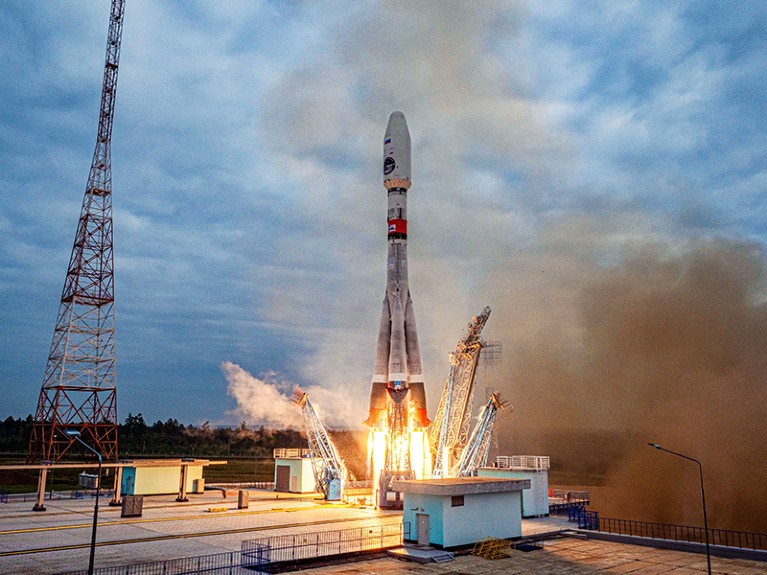
A Soyuz rocket launched Luna 25 to the Moon from Vostochny Cosmodrome in eastern Russia.Credit: ROSCOSMOS STATE SPACE CORPORATION/HANDOUT/EPA-EFE/Shutterstock
Russia has launched an uncrewed spacecraft to the Moon’s south pole — its first lunar mission in 47 years. If successful, the mission would be the first to land in the region, and could mark the start of considerable activity there involving multiple countries and private companies.
“It’s an area where we might expect to see increased concentrations of water ice,” says Simeon Barber, a planetary scientist at the Open University in Milton Keynes, UK. “As you go further towards the pole, it gets colder and the potential for water ice increases.”
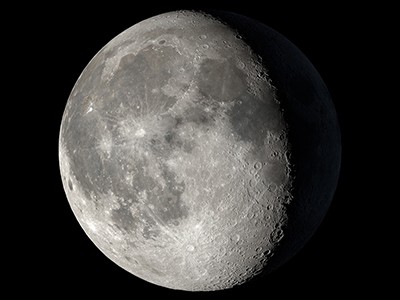
These six countries are about to go to the Moon — here’s why
Luna 25 launched aboard a Soyuz rocket at 11.11 p.m. UT on 10 August from the Vostochny Cosmodrome in eastern Russia — marking a move away from Russia’s dependence on Kazakhstan, which hosts its main launch site, the Baikonur Cosmodrome. It will take around 5 days for the spacecraft to reach a 100-kilometre orbit around the Moon. The landing attempt is scheduled for 21 August at the 100-kilometre-wide Boguslawsky crater, about 500 kilometres from the Moon’s south pole.
This is the first of many missions planned for the south pole. India’s Chandrayaan-3 will attempt to land in the region on 23 August. China plans to send a rover there in 2026, and NASA’s Artemis programme, which will attempt to return humans to the Moon for the first time since Apollo 17 in 1972, is also focusing on the south pole. As part of Artemis, several US companies are set to attempt landings there in the coming years.
Luna 25 is “an opportunity to steal the march on other people get some positive publicity,” says Roger Launius, NASA’s former chief historian.
Data collected since the 1990s suggest that the Moon’s poles contain sizeable quantities of water ice, which, if accessible, could be a valuable resource for future human missions. “You can generate hydrogen and oxygen from it which could be used to produce either drinking water, breathable air, or even to produce rocket fuel,” says Nico Dettman, lunar exploration group leader at the European Space Agency. That could make the Moon “a stepping stone for further destinations” in the Solar System.
In June, Yuri Borisov, head of Russia’s space agency Roscosmos, described the Luna 25 mission as “high risk”, with a 70% chance of success. NASA chief Bill Nelson said on 8 August that the agency “wished them well”, noting that NASA saw any space race to return humans to the Moon as being between the United States and China.
Two decades in the making, Luna 25 is a stationary lander that weighs about 1,750 kilograms and is Russia’s first attempt to land on the Moon since the Luna 24 mission in 1976, which returned lunar rocks to Earth. By comparison, Luna 25 is “fairly modest”, says Scott Pace, former executive secretary of the US National Space Council; the craft carries just 30 kilograms of scientific instruments.
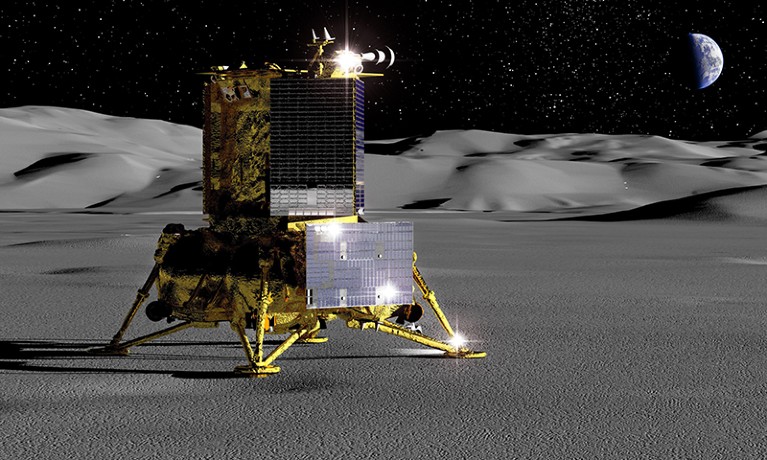
The Luna 25 lander is scheduled to land on the Moon’s surface on 21 August (artist’s impression).Credit: Mechanik/Alamy
The mission’s ambition might be grander than its scientific return, says Pace. “Politically they probably feel they have to [go back],” he says, given activity from other nations. “I think it’s more of a statement that they’re still here and they still have ambitions.” Russia is already working with China to build a lunar research station, with China also hoping to send astronauts to the Moon by 2030.
Luna 25’s main instrument is a robotic arm that will attempt to dig up to 50 centimetres into the floor of the Boguslawsky crater to look for signs of water ice. Barber had been part of a European team that would have collaborated with Russia on these activities and a planned follow-up mission, Luna 27, but the collaboration ended last year following Russia’s invasion of Ukraine.
Water ice, if discovered, would be useful scientifically. “By understanding how the Moon has collected water over time, we could start to piece together the history of water in the Solar System,” says Barber. “We can start asking questions about the local conditions near Earth as it was evolving.”
But striking ice at Boguslawsky is “pretty unlikely” because temperatures in the crater are too high, says Margaret Landis, a planetary scientist at the University of Colorado, Boulder. A smaller and more deeply shadowed crater inside Boguslawsky might be more promising, but it’s unclear whether Russia could attempt a landing here. (Roscosmos declined Nature’s request for interview.)
“A null result is potentially just as interesting as a positive detection,” says Landis. Next year, a NASA rover called VIPER and a separate hopping spacecraft called Micro-Nova, from the firm Intuitive Machines in Houston, Texas, will also look for ice inside lunar craters at the south pole. Results from these various surface missions could “help us narrow down where the water could be”, says Landis.
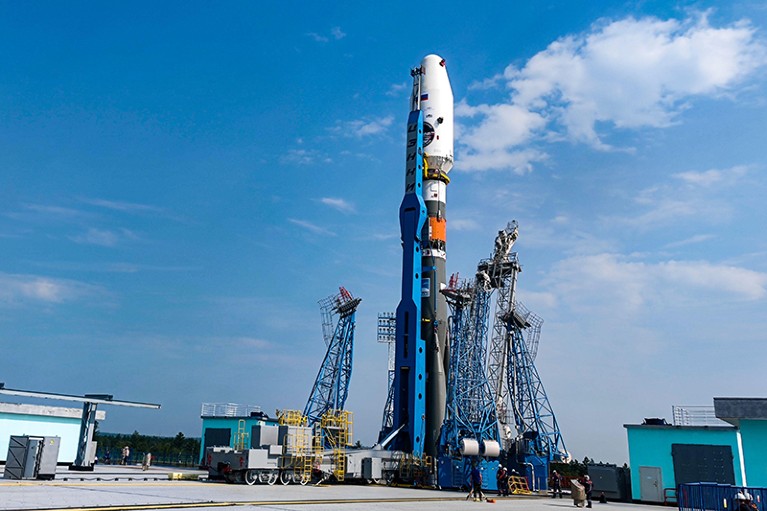
The Soyuz rocket on the launch pad at Vostochny Cosmodrome.Credit: Roscosmos State Space Corporation via AP/Alamy
Luna 25 will also image the surface, study the interaction between the solar wind and the Moon, and deploy a laser reflector to precisely measure the Earth–Moon distance. Provided that the landing goes smoothly, the craft is expected to operate for one year.
If Luna 25 lands safely, Russia will have succeeded where many others have recently failed. Since 1976, only China has successfully landed on the Moon, with a lander and rover in both 2013 and 2018, and a sample-return mission in 2020. In 2019, India’s Chandrayaan-2 mission and Israel’s Beresheet lander crashed on the surface, and Japan’s Hakuto lander suffered the same fate in April.