x




Microphones capture ultrasonic crackles from plants that are water-deprived or injured.
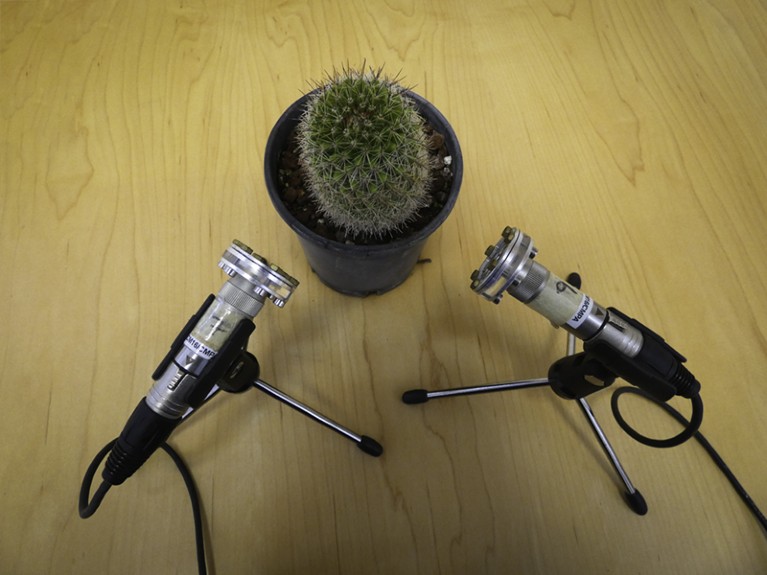
Research showing water-stressed or injured plants emitting high-pitched sounds could have implications for horticultural monitoring.credit: Lilach Hadany
Plants do not suffer in silence. Instead, when thirsty or stressed, plants make “airborne sounds,” according to a study published today in Cell1.
Plants that need water or have recently had their stems cut produce up to roughly 35 sounds per hour, the authors found. But well-hydrated and uncut plants are much quieter, making only about one sound per hour.
The reason you have probably never heard a thirsty plant make noise is that the sounds are ultrasonic — about 20–100 kilohertz. That means they are so high-pitched that very few humans could hear them. Some animals, however, probably can. Bats, mice and moths could potentially live in a world filled with the sounds of plants, and previous work by the same team has found that plants respond to sounds made by animals, too.
To eavesdrop on plants, Lilach Hadany at Tel-Aviv University in Israel and her colleagues placed tobacco (Nicotiana tabacum) and tomato (Solanum lycopersicum) plants in small boxes kitted out with microphones. The microphones picked up any noises made by the plants, even if the researchers couldn't hear them. The noises were particularly obvious for plants that were stressed by a lack of water or recent cutting. If the sounds are pitched down and sped up, “it is a bit like popcorn — very short clicks”, Hadany says. “It is not singing.”
Khait et al.
Plants do not have vocal cords or lungs. Hadany says the current theory for how plants make noises centers on their xylem, the tubes that transport water and nutrients from their roots to their stems and leaves. Water in the the xylem is held together by surface tension, just like water sucked through a drinking straw. When an air bubble forms or breaks in the xylem, it might make a little popping noise; bubble formation is more likely during drought stress. But the exact mechanism requires further study, Hadany says.
The team produced a machine-learning model to deduce whether a plant had been cut or was water stressed from the sounds it made, with about 70% accuracy. This result suggests a possible role for the audio monitoring of plants in farming and horticulture.
To test the practicality of this approach, the team tried recording plants in a greenhouse. With the aid of a computer program trained to filter out background noise from wind and air-conditioning units, the plants could still be heard. Pilot studies by the authors suggest that tomato and tobacco plants are not outliers. Wheat (Triticum aestivum), corn (Zea mays) and wine grapes (Vitis vinifera) also make noises when they are thirsty.
Previously, Hadany’s team has also studied whether plants can ‘hear’ sounds, and found that beach evening-primoses (Oenothera drummondii) release sweeter nectar when exposed to the sound of a flying bee2.
So are plant noises an important feature of ecosystems, influencing the behaviour of plants and animals alike? The evidence isn’t yet clear, according to Graham Pyke, a retired biologist at Macquarie University in Sydney, Australia, who specializes in environmental science.
He’s sceptical that animals listen to the moans of stressed plants. “It is unlikely that these animals are really able to hear the sound at such distances,” he says. He thinks the sounds would be too faint. Further research should shed more light on the matter. But Pyke says he’s perfectly willing to accept that plants ‘squeal’ when stressed.