x




Equipment and expert aid are urgently needed for 4.7 million people in the country’s neglected northwest.
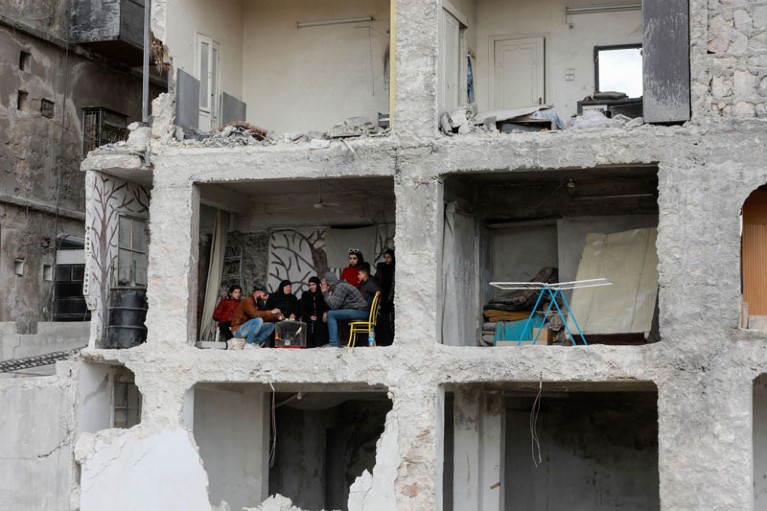
Ali al-Bash, his mother Amina Raslan and their family in a building in Aleppo damaged by the 6 February earthquake.Credit: Louai Beshara/AFP/Getty
It’s been three weeks since southern Turkey and northwest Syria were devastated by earthquakes, starting on 6 February. More than 50,000 people have died, 70,000 are injured and at least 160,000 buildings have totally or partially collapsed.
United Nations organizations and other aid agencies have joined thousands of volunteers in both countries. The World Food Programme is delivering millions of hot meals. The World Health Organization (WHO) is supplying hospitals with painkillers and antibiotics. The World Bank has pledged nearly US$1.8 billion for recovery and reconstruction, and UN secretary-general António Guterres is appealing for $1 billion for Turkey and close to $400 million for Syria, to be distributed to organizations providing food, shelter and education. Separately, the Red Cross/Red Crescent has launched an appeal to raise around $700 million.
Turkey–Syria earthquake: what scientists know
Turkey’s government has pledged to rebuild homes within a year. But there’s no such help (and much less other assistance) across the border in northwest Syria, where the earthquake killed more than 4,500 people, injured 8,500, demolished around 10,000 buildings and left some 11,000 people homeless. Northwest Syria’s inhabitants have no unified government. They’re trapped in a war, a legacy of a 2011 revolution — part of the Arab Spring — that was suppressed by the government of President Bashar al-Assad in a military operation backed by Russia. The region is also effectively isolated; there are only three (temporary) crossing points for supplies to reach people along Syria’s 900-kilometre border with Turkey.
Even before the earthquakes, the UN Office for the Coordination of Humanitarian Affairs estimated that more than half of northwest Syria’s 4.7 million people are internally displaced, and around 70% of those are living in temporary accommodation (often in tented cities). More than three million do not have enough to eat and one-third are disabled, many because of the war. Health-care facilities have been targeted, leaving only 66 hospitals still functioning, but poorly equipped, amid an ongoing cholera outbreak.
Nature has spoken to researchers, medical personnel and engineers in the region and internationally. They tell us that northwest Syria urgently needs expertise and specialized equipment, in addition to funding. For example, volunteer engineers are going house-to-house tapping walls with hammers to gauge whether a building is inhabitable.The WHO estimates that between them, the region’s hospitals have 64 X-ray machines and 73 renal dialysis machines, 7 computerized tomography (CT) scanners and one magnetic resonance imaging (MRI) machine. But researchers have told Nature that access to spare parts and expert technical support is as important as the machinery itself to keep things functioning.
There are research projects studying the situation. One is the UK-funded Research for Health Systems Strengthening in Syria, which is investigating how health care is being affected by war, and determining what more-sustainable models of governance and financing could look like, says co-investigator Abdulkarim Ekzayez, an epidemiologist at King’s College London.
One MRI for 4.7 million people: the battle to treat Syria’s quake survivors
Members of the international research community can also join broader efforts to alleviate the situation. They can donate funds — for example, by responding to international appeals or giving to the organizations listed at go.nature.com/3kq2rpn. They can urge their lawmakers to call for crossing points into northwest Syria to remain open long after emergency humanitarian assistance ends — two of the three are due to close in May, the third in July. If that happens, the region’s people will be cut off.
Researchers can urge the WHO to prioritize the region’s health needs. The agency is trusted and, through director-general Tedros Adhanom Ghebreyesus, it could do more to use that status to urge all the power brokers on the ground to allow it to work with other experts to deliver both immediate and longer-term help, including much-needed assistance to rebuild homes and health systems.