x






Researchers have detected increased emissions for five ozone-depleting chlorofluorocarbons.
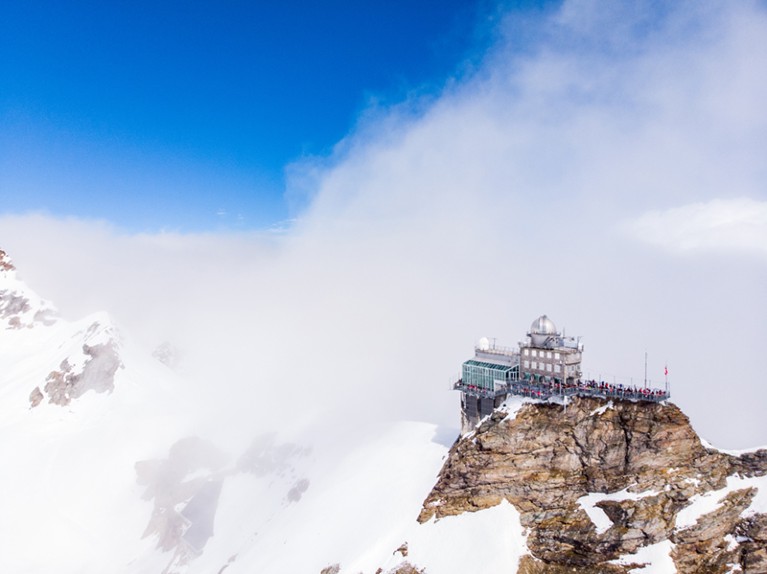
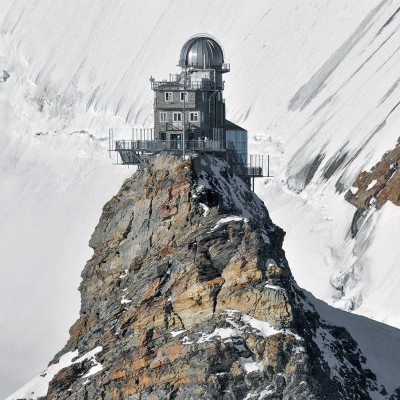
Researchers detected a surprising rise in levels of chlorofluorocarbons between 2010 and 2020 using a monitoring network that includes the Jungfraujoch research station in Switzerland.Credit: Shutterstock
The Montreal Protocol, which banned most uses of ozone-destroying chemicals known as chlorofluorocarbons (CFCs) and called for their global phase-out by 2010, has been a great success story: Earth’s ozone layer is projected to recover by the 2060s.
So atmospheric chemists were surprised to see a troubling signal in recent data. They found that the levels of five CFCs rose rapidly in the atmosphere from 2010 to 2020. Their results are published today in Nature Geoscience1.
The chemists policing Earth’s atmosphere for rogue pollution
“This shouldn’t be happening,” says Martin Vollmer, an atmospheric chemist at the Swiss Federal Laboratories for Materials Science and Technology in Dübendorf who helped to analyse data from an international network of CFC monitors. “We expect the opposite trend, we expect them to slowly go down.”
At current levels, these CFCs do not pose much threat to the ozone layer’s healing, said Luke Western, a chemist at the University of Bristol, UK, at an online press conference on 30 March. CFCs, once used as refrigerants and aerosols, can persist in the atmosphere for hundreds of years. Given that they are potent greenhouse gases, eliminating emissions of these CFCs will also have a positive impact on Earth’s climate. The collective annual warming effect of these five chemicals on the planet is equivalent to the emissions produced by a small country like Switzerland.
It’s highly likely that manufacturing plants are accidently releasing three of the chemicals — CFC-113a, CFC-114a and CFC-115 — while producing replacements for CFCs. When CFCs were phased out, hydrofluorocarbons (HFCs) were brought in as substitutes. But CFCs can crop up as unintended by-products during HFC manufacture. This accidental production is discouraged by the Montreal Protocol, but not prohibited by it.
“A lot of this probably boils down to the factory level,” Vollmer says, pointing out that HFC production is on the rise. “A factory can be run relatively clean or relatively dirty.”
The rise in the levels of the two other CFCs is a mystery. “CFC-13 and CFC-112a should not currently be used or produced,” says Rona Thompson, an atmospheric scientist at the Norwegian Institute for Air Research in Kjeller who was not involved in the analysis.
The researchers speculate that levels of CFC-112a might be on the rise because of its use as a solvent or as a chemical feedstock. However, they say they need to discuss this idea further with chemical engineers to confirm that assessment.
Illegal CFC emissions have stopped since scientists raised alarm
But the appearance of CFC-13 is much more baffling. “We really have no clue” where the emissions are coming from, Vollmer says. “We don’t know of any chemical process where this will show up as a by-product.” And, because there aren’t enough monitoring stations around the globe, it is difficult to pinpoint where this and the other CFC emissions are coming from, Thompson says.
Nonetheless, Andreas Engel, an atmospheric scientist at Goethe University Frankfurt in Germany, says this research shows that the global monitoring system is largely working. Scientists are keeping a close watch on the planet’s atmosphere and spotting problems. “We just need to find out where it is coming from and then people will be willing and obliged to fix it,” Engel says.
This is what happened a few years ago, when researchers detected high levels of CFC-11 in the atmosphere2, and traced them to eastern China3. They deduced the source on the basis of readings from monitoring stations in South Korea and Japan, reporting it in May 2019, and afterwards, levels began to fall. Scientists got somewhat lucky with CFC-11: monitoring stations equipped to detect that particular chemical happened to be located relatively close to the source.
China feels the heat over rogue CFC emissions
Engel says it would help to increase the coverage of CFC-monitoring stations — for instance, the continents of Africa and South America have little if any coverage.
If most emissions of the five recently detected CFCs are coming from the production of CFC-replacement chemicals, the world might need to think differently about HFCs, and perhaps even the next-generation of refrigerant chemicals — hydrofluoroolefins (HFOs) — Vollmer says. HFO production can emit CFCs too, he says.