x






Extensive flooding could have severe consequences for farming, health and the environment.
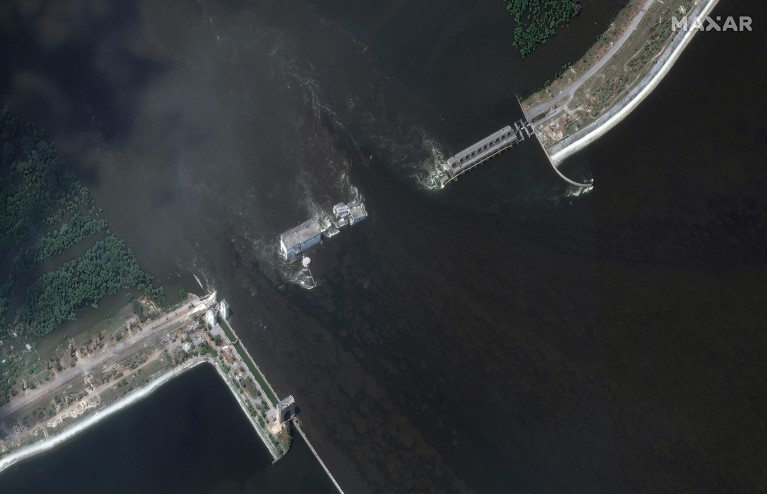
Large sections of the Kakhovka dam have collapsed, unleashing catastrophic floods. Credit: Satellite image (c) 2023 Maxar Technologies via Getty
The 68-year-old Kakhovka dam on Dnieper River in south Ukraine collapsed on the morning of 6 June after a suspected explosion, plunging Ukraine into an unprecedented humanitarian and environmental crisis.
Spanning an area of more than 2,000 square kilometres, the dam’s reservoir is the country’s largest in terms of water volume. The dam has been controlled by Russian forces for more than a year.
The breach triggered extensive flooding, which peaked at 5.6 metres in Kherson on 8 June and has so far displaced more than 20,000 people across dozens of settlements, including in Russian-held areas on the river’s lower left bank. The deluge is expected to continue for at least a week.
Nature spoke to researchers and specialists on rivers and environmental science about the continuing impacts of the disaster.
Before the breach, the Kakhovka reservoir held more than 19 cubic kilometres of water. “Now, there are only 11 cubic kilometres of water left,” said Oleksandr Krasnolutskyi, Ukraine’s deputy minister of environmental protection and natural resources at a press briefing on 8 June.
The reservoir provides drinking water for more than 700,000 people in south Ukraine. Cities on the Dnieper River, including Kherson, Nikopol, Marhanets and Pokrov, are short of water supplies, according to the United Nations.
And the flood waters themselves have caused extensive damage — destroying houses, roads and other crucial infrastructure.
As the water level in the reservoir drops, there will not be enough water for the irrigation canals that it usually serves, says Roger Falconer, a water engineer at Cardiff University, UK, who specializes in modelling dam failures. “So it could affect crops both downstream and upstream.”
Floodwater has inundated tens of thousands of hectares of farms and arable lands, washing away their topsoil layers, according to Ukraine’s environment ministry. “We will not be able to cultivate agricultural plants on this soil for many years ahead,” said Krasnolutskyi. Falconer adds that the floods could wash fertilizers used on agricultural land into the river, where they could disrupt aquatic ecosystems.
The sudden surge of water downstream has had immediate and far-reaching impacts on the biodiverse ecosystems. “Nearly 160,000 animals and 20,000birds are under threat because of the catastrophe,” said Krasnolutskyi.
Some of the species concerned are rare, or found only in this area. These include the globally endangered Nordmann’s birch mouse (Sicista loriger), according to a report by the Ukrainian Nature Conservation Group (UNCG) in Vasylkiv.
The Kakhovka reservoir itself is home to dozens of fish species. The rapid draining of its water means that vast numbers of fish will be either stranded in shallow, dried-up zones, or swept away to sea, where they will perish in the salt water.
“What we have seen is the tip of the iceberg,” says Oleksii Vasyliuk, an environmentalist and co-founder of UNCG. “This is ecocide.”
Nearby national parks have also been flooded, and this will cause irreparable damage to their flora and fauna.
Nine sites in Ukraine’s Emerald Network, a European-wide conserved area, as well as five internationally important wetlands have been flooded. Around 55,000 hectares of forest have been inundated with water that is predicted to remain stagnant for 20 days, according to the environment ministry.
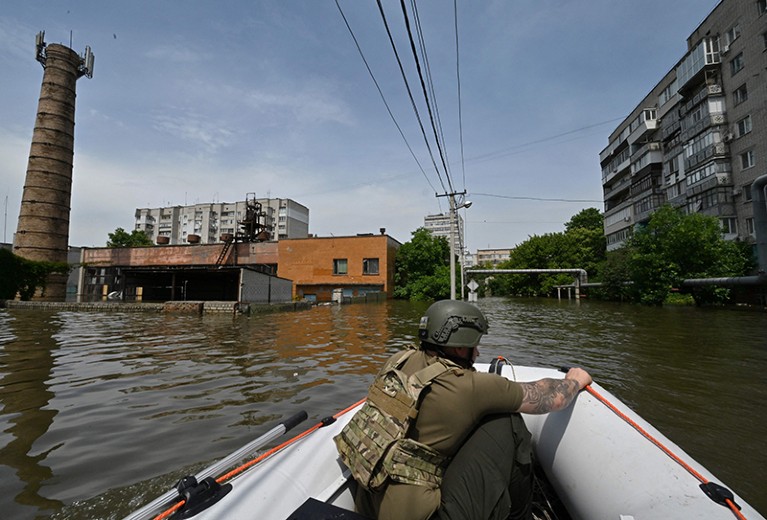
A member of Ukraine’s National Guard brings food to Kherson residents stranded by flooding.Credit: Genya Savilov/AFP via Getty
Europe’s largest nuclear power plant, Zaporizhzia, is located around 150 kilometres upstream of the Kakhovka dam. The plant’s reactors have been shut down for more than 8 months — but it needs water for cooling to manage the residual decay heat of its six reactors, and is continuing to pump cooling water from the reservoir, according to the International Atomic Energy Agency.
If the water level in the Kakhovka reservoir drops too low to supply cooling water, Zaporizhzia can switch to alternative water supplies. There are also two cooling towers that can be used for atmospheric cooling, and require only a small amount of water to operate, says Malte Jansen, an energy scientist at the University of Sussex, UK.
Perhaps more concerning is the potential dispersal of toxins. More than 150 tonnes of machine oil from the Kakhovka hydroelectric power station, which sits on the dam, have spilled into the Dnieper River, according to the environment ministry. The floodwater also carried garbage, together with construction waste and sewage, into the Dnieper watershed, according to Krasnolutskyi, where it could potentially contaminate supplies of drinking water.
If the reservoir’s water level continues to recede, it will eventually return to the river’s baseline level before the dam was built 68 years ago, says Falconer.
He adds that the collapse will ultimately lead to changes in the reservoir’s bed topography, and that it could also increase ‘shear stress’, the force of flowing water against the river bed that could disturb potentially toxic sediment.
“It will be necessary to either plant these areas with a forest, or sow meadow grasses so that the wind does not blow away this silt at the bottom of the dried reservoir, because it is contaminated with waste from Zaporizhzhia,” says Vasyliuk.
The environment ministry says that a scientific survey will be needed to explore whether the dam should be rebuilt. But a complete assessment of the flood’s impact is unlikely at present: Russian forces currently control the south side of the river, where the majority of the flooding has occurred. “Nothing can be done to minimize the consequences,” says Vasyliuk. “This is a zone of both an environmental disaster and active hostilities.”