x




Models show that death rates must decline faster to meet Cancer Moonshot goals to cut deaths in half in 25 years.
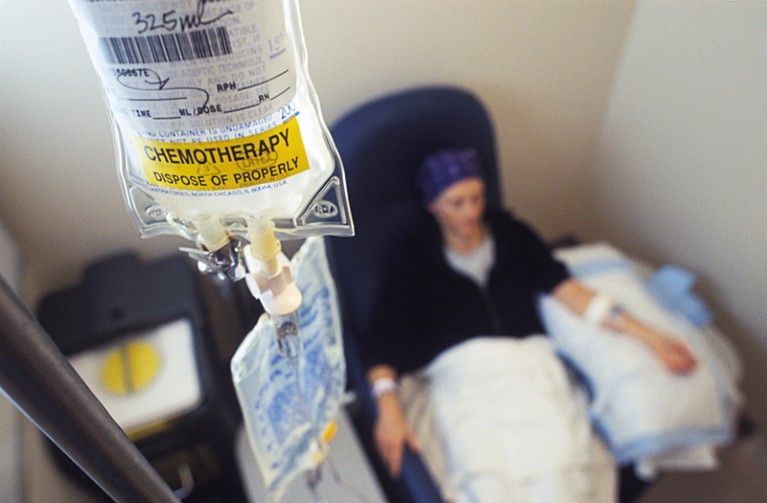
A cancer patient receives chemotherapy. Mortality rates from cancer in the US need to fall more quickly in order to reach ambitious goals to reduce deaths.Credit: Sam Ogden/Science Photo Library
Death rates for most of the deadliest cancers in the United States need to fall more quickly if ambitious goals set by the president are to be met, according to a study by the US National Cancer Institute (NCI).
Last year, President Joe Biden called for the country to halve its cancer death rate in 25 years as part of his Cancer Moonshot programme. A team of NCI researchers looked at cancer mortality from 2000 to 2019 to learn what it would take to achieve that goal.
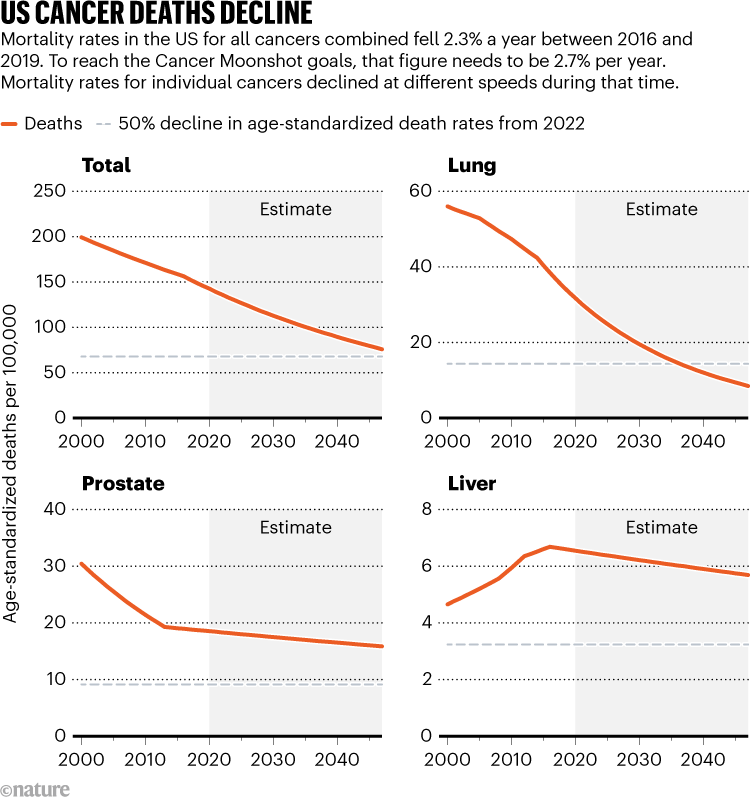
The team found that cancer death rates overall fell in the United States by about 2.3% each year between 2016 and 2019. If that rate of decline continues until 2047, the cancer death rate will have dropped by 44% since 2022 — short of Biden’s goal.
To reach the 50% goal, cancer death rates must go down faster: by 2.7% each year between now and 2047, the study authors found. They published their findings on 17 April in Cancer Discovery.1
“Doing more of what we have today is not enough,” said NCI director Monica Bertagnolli in a press briefing about the study at the annual meeting of the American Association of Cancer Research in Orlando, Florida, which ran from 14 to 19 April. “We need much more to cover the last mile.”
As well as looking at overall cancer deaths, the team — led by cancer epidemiologist Meredith Shiels — analysed mortality rates for each of the six most common cancers: lung, colorectal, pancreatic, breast, prostate and liver cancers. Together, these are responsible for more than half of all cancer deaths in the United States. The researchers adjusted the data to account for effects of the country’s ageing population on cancer incidence and mortality.
They found that much of the decline in overall cancer death rates has been driven by a decrease in lung cancer mortality, which dropped by 4.7% a year between 2014 and 2019.
Another study of US cancer mortality rates found similar marked reductions in death rates from lung cancer2. Rebecca Siegel, an epidemiologist at the American Cancer Association in Atlanta, Georgia, who led the study, says that these were probably a result of recent improvements in diagnosis, surgical techniques and therapies. “All of these are contributing to improvements in survival for every stage of lung cancer diagnosis,” Siegel says.
Of the six most frequent cancers, the NCI analysis found that mortality rates declined substantially for lung, colorectal and breast cancers between 2016 and 2019. But trends in prostate, pancreatic and liver cancer (including a type of bile-duct cancer found inside the liver) were not as encouraging. Improvements in prostate cancer death rates have been tapering off since 2012, and pancreatic and liver cancer death rates have been nearly flat.
But there is reason to hope that death rates from liver cancer might also be on the cusp of decline, says Siegel. The data suggest that mortality rates are already beginning to plateau, as antiviral therapies capable of treating infection with hepatitis C virus, a leading cause of liver cancer, have become available. The key now, she says, is to ensure that more people are tested for the virus and receive treatment.
Overall, the modelling gives researchers a sense of where the field stands, says Siegel, but she warns against extrapolating too far into the future. “It’s important to have a roadmap, but also to be flexible and take detours. Things change all the time.”