x






Genomic analysis reveals that the wheat blast fungus spread independently from South America to two other continents.
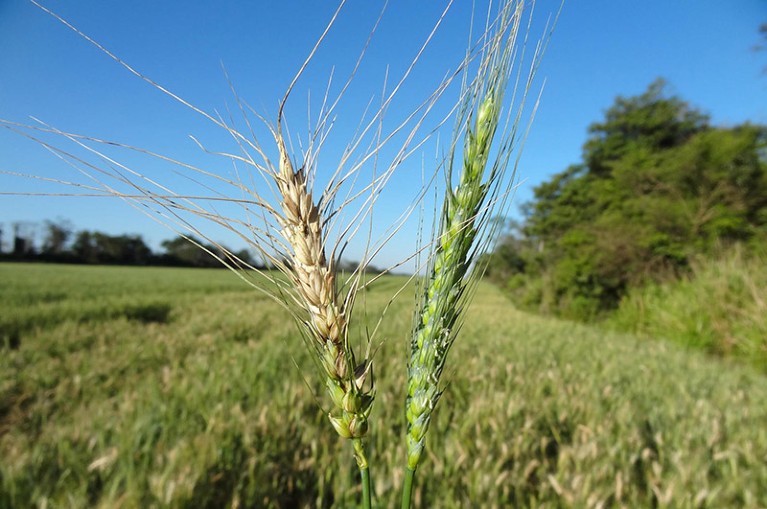
A head of wheat infected by the wheat-blast fungus (left), compared with a healthy one (right).Credit: Nature and Science/Alamy
Could the next pandemic hit global food supplies? Scientists warn that a fungal pathogen that threatens wheat production in South America is poised to go global.
Outbreaks of the ‘wheat blast’ pathogen Magnaporthe oryzae in parts of Africa and Asia originated from a single family of the fungus that was imported from South America, researchers report on 11 April in PLoS Biology1. Scientists warn that this lineage could strike elsewhere, or develop worrying traits such as fungicide resistance and the ability to affect other important food crops.
“This is a very serious disease; it threatens wheat cultivation in some of the poorest parts of the world,” study co-author Nick Talbot, a plant pathologist at the Sainsbury Laboratory in Norwich, UK, said at a press briefing. “It also has the capacity to spread throughout the world.”
Magnaporthe oryzae infects wild and cultivated grasses, most notably rice and wheat. Researchers first detected the pathogen in Brazilian wheat crops in the 1980s. The fungus has since marched across South America, causing periodic outbreaks and limiting wheat cultivation in some areas.
In 2016, Bangladesh recorded Asia’s first wheat blast outbreak, and researchers established that it was caused by a lineage related to those circulating in South America. Two years later, M. oryzae reached Africa for the first time, striking wheat crops in Zambia. But it wasn’t clear whether the pathogen had arrived from Bangladesh or South America.
To pinpoint the pathogen’s origin, researchers analysed more than 500 M. oryzae samples for 84 genetic markers, and sequenced the genomes of 71 of the samples isolated. Those from the 2018 Zambia and 2016 Bangladesh epidemics belonged to distinct branches of a wheat blast lineage circulating in South America. That conclusion echoes results from a preprint study posted last June2 that analysed genomes from African, Asian and South American wheat blast isolates.
This suggests that wheat blast strains from South America reached Africa and Asia independently, says Hernán Burbano, an evolutionary geneticist at University College London, who was part of the study. “It shows that people are moving the pathogen around somehow,” he adds.
“This was a big surprise,” says Bruce McDonald, a plant pathologist at the Swiss Federal Institute of Technology (ETH) in Zurich, Switzerland, who was not involved in the study. He agrees that human activity is the most likely culprit.
The import of infected seeds is a likely source of the outbreaks, say researchers — Bangladesh acquired vast quantities of wheat seed from Brazil in the year before wheat blast appeared. But the precise origin is unclear. The lineage implicated was found in Brazil, as well as in Bolivia.
Tofazzal Islam, an ecological chemist at Bangabandhu Sheikh Mujibur Rahman Agricultural University in Gazipur, Bangladesh, told the briefing that researchers are now using the genomic information to monitor the spread of wheat blast throughout Bangladesh. His team is also using the insights obtained to breed wheat crops resistant to the pathogen lineage behind the epidemic.
But the genomic analysis also highlights threats. Although the lineage responsible for the outbreak remains susceptible to certain fungicides, laboratory experiments show that resistance could emerge from spontaneous mutations. The strain, which reproduces by cloning itself, could gain new traits by mating with another lineage of M. oryzae. The researchers found that the wheat blast strain can mate with an M. oryzae strain the infects African millet crops.
McDonald says efforts should be made to eradicate wheat blast from Bangladesh and Zambia. But he’s sceptical that genomic surveillance will do much to slow the fungus’s spread. Global funding cuts have meant that there are fewer scientists on the lookout for and reporting emerging plant diseases, he says. “Global surveillance is woefully inadequate to detect new outbreaks of any disease before they have already become established.”