x






By scouring websites and pestering university human-resources departments, Amanda Gorton and Tess Grainger are tracking the vast differences in leave entitlements across North America.

Tess Grainger applied for grants partly on the basis of leave policies.Credit: Caitlin Meggs
As is the case for many parents in academia, parental leave has played a major part in the trajectories of our lives and scientific careers. We both had children while completing graduate school and postdoctoral positions, and our decisions about when to have children and where to pursue our next academic positions were influenced heavily by the availability of paid parental leave.
Unfortunately, the details of leave policies for new parents can be difficult to uncover. We found one database of these policies for tenure-track faculty members across academic institutions in the United States and Canada. However, we wanted to break down the differences between available paid leave across career stages, from graduate students and postdoctoral fellows to staff and faculty. To address this, in 2020, we decided to create a database of parental-leave policies at institutions across the United States and Canada. We wanted to make this database to assist others in navigating an already-challenging life event. We also wanted to share first-hand some of the difficulties of securing paid time off as an academic with a growing family.
A.G. is Canadian and had her daughter six months before she defended her PhD in ecology, evolution and behaviour at the University of Minnesota in St Paul in 2019. She received six weeks of paid leave and took another six weeks while on a paid fellowship. She returned to work full-time after 12 weeks, exhausted.

Don’t get mad, get equal: putting an end to misogyny in science
When A.G. and her husband decided they wanted to have a second child during her postdoctoral programme at the university, they planned ahead. In the interim, A.G. had, through word of mouth, learnt from other parents about how to maximize her parental leave. She started paying into the short-term disability insurance scheme before she became pregnant, and she didn’t use any sick or vacation days leading up to the birth of her son last January. In the United States, an individual can purchase short-term disability insurance that can be used to cover part of their salary during pregnancy or parental leave. A.G. had a total of 10 sick days (the maximum allowed) and 21 vacation days, all of which she used while on parental leave. (Minnesota just passed a law granting 12 weeks of paid parental leave, but this won’t take effect until 2026.)
For her second child, A.G. was able to take 20 weeks of parental leave. Hers is an excellent example of the patchwork of policies that must be applied in some cases: she used short-term disability, six weeks of paid parental leave, unpaid leave and vacation and sick days.
T.G. is also Canadian and had her first child after finishing her PhD in ecology and evolutionary biology at the University of Toronto, Canada. The country has a relatively generous federal policy on leave, but most graduate students do not qualify for this, because only time spent working as teaching assistants generally contributes towards the hours eligible for employment insurance. Fortunately, T.G.’s PhD supervisor generously offered her a paid research assistantship at the end of her degree so that she would be eligible for federal leave. She took eight months of paid leave (at 55% of her graduate-student salary) before starting her postdoctoral work. She now has a second postdoctoral position at the University of British Columbia, funded by the Natural Sciences and Engineering Research Council of Canada (NSERC).
T.G. had her second child last August, and owing to policy changes at NSERC in 2019, she has been able to take a year of parental leave at 100% of her postdoc salary. Her family’s decision to have both of their children while in Canada and her motivation to apply for grants with generous leave policies were influenced heavily by her desire to take more parental leave.
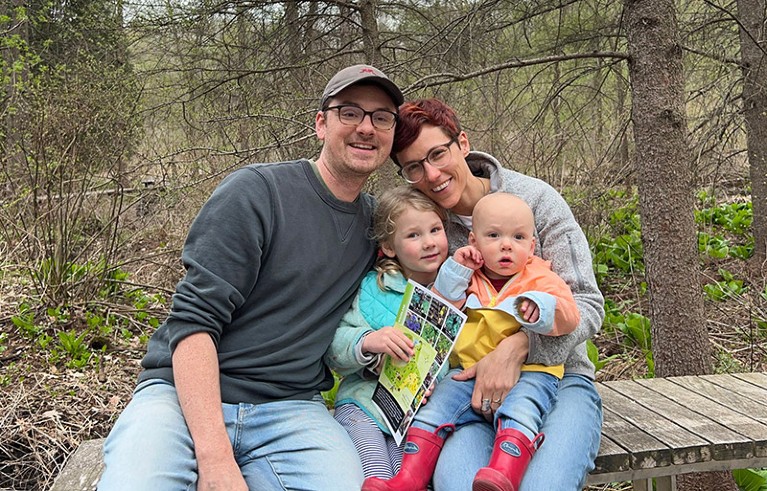
Amanda Gorton with her husband, son and daughter.Credit: Charlie Willis
Our experiences exemplify the range of paid leave available at academic institutions in North America. Although the benefits of paid parental leave — both for the mental and physical health of parents and children, and for gender equality in the workforce — are widely acknowledged, we were surprised that there was no easy way to look up and compare leave policies across academic institutions. We both felt strongly that parental-leave information should be easily accessible to people deciding where to pursue their degrees or apply for academic positions.
For our database, we focused on around 30 Canadian institutions and 146 US universities classified as R1, or research-intensive, by the Carnegie Classification of Institutions of Higher Education. We recorded data on the length of paid parental length across institutions, the academic job (such as graduate student, postdoc, faculty member or staff member), parent type (such as ‘birthing’ or ‘non-birthing’, adoptive parent or foster parent), and whether the institution was public or private. We examined restrictions on parental-leave policies, such as requiring a certain number of hours worked before being eligible or requiring the use of vacation or sick leave.
Compiling this database required scouring universities’ websites and contacting human-resources representatives. With our young children and full-time work keeping us busy, we, ironically, did not have time to collect the data. We were fortunate to find, through Twitter, two undergraduate research assistants to help us, who were paid by their university: Yerin Lee and Gwendolyn Clark, based in evolutionary biologist John Stinchcombe’s laboratory at the University of Toronto, Canada.

From process to outcome: working toward health equity
Once we started looking at the policies, the first major determinant of the amount of paid leave at universities that jumped out was, unsurprisingly, country. Canada has federally mandated paid parental leave that provides 55% salary for up to 50 weeks for the parent giving birth and for up to 35 weeks for the other parent. These rates are flexible; parents can reduce their salary further to acquire more weeks’ leave. A couple can take a maximum of 40 weeks paid at 55% or 69 weeks paid at 33%. These rates are often topped up by the employer, usually for only a portion of the leave period.
But people in certain academic stages, such as undergraduate and graduate students, usually do not qualify for this federal leave, because they are not able to accrue enough eligible work hours. It is then up to the individual university to have a policy in place that allows these groups to take paid leave.
By contrast, the United States has no federally mandated paid parental leave. The Family and Medical Leave Act requires companies with more than 50 employees to provide 12 weeks of unpaid, job-protected leave for specific reasons, including pregnancy. This law applies to all US universities in our database. Although 11 states and the District of Columbia have their own mandated paid leave policies, this is far from common. Within these constraints, US and Canadian universities have a lot of latitude to decide the type, amount and length of paid parental leave that they offer.
In addition to the differences in federal policies, we found discrepancies in the length of paid parental leave offered across career stages and institution types. In the United States, the average length was six weeks, well below the recommended guidelines for maternal and infant health, according to one report by the New America think tank, based in Washington DC. Graduate students and postdocs receive, on average, the shortest length of paid leave: less than four weeks at public universities. Most day-care centres will not take infants that young. Furthermore, private universities in the United States offer, on average, more than double the length of paid leave (see ‘Less leave at US institutions’). In Canada, graduate students are not considered employees; as a consequence, they receive, on average, only 10–12 weeks of paid parental leave, a rate that is one-third of what faculty members receive and 20% of the federally mandated leave.
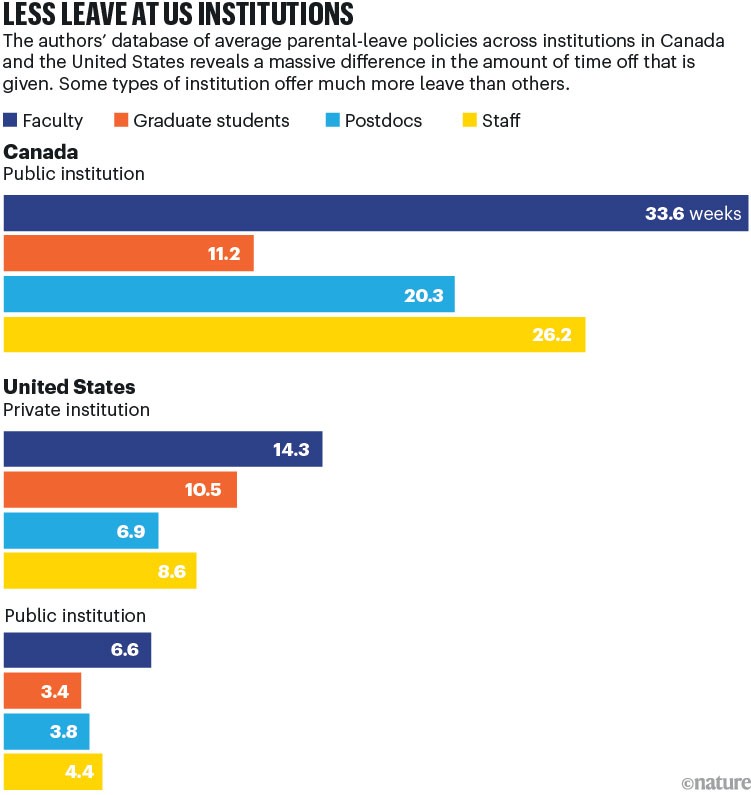
Source: Amanda J. Gorton & Tess Grainger
We have only scratched the surface of analysing these data, so we are looking for collaborators interested in conducting more in-depth analyses, expanding the database beyond North America, and publishing findings.
Although our degrees are in the same field, we never met nor collaborated until this idea came to fruition. It was pursuing this passion project (and bonding over the chaos of having children under five years of age) that brought us together. Our hope is that these data can help prospective parents to chart their career paths in academia while building their families. We also hope that it will spur universities to thoroughly examine their own parental-leave policies in comparison to those of other institutions. Only by exposing the discrepancies in leave across institutions, career stages and parent type, can we begin to enact policy changes.