x




Rod-shaped structures named ‘obelisks’ are even smaller than viruses but can still transmit instructions to cells.
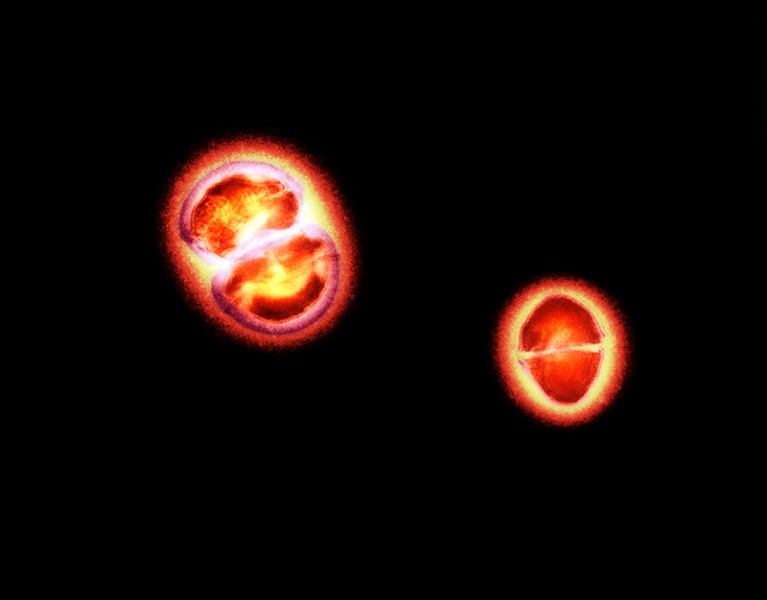
Streptococcus sanguinis bacteria live in the human mouth and are hosts to a newly described group of RNA entities.Credit: UK Health Security Agency/Science Photo Library
The human microbiome just gained a new dimension: scientists have discovered tiny bits of RNA — even smaller than viruses — that colonize the bacteria inside human guts and mouths1. Too minimal to be considered a standard life form, these scraps of genetic material are among the smallest known elements to transfer information that can be read by a cell, and the sequences that they encode are new to science.
“That’s, like, wildly weird,” says cell and developmental biologist Mark Peifer at the University of North Carolina at Chapel Hill, who was not involved in the work. The research rekindled his sense of the joy that scientific discovery can bring, he says. “The world is just full of new things. And once you start to look, you find them.”
The work was posted on the bioRxiv preprint server on 21 January, and has yet to be peer reviewed.
Obelisks, as preprint co-author and biochemist Ivan Zheludev at Stanford University in California and his colleagues are calling the newly discovered elements, are flattened circles of RNA. The authors’ analysis suggests that these circles are folded into rod-like structures.
Flattened circles have been seen before, in the form of ‘viroids’ — structures made of RNA that are similar to viruses, but are much smaller. They were first discovered in the 1970s, when some were found to cause diseases in plants. Soon scientists discovered a similar element that can cause hepatitis in humans. A flurry of studies in the past five years have reported viroid-like elements in a range of animals2,3 and fungi4, and a study5 last year provided the first hint that they might be present in bacteria.
Massive DNA ‘Borg’ structures perplex scientists
Zheludev and his colleagues took advantage of the characteristic circular RNA of viroids to search for similar elements in databases of RNA from human stool. And there, they found the obelisks.
Although obelisks have the same shape as many viroids, their genetic sequences are very different — implying that they comprise a separate but related group. Follow-up searches turned up a plethora of obelisks in stool samples taken from people across every continent. The authors found evidence of the elements in almost 10% of samples of gut and oral microbiota collected from 472 individuals, most of them from North America.
The study is “a milestone” because it presents the best available evidence that such elements are widespread in the bacterial world, and not just in more complex organisms, says molecular biologist Joan Marquez-Molins at the Swedish University of Agricultural Sciences in Uppsala, who was not involved in the work. “It’s not really something sporadic or isolated in the population — it’s really affecting a considerable amount of the sample,” he says.
Nobody knows how obelisks might affect human health. The components of the microbiome — including bacteria, fungi and other organisms — “all exist in a balance”, says virologist Anamarija Butković at the Pasteur Institute in Paris, who was not involved in the work. “It’s interesting to think what obelisks are doing there, and how they might affect this whole balance.”
The answer could come from the common mouth bacterium Streptococcus sanguinis, in which the researchers found a family of obelisks. Because S. sanguinis is easy to grow, Marquez-Molins and Buković hypothesize that scientists might be able to use these bacteria to address questions about how obelisks replicate, how they affect bacteria and what their proteins do.
Such experiments could reveal truths about the origin of life itself. Some scientists have speculated that, because viroids and their relatives are small, simple and have the capacity to self-replicate, they are the precursors of all life on Earth, Butković says. Although scientists have just seen obelisks for the first time, they might have shaped us from the start.