x



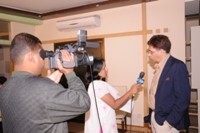
 Dr Mizanur Rahman Shelley has seen life up close through different lenses — as a student politician, as a bureaucrat, as an academic and as a technocrat minister. As a writer, he has tried different genres of writing, poetry included, and done so successfully. In ‘The symphony of our times’, his memoir in progress which will be serialised in My Blog (He is one of my close friends and has given his permission), starting from today, Dr Shelley leads the readers down memory lane...
PART I
The symphony of our times
THE dawn of memory came in a city called Kolkata. It was the first half of the 1940s. Early recollections had their inception in 11 Tarak Datta Road. A compact flat at one end of that road, located between Syed Ameer Ali Avenue and Kareya Road, was the residence of our childhood. Father BM Rahman and mother Rezia Rahman lived there with their children: eldest daughter Khaleda Khanum Regina, me and younger brother Maswoodur Rahman Prince.
During the mid-1940s father was posted as the controller of fertilisers of the agricultural department of the provincial government of Bengal. In those days, the farmers had great reluctance to use chemical fertilisers. Father and his colleagues were busy informing the cultivators of their uses and benefits. Our small Kolkata flat was, therefore, packed with leaflets and pamphlets describing the qualities of ‘strange’ objects like urea, muriate of potash and triple super phosphate, etc. At that time, I could not read Bangla, mother and elder sister used to read these leaflets aloud for my benefit.
There was a narrow open space in front of our apartment building, ‘Islam Castle’. That was the playground of our childhood where we spent most of our holidays and after-school hours. Elder sister Khaleda Khanum Regina studied at the nearby missionary convent. I was also admitted to the ‘infant’ class. I recall that the courtyard of the school had several trees with violet flowers which closed their petals if someone touched them. For me the pleasure of touching those flowers was the only delight in the school. There was a mischievous muscular class friend called Runu whose pinches were painful. His bullying further discouraged me from attending school. I quarrelled every day with the domestic help who used to take me to school across the main road studded with tram-line. Sometimes, I played truant and instead of attending classes went to aunty Jamila Khatun’s (Shahida) place in the nearby Col Biswas lane. Her indulgent affection filled my hours stolen away from school and there was no dearth of tasty food and drinks.
Mother Rezia Rahman alias Hamida had her lessons in Bengali literature from her mother, my grandmother Rokeya Mannan. Our place was stacked with many books, novels, collections of short stories and poems. As I had my early education in English medium, I was not well-acquainted with Bangla and could hardly read Bangla books. A big-sized colourful book of Bangla poems used to attract me and I shuffled through its pages with great interest in the accompanying illustrations. Later, I came to know that it was a Bengali version of Fitzgerald’s English translation of the timeless poems of Omar Khayyam. The Bengali translator was Naren Deb, a reputed writer of the time. The Bengali middle class preferred that book as popular wedding gifts. I didn’t understand the meaning of the poems but the resonance of the words felt sweet as mother read those out:
The caravanserai is old and broken
but, there is a constant and lively
coming and going there
Or
The heavenly hunter
throws his arrow of light,
and hits the high minarets
of the royal palace
like shiny, molten gold.
Our childhood was vibrant with words and rhymes. It was also terrified and shaken by the sky-rending and deadly sounds of the Second World War. The war was far off in the West, in European countries and shores. In the East, however, we heard our elders saying that the war was brought to our doorsteps in Myanmar (Burma) and Assam by the axis power Japan. Calcutta was terrified by the threat of Japanese bombs. The children, however, were not frightened. The rhymes they recited were full of humour and took a dig at the retreating Britisher. One remembers evenings when red-faced white soldiers returned to their barrack in military trucks. Playful children shouted in joy: ‘Tommy, Tommy!’ That was the popular title of the British soldiers. In reality, American GIs used to be also there. They zestfully threw packets of tasty chocolates among the children crowding the roadsides.
In a corner of the main street was located the grocery shop of maternal uncle Abdul Bari Warsi. His cousin, our uncle Hashem, was the busy salesman. In those days a fraction of a taka, a quarter or a half could buy delicious candies and biscuits of varied colours. My elder sister Regina and I collected fistfuls of coins from mother’s box and bought tasty toffees and lozenges in exchange.
Another indelible memory with uncle Bari was imprinted in childhood memory. I do not remember exactly when, where and how he took me to that distant house with red floors. It could have been on the outskirts of Kolkata. I recall that railway tracks ran by the garden in the back. Trains bound for far destinations whistlingly passed by at frequent intervals. A number of young boys and girls had gathered their house on a Sun-lit morning. We came to know later that uncle Bari at that time was a red-card holder member of the Communist Party. During the British Raj such an association was against the law. That day the bunch of youth had congregated to rehearse ‘The Communist International’. They played the harmonium and passionately sang the Bangla version rendered by rebel poet Kazi Nazrul Islam:
Awake and arise,
O starving prisoners all,
Awake, all you unfortunates
and deprived masses of the world.
The voice of the hearts
of the people at large
strikes terror
in the minds of torturers.
Listen, oh you oppressor!
and grabber!
We, who are the have-nots
today,
Will become the victors
tomorrow.
The innate message of the thrilling song was beyond understanding in our early childhood, but the touching tune and rhyme rhythm in memory for a long time.
Our family increased in the little flat of Tarak Dutta Road. Younger sister Najma, Nargis Islam was born there. Younger brother Rousseau, Mahbubur Rahman followed. One day I was playing with friends near the iron gate of the building and was delighted to find my maternal grandmother coming in a rickshaw from the Shialdaha Rail station. She lived in Dhaka with grandfather Abdul Mannan Warsi, an educationist and member of the Bengal Education Service. He was working as superintendent of the Normal School at Dhaka after having served as teacher and headmaster of various government high schools of united Bengal. Grandma, whom we called Lal Buji because her complexion was very fair, almost golden and was, therefore, also called Kanchan (gold), came to Calcutta on learning of Rousseau’s birth. Needless to say younger brother Prince, whom we lovingly called Khokon (little boy) and I were replete with joy on her arrival.
To be continued.