x





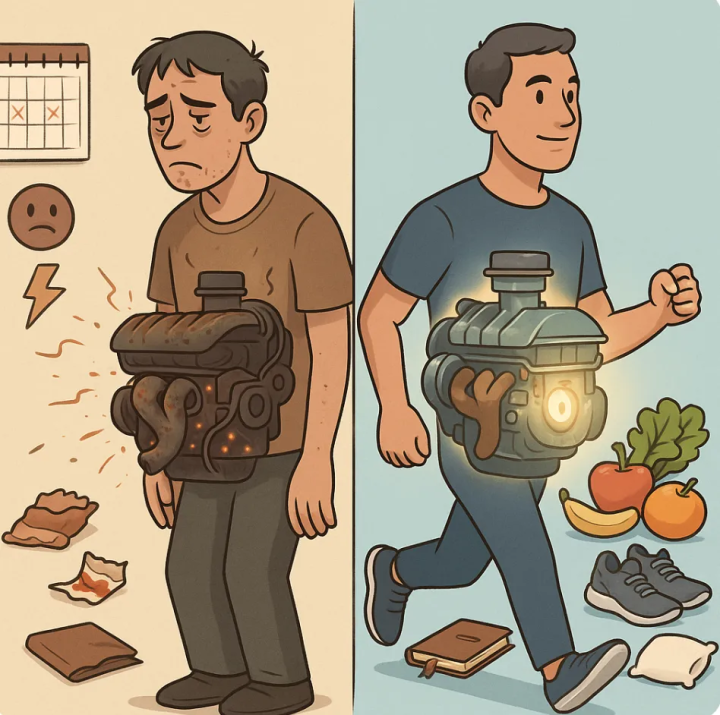
Picture two identical cars.
One is fueled with care, driven smoothly, and taken in for regular tune-ups.
The other? Neglected. Bad gas. No maintenance. Rust creeping under the hood.
Same make. Same model.
But one hums. The other wheezes.
That’s your body.
Because aging isn’t what wears us down.
Oxidative stress is.
Aging is inevitable. But how fast you age? That’s chemistry.
Every moment, your cells are hard at work making energy. That job belongs to your mitochondria, the tiny engines inside nearly every cell.
But just like car engines, they don’t run clean.
They release exhaust, unstable molecules called ROS (reactive oxygen species).
Think of ROS as microscopic sparks.
A few? Harmless.
Too many? And those sparks start to scorch the machinery.
That damage is called oxidative stress, and it’s the biological version of rust.
Over time, it wears down your DNA, weakens your metabolism, shortens your telomeres (the protective tips of your chromosomes), and sets the stage for chronic disease: heart disease, Alzheimer’s, type 2 diabetes.
But here’s the good news…
You’re not powerless. Inside you is an elite cleanup squad—enzymes like glutathione, superoxide dismutase (SOD), and catalase.
Their job? Neutralize the sparks before they light a fire.
But here’s the twist:
They don’t just show up automatically.
They have to be trained.
Too little stress? They go quiet.
Too much stress? They collapse.
Just the right amount? They grow stronger.
That healthy challenge has a name: mitohormesis—the sweet spot of stress that builds resilience instead of decay.
Here’s the formula that determines how fast (or slow) your body ages:
Oxidative Stress = ROS Load − Antioxidant Capacity
That’s it. Just two variables:
How many sparks your body makes (ROS load)
And how well your body cleans them up (antioxidant capacity)
If your spark load is high and your cleanup crew is weak, you rust fast.
If you make fewer sparks or boost your defenses, you age slower.
So how do you tip the balance in your favor?
Exercise does two things at once:
It increases ROS (those sparks), and it teaches your body to handle them better over time.
This is called hormetic stress—stress that makes you stronger.
Just like lifting weights breaks down muscle so it can rebuild stronger, exercise “challenges” your mitochondria to become more efficient.
Regular movement turns on genes that tell your body: “We need more cleanup crew. Upgrade the defenses.”
But here’s the catch—more isn’t always better.
Too much intense training without enough rest creates chronic stress and floods the system with sparks your body can’t keep up with.
The goal isn’t punishment. It’s adaptation.
Moderate cardio. Strength training. Daily walking. Flexibility. Recovery days. That’s how you train your engine, not blow it out.
The food you eat either fans the flames or puts them out.
Highly processed, high-sugar, and high-fat diets increase oxidative stress by flooding your body with substances it sees as a threat.
In contrast, whole plant foods provide nutrients and compounds that actively increase antioxidant capacity.
The biggest heroes?
Polyphenols. These are natural plant chemicals found in berries, leafy greens, herbs, spices, colorful veggies, green tea, and cacao.
They act like coaches—turning on your internal antioxidant defense systems, especially the Nrf2 pathway—which boosts your body’s own production of glutathione, catalase, and SOD.
A quick note on supplements: While whole foods rich in antioxidants (like berries, greens, and herbs) support your body’s defenses, isolated antioxidant supplements such as high-dose Vitamin E or C haven’t shown consistent benefits in aging—or may even blunt the body’s natural adaptation to stress, especially post-exercise. Whenever possible, get your defense team from food, not pills.
So next time you’re choosing between a blueberry smoothie and a muffin, remember: one is rust fuel, the other is rust prevention.