x





We all know the importance of diet and exercise for weight loss, as well as a sustained commitment to losing weight and keeping it off. There is, unfortunately, no magic weight-loss pill that can shed the pounds and keep them off for good. There are, however, some pretty miraculous organic compounds that prime your body for weight-loss and help boost your metabolism. Amino acids for weight loss are a safe and natural way to support your weight-loss efforts.
Our bodies are constantly burning carbohydrates, fats, and proteins to provide the energy for all the reactions that are continuously ongoing, 24 hours a day. The sum total of the energy utilized by all these reactions is called the basal metabolic rate.
The basal metabolic rate refers to the rate of energy production when you are inactive and not absorbing food. The best time to determine your basal metabolic rate is when you are sleeping. The same basic metabolic functions that determine the basal rate of energy expenditure also proceed when you are active. During the day, your total metabolic expenditure is the sum of your basal rate (which occurs continuously) and the energy you expend throughout your daily activities. When weight-loss promos and articles feature the appealing words “boost your metabolism,” they are really just saying “increase your basal metabolic rate.”
Here’s how it works: if your basal metabolic rate doesn’t match the calories you eat in a day, you will lose weight. Expressed differently, if you can rev up your basal metabolic rate (i.e., boost your metabolism), you will lose weight even if you maintain the same caloric intake. Great news for those of us who don’t want to have to eat fewer calories.
There are two major contributors to the basal metabolic rate.
The thousands of proteins in your body are continuously being produced and degraded. That’s protein turnover!
Energy, in the form of ATP, fuels protein turnover—both the process of tearing protein down and the process of building protein back up. Anywhere from one-third to one-half of our basal energy production is used to fuel protein turnover. The exact amount of energy used for protein turnover depends on how much muscle you have (the amount of protein in the rest of the body is pretty constant between individuals) and how fast muscle protein is turning over.
The most effective way to boost your metabolism is to increase your muscle mass. A 10-kilogram difference in muscle mass, with everything else constant, is about a 35,000-kcal difference in energy expenditure over a year. Since about 3,500 kcal is stored in 1 pound of fat, a 35,000-kcal difference in energy expenditure translates to a gain or loss of 10 pounds of fat over a year. As we age, we inevitably lose muscle mass and put on fat. It’s easy to see why when we do the math!
Exercise and protein/essential amino acid intake are the best ways to build muscle fast. Exercise increases muscle protein turnover for many hours post workout, and can, over a period of time, help you build muscle mass. However, don’t expect major changes in muscle mass from exercise alone—you must increase the amount of protein and essential amino acids you consume to significantly affect mass.
Increasing dietary protein/essential amino acid (EAA) intake is the key to boosting your basal metabolic rate. Doing so will stimulate muscle protein turnover and increase muscle mass over the long term.
Dietary protein, and EAAs in particular, stimulate muscle protein turnover in two respects.
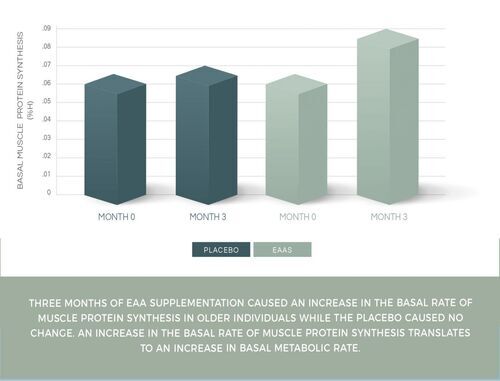
1. Supplementing your diet with EAAs has been shown to increase the basal rate of muscle protein turnover. More energy is used to fuel the increase in muscle protein turnover, thereby giving a persistent “boost” to your metabolism. Check out the results in the figure below.
2. The second aspect of increased dietary protein and EAA intake boosting your metabolism is their influence on diet-induced thermogenesis.
Your metabolic rate goes up about 10% for a couple of hours after you eat a meal containing dietary protein or you consume an EAA supplement. The amount of increase depends on how much protein you eat with the meal or how many grams of EAAs you take. This response has been studied for many years and is called diet-induced thermogenesis.
Diet-induced thermogenesis refers to energy lost as heat after you eat protein. Diet-induced thermogenesis is only activated by dietary protein or EAAs, as neither dietary carbohydrate nor fat have much effect on metabolic rate. When you consume dietary protein or an EAA supplement, your metabolic rate increases because energy is used to digest the protein and absorb the resulting amino acids. A meal containing dietary protein or an EAA supplement increases the metabolic rate by stimulating the rate of protein synthesis in the body, particularly in muscle, since the process of synthesis requires energy.
Diet-induced thermogenesis of dietary protein actually lessens the caloric impact of protein. Calories are classically determined by combusting the food source in a device that measures the energy released. In the case of protein, 4 kcal/g of protein are normally released by combustion, so the caloric-equivalency of protein is traditionally 4 kcal/g. In other words, you can calculate how many protein calories are in a meal by multiplying the grams of protein by 4 kcal/g. However, since the digestion of protein increases metabolic rate approximately 10%, the net caloric intake from the protein component of the meal is actually 10% less than determined by the traditional approach, or 3.6 kcal/g.
Why not just stimulate diet-induced thermogenesis with dietary protein? Because consuming EAAs increases protein turnover more than any dietary protein can, and therefore EAAs have a greater impact on diet-induced thermogenesis. Take a look at the following figure.

EAAs require less work in the intestines to be absorbed, so it may take less energy for the body to digest EAAs than it does for the body to digest intact protein on a gram-per-gram basis. Even so, EAAs stimulate protein synthesis about three times more than intact protein does, and, therefore, cause a greater increase in diet-induced thermogenesis.
The stimulation of protein synthesis by the ingestion of EAAs is an entirely natural biological process without any known adverse effects. Long-term consumption will result in an increase in muscle mass and other health benefits, including a boost to your metabolism, not possible with drug therapy.
AGING - MUSCLE LOSS -DISEASE ARE YOU AT RISK LEARN MORE