x






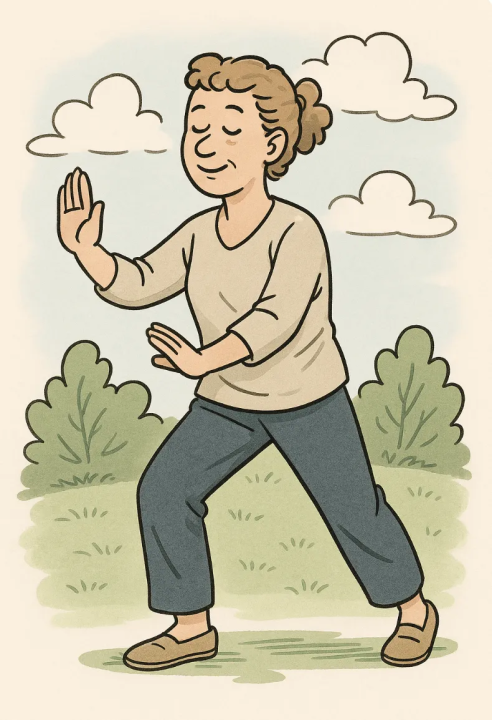
In 2023, a group of researchers ran a clinical trial that puzzled even the scientists running it. The participants were older adults living with Type 2 diabetes and mild memory loss, a combination known to speed cognitive decline. The research team expected a walking program to help. Walking boosts blood flow to the brain, strengthens the heart, and improves insulin sensitivity.
But something unusual happened.
Half of the participants were assigned to brisk walking. The other half practiced a gentle routine of slow, circular movements that looked almost too easy. The researchers thought the walking group would come out on top.
Thirty-six weeks later, the data told a different story.
The group doing the slow movements — Tai Chi — scored higher on tests of memory and thinking. Their global cognition scores improved more than the walkers’, despite the lower intensity of the movements. They also performed better on executive function tests, which measure working memory and problem-solving skills (functions controlled by the brain’s frontal lobes).
A low-intensity practice had outperformed a classic aerobic exercise.
This unexpected result lit a spark. Scientists began asking a new question:
How can something so gentle act like medicine?
That question has now been explored across dozens of conditions, from arthritis to COPD to depression. And the same pattern keeps showing up: Tai Chi quietly improves systems of the body that, until recently, were thought to require vigorous exercise or medication to change.
Lets walk through the science of what happens inside the body when it moves slowly with intention.
Most people think of exercise as something sweaty, pounding, or fast. Something that makes you breathe so hard you can’t talk. Tai Chi doesn’t look anything like that. Movements are slow. Breathing is calm. Many older adults do it in regular street clothes.
Yet study after study shows clear physical change.
Tai Chi trains balance by asking the body to shift weight in a controlled, deliberate way. Over time, this strengthens the stabilizer muscles around the ankles, knees, and hips. These muscles help you stay upright when you’re bumped or lose footing.
In a 2023–2024 group of trials, Tai Chi reduced fall risk by about 24% and improved the Timed Up-and-Go test, a standard balance test, by nearly a full second. For older adults, a one-second improvement can mean the difference between catching themselves and hitting the floor.
People with knee osteoarthritis often struggle with stiffness and pain caused by worn cartilage. Tai Chi helps by strengthening the muscles that support the knee and improving joint position sense, the brain’s ability to tell where the leg is in space.
Across 13 trials, Tai Chi reduced knee pain and improved physical function. The longer people practiced, the greater the improvement. In some groups practicing three times a week, the reduction in pain was almost twice as large as shorter programs.
Lower-back pain shows a similar pattern. A network meta-analysis compared many types of exercise and found Tai Chi ranked at the very top for improving chronic low-back pain: above core exercises, Pilates, stretching, and aerobic exercise. Researchers believe the slow rotation of the trunk and pelvis strengthens deep core muscles that protect the spine under daily stress.
In COPD, the airways narrow and the lungs lose elasticity. This makes breathing feel like trying to inhale through a straw. Tai Chi teaches deeper, slower breathing that uses the diaphragm (the main breathing muscle) more effectively.
A 2024 review of over 1,000 COPD patients found that Tai Chi improved FEV₁ (forced expiratory volume in 1 second, a key measure of lung function) and increased walking endurance on the Six-Minute Walk Test. These gains suggest the lungs became more efficient and the muscles involved in breathing strengthened over time.
Tai Chi does more than move the body. It also trains the mind to focus on each shift of weight, each rotation of the spine, and each controlled breath. This combination activates many areas of the brain at once.
Several clinical trials show that Tai Chi reduces symptoms of depression — in some older adult groups, the improvement was large enough to be noticeable in daily life. In one 2023 review, long programs (24 weeks or more) produced the biggest shifts in mood.
Scientists think this happens because Tai Chi lowers cortisol, the body’s main stress hormone, and increases vagal tone, a measure of calm activity in the nervous system that helps regulate the heart, digestion, and emotional response.
People with insomnia often feel “tired and wired,” exhausted but unable to settle their nervous system. Tai Chi’s breathing and slow pacing help quiet this internal alertness.
Across trials of older adults, Tai Chi improved total sleep quality on the Pittsburgh Sleep Quality Index. Programs lasting eight weeks or longer created the biggest changes in feeling rested during the day.
The diabetes and mild memory loss study mentioned earlier is part of a growing body of evidence. Tai Chi seems to improve blood flow to the brain, support areas involved in memory, and strengthen networks responsible for attention.
In imaging studies, people doing Tai Chi show more connectivity in brain areas that coordinate movement and planning. This may explain why Tai Chi practitioners often perform better on tests of executive function after several months of practice.
If the phrase “medicine in motion” sparked something in you, a sense that healing doesn’t always have to be hard or punishing, the next section will give you the deeper understanding you’ve been looking for.