x






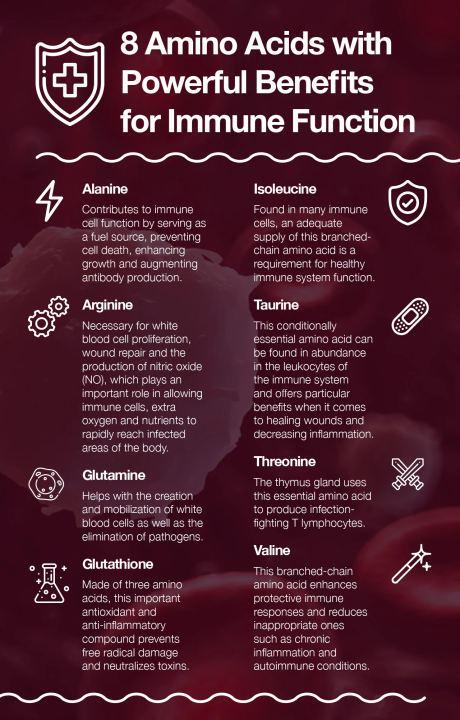
Proper nutrition is a must for a strong immune system. Immune-boosting vitamins like zinc, copper, B vitamins, and iron are some of the key micronutrients that help keep immune function running at full strength. In fact, many multivitamins are marketed as “immune system boosters.” The most important nutrient for optimal immune function, however, may be protein. If you're interested in optimizing the way your immune system responds to threats, however, it's vital that you understand the connection between amino acids and immune function.
Studies of malnourished children in developing countries have demonstrated the strong link between protein intake and immunocompetence, or the ability to fight off infection and disease. Most components of the immune system defense arsenal are proteins, so it's only logical that in order to have an immune system that operates at peak capacity, the building blocks for these proteins, amino acids, must be in plentiful supply.
Before delving into the relationship between amino acids and immune function, let's take a moment to review some basics about the immune system itself.
Chances are, you have a basic grasp of the role of the immune system: it prevents you from getting sick. To get a bit more precise, a well-functioning immune system protects the body from the threat posed by infectious agents such as bacteria, viruses, fungi, parasites, and other noxious invaders.
All the cells of the immune system originate in the bone marrow, whether they go on to circulate through the bloodstream, disperse to other locations throughout the body, or develop into the lymphoid organs: the thymus, spleen, and lymph nodes.
The immune system has what can be thought of as two different modes: innate immunity and acquired immunity (also called specific or adaptive immunity). Both modes involve the same collection of immune cells described above, but it's important to differentiate between the two.
Innate immunity functions as the first line of defense against infectious agents. Its primary purpose is to prevent those pathogens from entering the body, and, if they do manage to enter, swiftly disposing of them. Often, this involves an inflammatory response in which compounds called prostaglandins to cause blood vessels to dilate so that blood flow to the infected area can increase.
The innate immune system also relies on physical barriers and blood-borne defenders such as cytokines and a type of white blood cell called leukocytes. Phagocytes, the most abundant of the many types of leukocytes, specialize in physically engulfing infectious organisms, a process known as phagocytosis, then destroying them using naturally generated toxic chemicals, such as superoxide radicals or hydrogen peroxide. Natural killer cells, another key element of the innate immune response, use a similar process to destroy pathogens.
The central difference between innate immunity and acquired immunity is that the innate immune system has no memory and does not alter its response based on prior exposure to a specific pathogen. The innate immune system takes on invaders first, but the acquired immune system is both more powerful and more flexible.
The acquired immune response relies on cells called lymphocytes, specifically B cells and T cells, each of which responds specifically to a single pathogen. Lymphocytes remain active for some time after they first detect a threat, which allows for the development of immunological memory. This lays the foundation for a fortified, more effective immune response when facing off against a pathogen it has encountered before.
Infectious invaders carry with them substances known as antigens. Lymphocytes recognize pathogens based on these antigens. B lymphocytes carry antibodies on their surfaces that bond to the antigens on invaders to form an antigen-antibody complex. Once the B cell processes this complex, it displays certain proteins which attract matching helper T cells that release chemicals called lymphokines. The lymphokines, in turn, signal the B cells to release a flood of antibodies into the bloodstream where they then bind to invaders, marking them for phagocytosis or destroying them on the spot. This is known as the humoral immune response.
Some infection agents, viruses in particular, enter directly into the cells of the human body, thus escaping detection by the antibodies B cells release into the bloodstream. The acquired immune system deals with these via a process called cell-mediated immunity. T lymphocytes confer this immunity. Infected cells signal to T lymphocytes by expressing peptide fragments derived from the invader in conjunction with proteins called the major histocompatibility complex (MHC) on their surface.
The acquired and innate immune systems communicate via cell-to-cell contact as well as the use of chemical messengers, chiefly cytokines. When everything works as it should, the systems carry out different tasks while working closely together.
Both the innate and acquired immune system need soluble substances found in the blood and other bodily fluids. According to a study done by the Institute for Quality and Efficiency in Health Care (IQWiG) in Cologne, Germany, "These are mainly proteins like enzymes, antibodies and short amino acid chains."
Proteins are of particular importance to the complement system, a part of the immune system made up of a group of proteins found in the blood that are critical in the defense against infection. Producing these specialized cells and proteins requires an abundant supply of amino acids, some of which must come from the diet. When the immune system can’t keep up with the production of these molecules, we become vulnerable to many health problems and diseases.
While very few people in the United States are “protein-malnourished,” many people may not be consuming enough high-quality proteins to obtain the amount of essential amino acids needed for optimal nutrition.
Dietary protein is broken down to provide amino acids. Essential amino acids are those that cannot be made by the body and therefore must be obtained from the diet. Nonessential amino acids can be synthesized in the body. However, under conditions of stress when the immune system is challenged, the body cannot keep up with the demand for certain amino acids so they are considered conditionally essential in that dietary sources are required to meet the demand.
As touched on previously, dietary protein deficiencies have long been known to impede immune function. Over the last decade and a half, scientists have begun to investigate the cellular and molecular mechanisms underlying the influence of protein on the immune system.
One of the most thorough inquiries into the link between amino acids and immune function, published by the British Journal of Nutrition, noted that recent studies show amino acids play several important roles in immune responses. They:
The article, authored by Drs. Peng Li, Yu-Long Yin, Defa Li, Sung Woo Kim, and Guoyao Wu, gives a comprehensive look at the evidence supporting the beneficial effects of dietary supplementation of amino acids on immune function. It appears that functional amino acids and sulfur amino acids in particular can enhance immune status.
Like all other cells, the cells that make up the immune system require energy. In fact, when immune system cells are challenged by a pathogen or disease, they require lots of energy in a hurry.
Mitochondria are the engines of cells and produce the energy needed to support all cellular functions. Balanced mixtures of essential amino acids have been shown to increase mitochondrial number and function. Studies show that when essential amino acids are consumed, they stimulate the production of mitochondrial proteins (a process called mitochondrial protein synthesis) including the production of enzymes that contribute to immune system functions. Amino acids help improve mitochondrial function by increasing the available number of enzymes involved in energy production.
If essential amino acid concentrations fall below the appropriate level, the number of mitochondria and their ability to work at full capacity is compromised. This energy shortage limits the ability of the immune system to keep producing all the cells needed to fight off the threat presented by pathogens and disease.
Beyond serving as the fuel source to build up and support the defense system arsenal, mitochondria also get directly involved in killing off infected cells and helping to coordinate signals and messages sent out by the immune system. Nutrients that support mitochondria, therefore, help to improve immune function.
The authors of the British Journal of Nutrition study cited earlier also state that advances in our comprehension of amino acid metabolism in leucocytes will likely prove critical to the development of effective methods for preventing and treating diseases linked to immunodeficiency. They concluded that amino acids "hold great promise in improving health and preventing infectious diseases.
A strong immune system is the key to staying healthy, and the key to a strong immune system is proper nutrition with nutrient-dense foods and high-quality proteins and amino acids.
While specific amino acids have been shown to be particularly useful when it comes to enhancing immune function, the British Journal of Nutrition article explains that care must be taken when supplementing due to "the negative impact of imbalance and antagonism among amino acids."
In simple terms, taking a well-formulated essential amino acid supplement will likely result in greater benefits for immune function than the use of a single amino acid supplement would. The effective use of amino acid supplements for immune support will consider the biochemistry and physiology of amino acids, their roles in immune responses, the nutritional and pathological states of individuals and expected treatment outcomes.
Learn More: www.drinkbc6.com