x





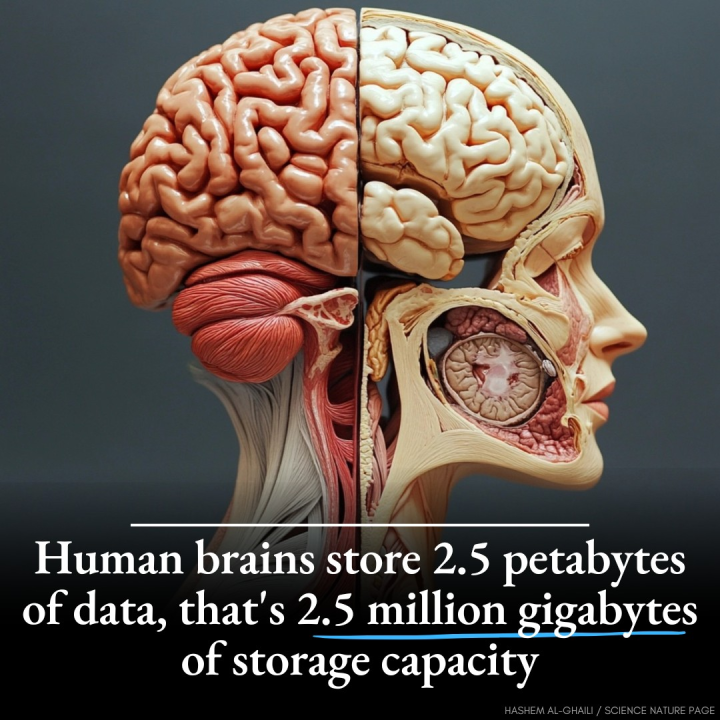
This storage capacity comes from the synapses between the neurons in the brain. Synapses are responsible for transmitting messages between neurons.
This storage capacity comes from the synapses that are happening between the neurons in the brain. Synapses are responsible for transmitting messages between neurons.
On average, the brain consists of 86 billion neurons that make up over 100 trillion connections. In other words, each neuron is capable of forming around 1,000 connections, which translates to 1,000 potential synapses.
There are around 125 trillion synapses in the brain. Each synapse can store up to 4.7 bits of information.
Scientists hope to use this knowledge to build energy-efficient computers that rely on deep learning and artificial neural networks to process and store data. Information storage is not limited to the brain.
In fact, your DNA can also store data. DNA could store all of the world's data in a single room, making it a powerful way to store information in the future.
A single gram of DNA can store up to 215 petabytes, which is equivalent to 215 million gigabytes of data. Scientists are now able to convert digital content into information that can be stored in DNA. In a recent study, researchers encoded a 52,000-word book in thousands of snippets of DNA.
They first converted the book into binary code with 0s and 1s and then stored this information using DNA’s four-letter alphabet of A, G, T, and C