
x
Black Bar Banner 1
x

NEW: About Me Look — turn on a full-width dark About Me from your profile Configuration (Profile Page Upgrade). The Academy, profile feeds and Media Feed now read like the News Feed. See Subscriptions »

New: AI Blog Autopilot — free for the next 30 days. Switch it on by November 15th »

NEW: Smart Mail is live — free for every member. Send broadcasts, build lists and run autoresponders. Open Smart Mail »

New training: The Campaign Map. Watch it now »

A+ A−
Ads by Markethive - View All
The Blog Feed
The Blog Feed
» Blog Feed
Write a New Blog Post
Search Blog Status
Most Viewed
Most Recent
Most Shared
Alphabetical
Markethive Blog (default)
My Blog Posts
Friends' Blogs
Blog Categories
All
Advertising
Blockchain & Cryptocurrency
Business Development
Diet & Weight Loss
Environmental
Health and Wellness
History and Culture
Home and Garden
Marketing
Mentoring & Training
Money & Finance
Other
Political
Prayer & Religion
Programming & Technical
Real Estate
Search Engine Optimization
Social Media
Spirituality
Sports & Recreation
Transport
Travel & Events
Website Design
Blogging Tools & Assets
My Blog Info
Members Subscribed to You
Blogs You Are Subscribed To
Website Widget
Wordpress Plugin
Subscribe for Greater Services
Subscribe to one of many subscriptions, each one includes the previous ones.. Unlock powerful tools, advance features, to build a powerful reach.

Skin Cancer What You Need To Know

Posted by Bobby Brown on March 26, 2020 - 4:06pm


What You Need to Know About Skin Cancer


Skin cancer is the most common type of cancer in the United States and the most treatable, if caught early. There are several types of skin cancer. We talked to dermatologist James DeVito, MD, of Sky Ridge Medical Center in Lone Tree, Colorado, to get the facts about skin cancer.

Types and symptoms

  • Basal cell carcinoma: The most common type of skin cancer, basal cell carcinoma (BCC) usually looks like pearly, shiny bumps. According to the American Cancer Society, roughly 8 out of 10 skin cancers are basal cell carcinomas.
  • Squamous cell carcinoma: Squamous cell carcinomas (SCC) are the second most common type of skin cancer. They’re usually rough and crusty and may look like a bug bite or pimple.
  • Melanoma: This type of cancer causes only about one percent of skin cancers but it is the most deadly, responsible for the majority of skin cancer deaths. It’s usually brownish in color and looks like a mole, often with irregular borders. “Melanoma has the tendency to spread throughout the body. That’s why it’s so deadly,” explains Dr. DeVito.

Actinic keratoses are dry, scaly patches that are considered precancerous. If left untreated, they may become SCC.

Risk factors
“We know that all of these cancers occur by ultraviolet exposure, and there’s clearly a genetic risk factor,” says DeVito. Natural sunlight and tanning beds both increase the risk of skin cancer. In addition, if you have fair skin, red or blonde hair, blue or green eyes or have irregular moles, you may be at increased risk of skin cancer, as is anyone who sunburns easily or had blistering sunburns as a child or teen. Having a family history of melanoma also increases your risk of skin cancer.


Diagnosis
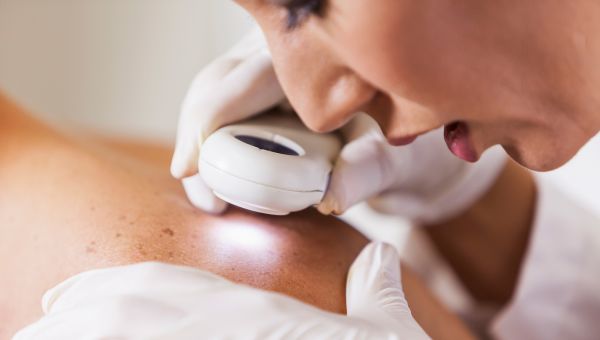
“Most of the time, we can diagnose skin cancer clinically, pretty much by looking at it,” says DeVito. But, doctors will perform a biopsy to find out for sure if the mark or lesion is cancerous.

If you notice a suspicious looking mark or mole on your skin, see your doctor. “We want patients to be on the lookout for moles that look different,” says DeVito.

Follow the ABCDEs at home to check yourself for melanoma: asymmetry, irregular borders, a variety of colors, a larger diameter, and evolution over time (does it change?)

Prevention
Limit sun exposure and avoid tanning beds. When you’re outside, use a physical sunscreen—that’s one that has either zinc oxide or titanium dioxide—of at least SPF 30, which can help protect again 97 percent of the sun’s rays. “I prefer 45,” DeVito says. “When the numbers get higher than 45 I don’t think they make much of a difference.” And, get annual mole checks, either by your primary care provider or dermatologist.

Treatment
Most skin cancer is surgically treated, says DeVito. BCC and SCC are sometimes burned off if it’s small enough, and topical treatments are available as well. In addition, SCC may be treated by freezing, phototherapy or laser therapy. After surgery, melanoma may be followed up with radiation or chemotherapy

Take Control Of Your Health  Learn More