x







Having a tight lower back isn't just a matter of discomfort: if your muscles are tensed and kinked, it means they aren't working properly to keep your bones and balance in line. Not only does alleviating lower back tension help increase your comfort, but it can also help prevent debilitating back injuries before they occur. Read on to find out what causes tightness in your lower back, plus 10 safe lower back stretches you can utilize to ease the tension and find pain relief.
The lower back is one of the most vulnerable parts of the body. Evolutionarily, while our brains are marvelously protected by the skull, and our most vital organs (the heart, lungs, and liver) are caged in by our ribs, our lower torso and lower back are practically wide open. This is a side effect of early man standing upright while our ape ancestors still move around on all fours. We gained the opposable thumb, but now all the weight of our brains and organs rests on one column of bone, nerves, and muscle tissue located in our lower back.
If we still walked on our knuckles, lower back pain and injury wouldn't be one of the leading causes of workplace and household harm, but since science is all about moving forwards, not backwards, let's talk about what might be holding us back.
There are many places where you may be getting improper lower back support, including:
There is a reason physical therapists and personal trainers cost a pretty penny: expert knowledge of anatomy helps them see from where your muscle pain is arising and how best to fix it. When most of us have lower back pain, we assume something is wrong with our lower back, but it could be a matter of having one leg shorter than the other, a tightness in our shoulders that's causing a misalignment, or just bad movement habits we've picked up along the way.
Guided exercise can relieve tight lower back pain that already exists and help prevent muscle tension and sprains we don't even know are on the inevitable horizon. Taking a fitness class or consulting a trainer could be all the diagnosis you need to fix chronic lower back pain if it's caused by inexpert exercise practices. Just remember: there's no shame in being wrong when you start out with fitness: every expert trainer was once a beginner too.
Some people use their lower back far more than the rest of the populace. If you're a mover or warehouse worker, you probably already know to wear a back brace and lift with your knees, but some injuries will surprise you regardless. If you're a medic, rescue worker, or homecare nurse, you may be called on to lift another person out of a dangerous position (a patient in a car wreck for example, or someone who's fallen in the enclosed space of a bathroom). And what about athletes who have to quickly contort their bodies in reaction to the games they engage in? Some careers and activities make your lower back more susceptible to injury than others.
One tweak or muscle strain can linger if you don't have time to rest the injury properly, and reinjury on top of that becomes more and more likely with each day. While not everyone can take the recommended time off to heal and rest, proper stretching can help a sprain heal faster and loosen the area so that reinjury is less likely to occur.
You may recognize a tight lower back by these tell-tale symptoms.
Some soreness after working out or doing some heavy lifting is to be expected, but if the pain doesn't subside after a few days, you may be looking at a more persistent injury that needs to be handled with care lest it gets worse.
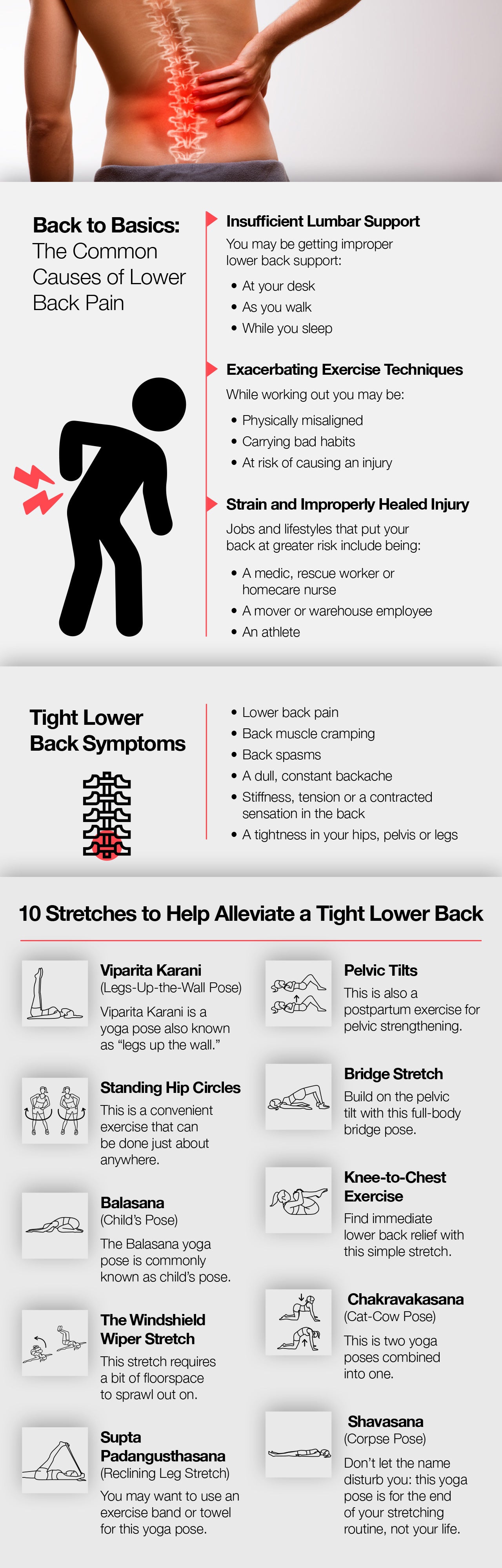
Here are some simple exercises and stretches you can do to increase your back's flexibility and loosen up lower back tension, from hips to hamstrings and more. It's important to help straighten the hips and the spine, and strengthen the legs as well, so we've covered all the bases when it comes to tight lower back pain relief.
Viparita Karani is a yoga pose also known as "legs up the wall" because, well, you rest your legs up against the wall. It engages your pelvic muscles, lower back, and the back of your neck, but primarily provides a deep stretch for your hamstrings and relaxes your lower back and pelvis.
This is a convenient exercise that can be done anytime and just about anywhere (before bed, upon waking, on the elevator, during a bathroom break, etc.), and targets the abdominal muscles, the erector spinae muscles (the ones that run the length of your spinal column), your pelvic muscles, and gluteal muscles. It helps to loosen your hip muscles and engage your core muscles for a nearly full-body stretch.
The Balasana yoga pose is more commonly known as child's pose. It stretches your hamstrings, your gluteus maximus, your spinal extensors, and your posterior muscles. By taking the pressure off your lower back, you can experience immediate relief and help stretch and lengthen.
This great stretch needs a bit of floorspace to sprawl out on, but it can beneficially impact the sacral muscles (at the base of the spine), the pelvic muscles, the erector spinae muscles, and your obliques.
This yoga pose involves your lower back, hamstrings, erector spinae muscles, abdominal muscles, and gluteus maximus. It also helps align the spine.
This exercise focuses on your abdominal muscles and increases flexibility in your lower back region, as well as your hamstrings, sacral muscles, and gluteus maximus.
Not unlike the pelvic tilt, the bridge stretch can build up strength in your quadriceps, hamstrings, and gluteus maximus.
This stretch utilizes the quadriceps, pelvic muscles, spinal extensors, and gluteus maximus to help loosen up your lower back muscles.
This is two yoga poses in one, combined to help stretch and flex the spine, hips, and abdomen. It engages your core muscles, specifically your abdominal muscles, erector spinae muscles, gluteus maximus, and triceps.
Don't let the name disturb you. This yoga pose is the end of the line for your stretching routine, not your life. It's designed to let your body rest and relax after all this productive stretching, and gives you a moment to release any remaining tightness or tension throughout your body.
A tight lower back can be caused by anything from poor posture to tight hamstrings or weak core muscles. Regardless of where the tension originates, you can address it with the above-listed stretches.
If for any reason stretching leads to more pain and not less, consult a fitness or chiropractic professional to get specific advice on your technique, to receive physical therapy, or to seek medical advice for any underlying issues (like arthritis, sciatica, a slipped disk, osteoporosis, etc.) that are causing your back problems in the first place.
With the right exercise routine, many people can loosen up a tight lower back, and subsequently sleep better, work better, and play better every day of the week. You can also help support healing, the right way, with a recovery blend of essential amino acids proven to improve rehabilitation outcomes. Get the scoop here.