x




When a young man or woman decides to build muscle, it often takes no more effort than just trying. Some weight lifting, some cardio, and before these youngsters know it they've got muscle groups popping up in places they didn't even know they had. But for older adults, building muscles is not just about losing weight and looking good, muscle gain starts to become vitally important to staying healthy and independent as we approach our 60s, 70s, 80s, and 90s.
As you age, not only do your joints creak and your hairs turn gray, but your muscle cells start to get eaten up and then not replaced. The younger we are, the more quickly the metabolic process revolves between catabolism (metabolism involving molecular breakdown to access energy) and anabolism (the metabolism of building new complex molecules like muscle proteins with that energy). When we get older, that process—along with so many others—slows down.
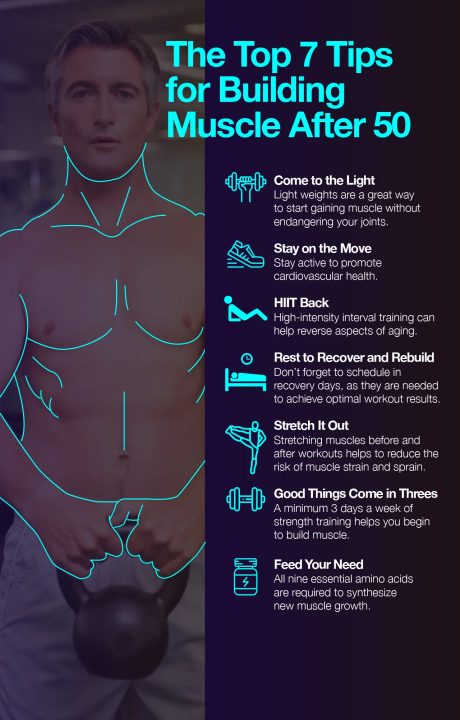
Reaching 50 is ideally the halfway point of a long and healthy life, and maintaining muscle strength is important if we want another strong 50 years on this earth. So without further ado, here are seven ways you can optimize your protein intake and start building muscle after 50.
If you want to safely begin to build muscle after years of a largely sedentary lifestyle, you don't want to head straight to the bench press. It's not fun but it's true: a twinge or a tweak to any one of your joints in these early days could snowball into a very severe injury if you're not careful, derailing your efforts before you even really get going. You'll get to the deadlifts and barbells soon enough after you've built up sufficient strength, but when starting out, start light.
Embracing lighter free weights can spur muscle growth without putting your wrist, elbow, and shoulder joints in any risk whatsoever. Studies show that more reps with lighter weights can stimulate protein synthesis just as well as lower amounts of reps with heavier weights. Lighter-weight training not only helps prevent initial injuries, but it also serves as a useful tool for repairing injuries. Similarly, higher reps with lighter weights leads to real muscle gain in older adults, so the only thing you're losing out on is risk, not reward.
Once you build up a foundation of muscle, you and your joints will be strong enough to load up a barbell with ever-increasing weights, but as you begin, light is alright. Play to your strengths when it comes to strength training, and you'll invariably improve as you age.
A sedentary lifestyle is dangerous to people at any age, but the damage done by inactivity compounds as we get older. To gain muscle, you have to not only incorporate a strength training program but also keep up with cardiovascular health. If your blood isn't pumping well, you're not getting the steady supply of oxygen and nutrients needed to build new protein for your muscles.
The cardio impact of walking and running changes in older adults, as seen in this 2010 study comparing younger (24 +/- 3 years) and older (64 +/- 6 years) participant groups. If you're starting from scratch, begin with walking, increase to jogging and then treat yourself to new pair of running shoes, and know that you're contributing to your muscle-building efforts with every new mile you cover.
High-intensity interval training (HIIT) is a great way to burn calories and build muscle quickly for all ages and fitness levels. HIIT is characterized by alternating short bursts of intense physical activity with periods of rest, and according to the Mayo Clinic, it can particularly benefit seniors down to the cellular level, and even reverse certain symptoms of aging.
While experts don't recommend that every workout be a HIIT workout, cycling it into your workout regimen can help push your abilities to higher heights. And if you're in a HIIT class full of athletes, just remember that your high intensity is different from their high intensity, and that's a-okay!
Regular exercise doesn't mean constant exercise, and in fact research shows that rest days are just as valuable for muscle building as workout days are. Recovery time means rebuilding time for your muscles, while overtraining syndrome occurs when excessive exercise is paired with an inadequate amount of resting time. The results of overtraining come with side effects that disturb the body's neurologic, endocrinologic, and immunologic processes, along with the unwelcome symptom of mood changes.
Your recovery times over 50 may be longer than they would be if you started working out in your 20s or 30s, but you'll know your body best: rest as long as you need, and then get back at it with the gains you've made.
If your muscles are tight, it's imperative that you stretch them. Stretching before (particularly dynamic stretches) and after your workout helps to limber up the muscle fibers and reduce the risk of muscle strains and sprains, whether you're working out on your own or under the guidance of a personal trainer.
A full-body workout is not complete without stretching, so be sure to pencil it in, as increased flexibility can help you avoid injury and perform better in your workouts.
Have you heard of the rule of thirds? It's a photography guideline for visually pleasing picture compositions. Do you know what "omne trium perfectum" means? It's Latin for "everything that comes in threes is perfect." Those rules apply to your strength-training workout frequency too: 3 days a week is a perfect minimum.
While the more's the better, especially if you're diversifying your workouts (lift weights on one day, go for a run on the next, etc.), it's nevertheless true that strength training at least 3 days a week can lead to good progression in muscle building and is a great place to start.
You cannot make muscles without protein. More specifically, you cannot synthesize new muscle protein without a proper amount of all nine essential amino acids. Most people looking to build muscle know that a high-protein diet and possibly consuming whey protein supplements will help them in gaining muscle, but just because you're getting enough protein doesn't necessarily mean you're getting all the amino acids required to build lean muscle without your body cannibalizing the other muscle cells you have to supply the demand.
Research shows that consuming protein regularly throughout the day and especially after a workout helps stimulate muscle protein synthesis to its optimal degree in elderly people who are well advanced beyond age 50.
Building muscle mass is far from being a young person's game: it's everyone's game to play and to win. While it's important to start cautiously if you've never worked out before, it's never too late to start building muscle, and the more you gain, the younger you'll feel, as it's been scientifically proven that proper fitness can reverse certain aspects of the aging process.
The health benefits of building muscle after 50 go far beyond improving your body weight and maintaining a trim physique. The strength-training efforts you start today can help you lose weight and, according to the American Bone Health organization, also help improve your bone density, which will matter more and more in the coming decades. Lifting weights or engaging in HIIT exercises 3 times a week could mean staying strong for the rest of your life. LEARN MORE