x






Let’s play a quick game.
Close your eyes. Now touch your finger to your nose.
Didn’t miss?
Congratulations. Your proprioception works.
Don’t worry…we’ll explain what that is in a minute. But first, let’s get one thing straight:
If you’ve ever caught yourself from tripping, walked across a dark room without crashing into a lamp, or climbed stairs without looking, you’re not just lucky.
You’re running a 24/7 invisible navigation system.
It’s time you met it.
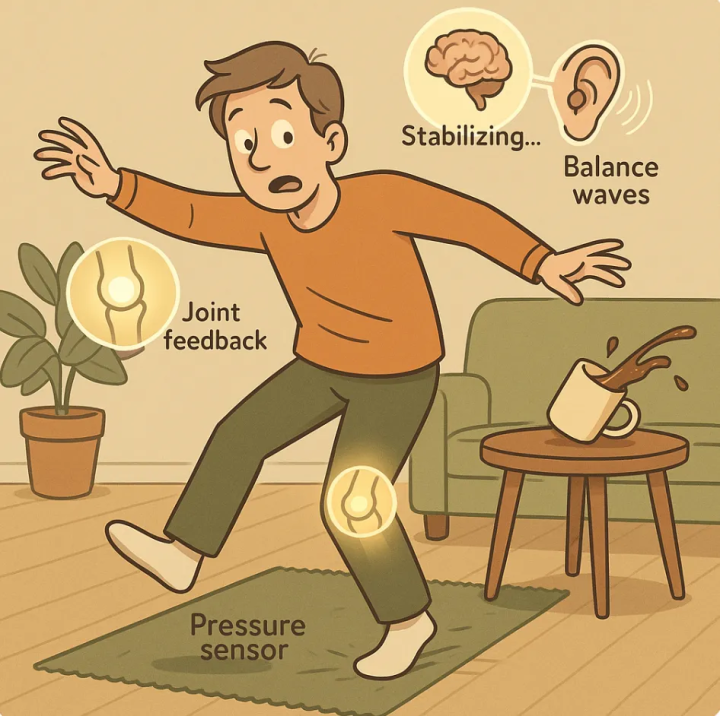
Proprioception is your body’s “Where am I?” sense. It tells your brain where your arms, legs, joints, and muscles are without needing to look.
You don’t see your foot land.
You feel it.
You don’t watch your fingers type.
You just type.
Proprioception is like your body’s internal GPS, updating your position, posture, and movement every split second.
It’s what lets you scratch an itch behind your ear, duck under a low doorway, or grab a falling phone midair. It’s also what saves you from embarrassment, injury, and, occasionally, death by laundry basket.
Balance doesn’t come from your core alone. It’s the result of three systems working together like a crack security team:
Eyes: Keep tabs on your surroundings.
Inner Ear: Detect tilt, spin, and acceleration.
Proprioceptors: Monitor your body’s position, pressure, and movement.
When they’re in sync, you move like a ninja.
When they’re not, you move like your uncle after two beers at a wedding.
Now saw an inch off one leg
.
It still stands. Sort of.
Saw another inch? It wobbles.
One more? It tips. You fall. And probably blame the rug.
That’s how balance slips away, quietly. Until one day, it doesn’t.
But over time, it erodes. Why?
You sit too much. Chairs don’t challenge balance.
You stop moving in weird ways. No more tree climbing, hopping fences, or chasing soccer balls barefoot.
You get injured. An ankle sprain is like breaking the antenna on your body’s radar.
You age. Sensors get dull, signals slow, reflexes lag.
You avoid risk. And ironically, that’s the riskiest move of all.
Like a muscle, if you stop using your proprioception, it stops showing up.
Yes. And guess what… you don’t need to lift weights or run marathons.
To rebuild proprioception, you do something radical:
You wobble. On purpose.
You challenge your balance. You flirt with instability. You force your body to say, “Whoa! What’s happening here?”
That’s how it learns again.
Proprioception thrives on variety, novelty, and small chaos.
Tightrope walkers don’t stay balanced by being still. They stay balanced by constantly correcting.
Little shifts. Tiny tweaks. Micro-adjustments every millisecond.
You want to become one of those people, the kind who can step on a pebble and not flinch, turn quickly without toppling, or navigate an icy sidewalk with the grace of a penguin in snow boots.
That kind of movement requires proprioception.
And yes, you can absolutely train it.
Standing on one leg while brushing your teeth
Bonus points: close your eyes.
Walking heel-to-toe like you’re on a sobriety test
Sober or not, it’s harder than it looks.
Balancing on a cushion, foam pad, or sand
Your brain loves unstable surfaces.
Tai Chi or yoga with your eyes closed
Suddenly “Warrior Two” becomes “Wobble One.”
Catching or tossing balls while standing on one leg
Add movement. Add unpredictability. Add results.
Balance is not a luxury.
It’s a survival skill.
And proprioception is the silent partner that makes it possible.
Train it now, before gravity files a complaint.
www.superbrainpower.org