x





In exam rooms and lab reports across the country, a strange pattern keeps emerging.
A woman in her 50s walks in, proud of her recent weight loss. She’s eating clean, walking daily, maybe even skipping breakfast like the headlines suggest. Her BMI is “perfect.” Her clothes fit better. Friends say she looks great.
But her labs tell a different story.
Her blood sugar is creeping up. Her triglycerides are elevated. Her energy is down. And under the surface, something crucial is missing: muscle.
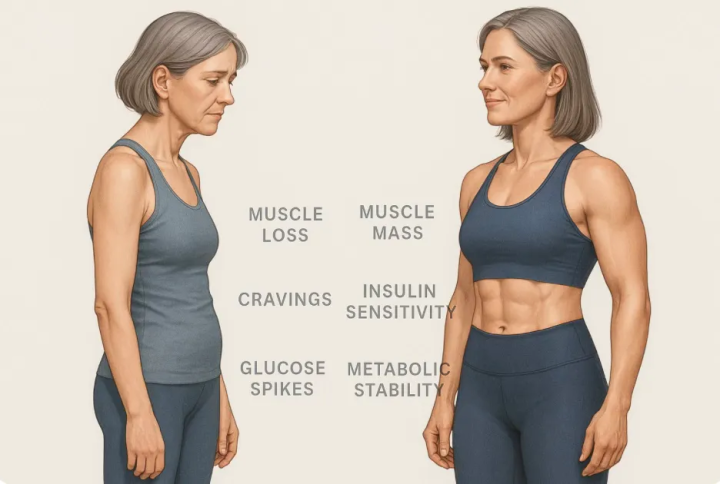
This is sarcopenic obesity, sometimes called ‘skinny fat’, a silent epidemic hiding in plain sight. It’s not about being visibly overweight. It’s about losing the very tissue that keeps you metabolically alive while still holding onto, or regaining, fat.
And it doesn’t show up on your bathroom scale.
The signs are easy to miss. There’s no headline that warns you. No calorie tracker that alerts you. You just slowly slip into a state where your body is lighter, but not healthier. You feel “successful” because you’re shrinking. But inside, your metabolic engine is breaking down.
Most people never see it coming. They follow the rules. Eat less. Move more. Chase the number on the scale. But over time, they trade away their engine (muscle) to lose the fuel (fat), and end up weaker, slower, and more insulin resistant than when they started.
And the worst part? This isn’t rare. It’s the norm in diet culture.
We’ve glorified weight loss without asking what we’re losing.
So you’ve started a new plan. Clean eating. Intermittent fasting. More steps, fewer snacks. The weight starts to drop—ten pounds, then fifteen. Compliments come rolling in.
But then, odd things start happening.
You’re tired. Always cold. Your sleep’s off. Your pants fit differently, but not in the “my glutes look great” kind of way, in the “where did they go?” kind. Your energy tanks. Sugar cravings creep back in. And the scale, once your friend?
Starts creeping up again.
Here’s what might’ve happened:
You didn’t just lose fat. You lost muscle.
And muscle isn’t optional, it’s one of your body’s core systems.
Muscle isn’t just for athletes or aesthetics. It’s the body’s most powerful metabolic organ, responsible for far more than strength or size.
It’s your glucose sink, both insulin-dependent and insulin-independent.
At rest, muscle uses insulin to absorb circulating glucose and store it as glycogen. But during exercise, something remarkable happens: muscle becomes insulin-independent, meaning it can pull glucose from the bloodstream without needing insulin at all. This is one of the fastest and most efficient ways to lower blood sugar and improve insulin sensitivity.
This makes muscle the only tissue in the body that can flexibly switch between insulin-requiring and insulin-free glucose uptake.
And that’s just the beginning. Muscle also:
Stores amino acids for tissue repair, immune function, and enzyme production
Burns more calories at rest than fat
Produces myokines, anti-inflammatory molecules that protect your heart, brain, and joints
Maintains posture, balance, and bone density, especially as you age
Starting around age 30, we naturally lose 3–8% of muscle per decade if we’re not actively preserving it. That rate doubles with inactivity or calorie restriction.
This isn’t graceful aging.
It’s unchecked muscle atrophy, and it affects everything from glucose control to longevity.
Fasting, calorie reduction, and movement are powerful tools. But they’re not foolproof.
When you cut calories, your body has to decide what to burn, fat, or muscle. And unless you’re lifting weights and eating enough protein, your body may assume the muscle isn’t needed.
So it breaks it down to harvest amino acids, especially if you’re regularly fasting more than 16-24 hours and not signaling to your body, through strength training, to keep the muscle.
That’s how people lose weight... and still end up with a slower metabolism, worse insulin sensitivity, and rebound weight gain.
You kept the fuel (fat), but lost the engine (muscle).
Your muscle is like that underappreciated team member who always shows up.
She soaks up sugar when you’ve had too much.
She burns fat when you need energy.
She stabilizes your joints and backs you up when life gets heavy.
But lately?
You’ve been skipping leg day.
And breakfast.
And protein.
At first, she hangs on. But over time?
She starts clocking out.
Soon, your cravings are higher, your balance is worse, and you can’t figure out why losing weight made you feel... weaker.
Because your body adapted to survive.
But not to thrive.