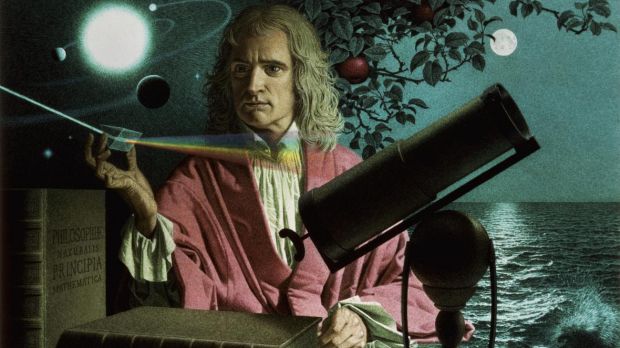
Although Isaac Newton is famous for his contributions to the development of the scientific world, the scientist seems to have had a number of secret obsessions with alchemy and some branches of theology, details that revealed another side of him and that came to light. only 200 years after his death.
A series of notes published for the first time show that Newton made several attempts to decipher some hidden codes in the Bible and to determine when the apocalypse will come. The personal notes were put up for auction by Sotheby's and include three pages in which Newton analyzes the Egyptian pyramids, under the impression that they hold the key to deep secrets. It will probably be sold at exorbitant prices of hundreds of thousands of euros, especially since they are the original copies that were saved, at the limit, from a fire caused by the scientist's dog.

"These documents are fascinating because among the lines you can see how Newton was trying to decipher the secrets of the pyramids," Gabriel Heaton, a manuscript specialist at Sotheby's, told The Observer. "It's a spectacular confluence that brings together Newton's personality and these incredible ancient objects that have fascinated people for millennia. The notes immediately give us clear clues about the deepest curiosities that preoccupied Newton ", he added.
The scientist studied the pyramids in the 1680s, during a period of isolation caused by criticism of his work by rival Robert Hooke. Newton was trying to discover the unit of measurement used by those who built the pyramids and believed that it was very possible that the ancient Egyptians were able to measure the Earth and that by finding the method used, he could determine the circumference of the Earth.
Thus, he hoped that he would be able to decipher other ancient measurements that would allow him to learn more about the architecture and dimensions of Solomon's Temple and to decipher the hidden meanings of the Bible.
Newton did not reveal to anyone his obsession with alchemy and various areas of religion outside the Orthodox spectrum, precisely because he feared that they would endanger his career.
Although his reputation is based on exceptional mathematical and scientific contributions, Newton and other areas of research were extremely important. A series of manuscripts also related to religion and alchemy were shown to the public at Sotheby's in 1936. Some of them were purchased by economist John Maynard Keynes, who described his idol, Isaac Newton, as "the last of the magicians."
Newton's descriptions, however, have varied over time. "He was an acid individual, always ready for a confrontation," Heaton said. Others categorized him as secretive, neurotic, vengeful, ruthless, arrogant, obsessive or even paranoid. "He liked to consider himself a new Messiah, the messenger of the universe to save the world," says Patricia Fara, a professor at Cambridge University.
In any case, Newton's genius is indisputable and, regardless of the field studied, he managed to always bring depth and complexity to the topics addressed.