x




Beyond UBI: Access Is Not Enough — Ownership Is Everything
There’s a quiet assumption behind Universal Basic Income that rarely gets questioned.
It sits beneath the headlines, beneath the policy debates, beneath the optimistic projections about automation and the future of work.
It says:
“If people have enough to survive, the system is working.”
At first glance, that sounds reasonable. Even compassionate.
After all, reducing poverty, eliminating financial anxiety, and providing a safety net for everyone—these are goals worth striving for.
But if we pause for a moment and look deeper, a more uncomfortable question begins to emerge:
Is survival really the goal?
Because survival has never been the true measure of a meaningful life.
People don’t aspire to merely exist.
They aspire to build, to contribute, to belong, and to have influence over the systems that shape their lives.
And that’s where the conversation around UBI begins to fall short.
UBI promises stability.
It offers predictability in an unpredictable world.
In an age where automation threatens jobs, where artificial intelligence is reshaping entire industries, and where economic inequality continues to widen, the appeal of a guaranteed income is obvious.
It reduces fear.
It creates breathing room.
It gives people the ability to make choices without immediate financial pressure.
And all of that has value.
But beneath those benefits lies something far less discussed:
UBI creates a ceiling.
Not an obvious one. Not a visible limit imposed by policy.
But a psychological and structural ceiling that defines the role of the individual within the system.
Because when income is provided without participation in value creation, something subtle begins to take shape:
You receive, but you do not shape.
You benefit, but you do not build.
You are supported, but you are not empowered.
Over time, this creates a quiet divide between those who design the system and those who live within it.
And that divide matters more than it appears.
It’s important to be clear:
UBI is not inherently “bad.”
In fact, in many contexts, it could serve as a powerful form of relief.
It could reduce extreme poverty.
It could stabilize communities in times of disruption.
It could provide a foundation during periods of transition.
But relief and transformation are not the same thing.
Relief addresses symptoms.
Transformation addresses structure.
UBI helps people cope with the system as it exists.
But it does not fundamentally change how value is created, distributed, or controlled.
And if the underlying structure remains unchanged, then inequality, dependency, and centralization will continue—just in a more softened form.
This is why UBI often feels like a solution, but behaves more like a buffer.
It absorbs pressure without redirecting it.
There is another layer to this conversation that rarely gets explored.
And that is the psychological impact of passive income systems.
When people are positioned primarily as recipients, it subtly shapes identity.
It shifts how individuals see themselves in relation to the economy.
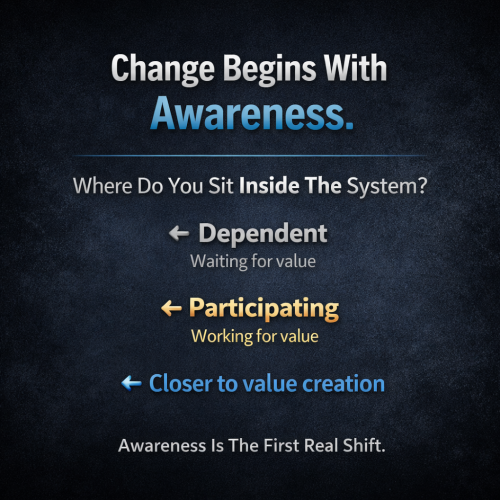
Instead of being active contributors, they become passive beneficiaries.
Instead of participating in value creation, they become dependent on value distribution.
This is not about motivation or work ethic.
It’s about positioning.
Human beings are deeply wired for participation.
We seek purpose through contribution.
We find meaning through involvement.
We build confidence through impact.
When those elements are removed or reduced, something important is lost—even if financial stability is present.
And over time, this can lead to disengagement.
Not because people don’t want to contribute…
But because the system no longer requires or rewards their participation in meaningful ways.
Now imagine a different model entirely.
Not one where value is generated in centralized systems and distributed outward…
But one where value is created through the network itself.
Where participation is not optional, but fundamental.
Where contribution—no matter how small—is part of the mechanism.
This is where Pool Funding introduces a fundamentally different perspective.
It is not designed as an income replacement.
It is designed as a participatory economic layer.
In this model:
There is no “outside” to the system.
There are no passive observers.
Everyone is part of the flow.
And that changes everything.
Participation is not just a functional difference—it is a psychological one.
Because when people contribute to something, they begin to feel ownership over it.
And ownership is one of the most powerful forces in human behaviour.
When people feel ownership:
Ownership transforms a system from something external…
Into something personal.
This is the key distinction:
UBI provides access.
Participation creates ownership.
And ownership leads to sustainability.
The language we use shapes the systems we create.
UBI defines individuals as recipients.
Even in its most optimistic framing, it positions people as beneficiaries of a system they did not build and do not control.
Pool Funding, by contrast, defines individuals as participants.
As contributors.
As co-creators of value.
This shift may seem subtle, but its implications are profound.
Because the future will not be shaped by those who simply receive systems.
It will be shaped by those who actively build, adapt, and sustain them.
And in a rapidly changing world, that distinction becomes critical.
One of the greatest challenges of modern economies is fragility.
Systems that rely on centralized control are efficient—but they are also vulnerable.
When disruption occurs, the effects ripple outward quickly.
We’ve seen this in financial crises, supply chain breakdowns, and global disruptions.
UBI attempts to address this by providing stability at the individual level.
But it does not necessarily increase resilience at the system level.
Participatory models, on the other hand, distribute both value and responsibility across the network.
This creates:
When many individuals contribute to a system, the system does not rely on a single point of failure.
It becomes more like an ecosystem than a machine.
And ecosystems are far more resilient.
Perhaps the most important shift of all is how we define wealth.
In traditional systems, wealth is something you accumulate.
It is measured by what you hold, control, or possess.
In participatory systems, wealth becomes something different.
It becomes something you help create.
It becomes embedded in relationships, in networks, in shared structures.
It is not just individual—it is collective.
And this changes how people think about success.
Instead of asking:
“How much do I have?”
The question becomes:
“How much am I contributing to something that grows?”
This kind of system would not have been possible at scale in the past.
But today, technology changes that.
Digital platforms, decentralized systems, and transparent tracking mechanisms allow participation to be:
This creates the possibility for entirely new economic models.
Models that are not controlled by a small number of institutions…
But are sustained by the collective activity of many.
This is not just an evolution of existing systems.
It is the beginning of something fundamentally different.
UBI is often presented as a solution to the future.
But in many ways, it is still rooted in the past.
It assumes a world where value is created in one place and distributed in another.
It assumes a separation between producers and recipients.
It assumes that stability comes from provision rather than participation.
But what if the future requires something else entirely?
What if stability comes from being embedded in a system you help sustain?
What if fairness comes from participation rather than redistribution alone?
What if the most resilient systems are not those that give the most…
But those that engage the most people in creating value together?
UBI may soften the edges of a system that no longer serves everyone.
It may provide relief during times of uncertainty.
It may even become a necessary stepping stone in certain contexts.
But it does not redesign the system itself.
And if we are serious about building a future that is fair, resilient, and truly human…
Then we need to go further.
We need to move beyond access.
Beyond passive support.
Beyond the idea that survival is enough.
We need systems that invite participation.
That create ownership.
That turn individuals from recipients into contributors, and contributors into co-creators.
Because the future will not belong to those who wait to be supported.
It will belong to those who choose to participate in building something better—together.