x




Beyond UBI: The Real Problem Isn’t Income — It’s Exclusion from Value Creation
For years, the global conversation has been centred around one dominant question:
“How do we ensure everyone has enough money to live?”
It’s a fair question.
An important one.
In a world where millions still struggle to meet basic needs, where inequality continues to widen, and where technological disruption threatens traditional employment, the urgency is real.
Universal Basic Income has emerged as one of the most widely discussed answers.
Provide people with a guaranteed income.
Remove the fear of poverty.
Create a foundation of financial security.
And on the surface, it makes sense.
But what if this question—important as it is—is not the right question?
What if it’s pointing us toward a solution…
That doesn’t address the root problem?
Let’s take a step back.
Why do people lack income in the first place?
It’s easy to say:
All of those are true.
But they are still symptoms.
Because underneath all of them lies something deeper:
People are excluded from meaningful participation in value creation.
This is the core issue.
Not just that people don’t have money…
But that they are not positioned within the systems that generate it.
Modern economies are incredibly efficient.
They are designed to maximise output, scale production, and optimise performance.
And in doing so, they tend to concentrate value creation into smaller and smaller groups.
Fewer people produce more.
Technology accelerates this.
Automation replaces roles.
Artificial intelligence enhances productivity.
Platforms centralise distribution.
The result?
Massive value is created…
But participation in creating that value becomes increasingly limited.
Which leads to an imbalance:
And when you are outside of value creation, your access to income becomes uncertain, unstable, or dependent.
This is where UBI enters the conversation.
Not as a redesign of the system…
But as a response to its consequences.
If people are excluded from value creation, then give them income anyway.
If jobs disappear, replace wages with distribution.
If participation declines, compensate for it financially.
And again—this has merit.
It acknowledges a real problem.
It provides relief.
But it does not solve the underlying issue:
Exclusion remains.
People are still outside the systems that generate value.
They are simply compensated for it.
Let’s imagine two different scenarios.
In the first:
A person receives a guaranteed monthly income.
They can cover their needs.
They have stability.
But they are not connected to any system of value creation.
They do not influence outcomes.
They do not participate in growth.
In the second:
A person contributes—however modestly—to a system.
They are part of a network.
Their input is recognised.
Their participation helps generate value.
Which of these creates:
Income matters.
But inclusion changes everything.
Because inclusion creates:
And those are the foundations of a thriving society.
Exclusion is not just an economic issue.
It’s a human one.
When people are excluded from participation, the effects ripple outward:
Over time, this leads to fragmentation.
Not just economically—but socially.
We begin to see divides between:
Between:
And no amount of financial distribution can fully repair that divide.
Because the issue is not just about money.
It’s about place.
So what if we flipped the question?
Instead of asking:
“How do we give people enough income?”
What if we asked:
“How do we ensure everyone can participate in value creation?”
That question leads to very different answers.
It shifts the focus from distribution…
To design.
From compensation…
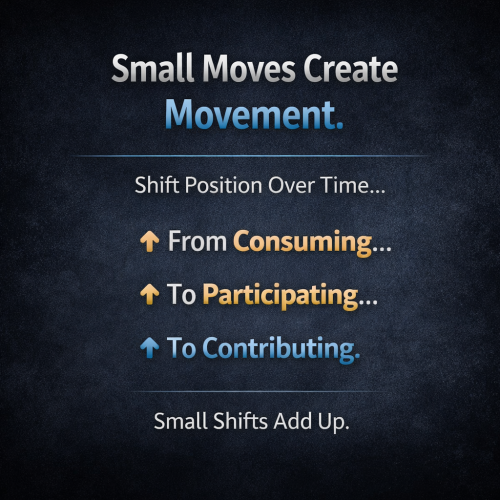
To inclusion.
From passive support…
To active engagement.
And once you start thinking this way, new possibilities begin to emerge.
A participatory economy does not assume that only a few create value.
It assumes that value can emerge from the contributions of many.
Not all contributions are equal.
Not all are large.
But all are part of the system.
This changes the structure entirely.
Because instead of a system that looks like this:
Few → create value → many receive
It begins to look like this:
Many → contribute value → many benefit
That shift may seem simple.
But it is profound.
Because it repositions the individual from the edge of the system…
To the centre of it.
This is the philosophy behind poolfunding.io.
It is not built on the assumption that people need to be supported because they are excluded.
It is built on the belief that people should not be excluded in the first place.
In this model:
It doesn’t ask people to wait for value to be distributed.
It invites them to become part of how value is created and circulated.
One of the biggest misconceptions about participation is that it requires significant input.
Time.
Skill.
Money.
But in networked systems, that is not necessarily true.
Because scale changes everything.
When many people contribute small amounts:
This is how ecosystems work.
No single element carries the entire system.
But together, they create something far greater.
There is an important distinction between dependency and interdependence.
Dependency means relying on a system without influencing it.
Interdependence means being part of a system where everyone plays a role.
UBI leans toward dependency.
Participatory systems move toward interdependence.
And interdependence creates strength.
Because it distributes both opportunity and responsibility.
As technology continues to evolve, the pressure on traditional employment models will increase.
This is not speculation.
It is already happening.
So the question is not whether change is coming.
It is:
How do we respond to it?
Do we:
Or do we:
The answer to that question will define the future of the economy.
At its core, this conversation is not just about economics.
It is about what kind of world we want to live in.
A world where:
Or a world where:
A truly human system does not just ensure survival.
It creates space for participation.
For growth.
For connection.
For meaning.
The problem was never just income.
Income is a symptom.
The real issue is exclusion from value creation.
And until that is addressed, any solution will remain incomplete.
UBI may provide relief.
It may reduce hardship.
It may even become part of the transition.
But if we want something more sustainable… more empowering… more human…
We need to go deeper.
We need to design systems where people are not positioned outside looking in…
But inside, contributing, building, and growing together.
Because the future will not be defined by how much we give people…
But by how many people we include in creating it.