x




From Contribution to Ownership:
Designing Economies That Actually Include People
The idea of a contribution-based economy is gaining traction.
It reflects how value is increasingly created in the digital age.
People collaborate across networks.
Communities organise resources.
Ideas scale faster than physical production ever could.
But as we explored earlier in the week, contribution alone is not enough.
Without structure, contribution can be absorbed rather than rewarded.
Which brings us to the more important question:
What does it actually take to move from contribution… to ownership?
For contribution to translate into meaningful participation, systems must be designed differently.
Not rhetorically.
Structurally.
Because systems determine outcomes.
They define who benefits.
They define who participates.
They define who holds influence over time.
If a system is designed to concentrate ownership, it will do so — regardless of how open or collaborative it appears on the surface.
If it is designed to distribute participation, different outcomes begin to emerge.
This is not a philosophical distinction.
It is architectural.
One of the common misconceptions around ownership is that it must be large to be meaningful.
That unless someone holds a significant stake, it does not matter.
But this is not how systems behave over time.
Ownership can be fractional.
It can be distributed across thousands or even millions of participants.
And when aligned correctly, even small positions can change behaviour.
People think differently when they are inside a system rather than outside it.
They pay attention.
They engage more deeply.
They take a longer-term view.
Ownership, even in small amounts, creates psychological alignment.
One of the biggest barriers to ownership has always been access.
Traditional systems require capital, connections, or institutional approval.
But digital infrastructure is beginning to change that.
New systems can be designed with lower entry thresholds.
Allowing individuals to participate earlier.
To contribute and gain exposure at the same time.
To move from observer to participant more easily.
This is where design becomes critical.
Because if entry points are too narrow, participation remains limited.
If they are too open without structure, value becomes diluted or chaotic.
Balance is required.
For ownership to align with contribution, systems must be able to recognise contribution.
This is not always simple.
Contribution can take many forms:
Time
Skills
Ideas
Coordination
Support
Community building
Not all contributions are easily quantified.
But if systems cannot recognise them at all, they cannot reward them.
This is one of the emerging challenges of digital economies.
How to build systems that acknowledge different forms of value — not just financial capital.
Communities play a critical role in bridging contribution and ownership.
Individually, people may have limited access.
Collectively, they can coordinate resources and opportunity.
This is where new models are beginning to emerge.
Collaborative funding systems.
Community-driven investment networks.
Shared participation frameworks.
Concepts such as poolfunding.io explore how coordinated communities can move beyond passive participation toward active involvement in funding and opportunity creation.
Similarly, tools like PMLcoin.app — positioned as a “Poverty Crusher” — aim to lower the barriers for individuals to engage with emerging financial ecosystems.
These are early-stage ideas.
But they point toward a larger shift.
From isolated participation… to coordinated participation.
One of the most important aspects of ownership is time.
Short-term rewards create short-term behaviour.
Long-term alignment creates stability.
Systems that connect contribution to long-term value tend to produce more sustainable outcomes.
People remain engaged.
They invest energy.
They contribute consistently.
Because they see a future within the system.
This is where many current models fall short.
They reward immediate activity, but not sustained involvement.
Designing for long-term alignment is more difficult — but far more powerful.
There is a growing risk in the current economic transition.
Systems that appear inclusive… but are not structurally inclusive.
They invite participation.
They encourage contribution.
But they do not distribute meaningful ownership.
This creates a form of surface inclusion.
People feel involved.
But they are not truly positioned within the system.
Over time, this can lead to frustration and disengagement.
Because the underlying imbalance remains.
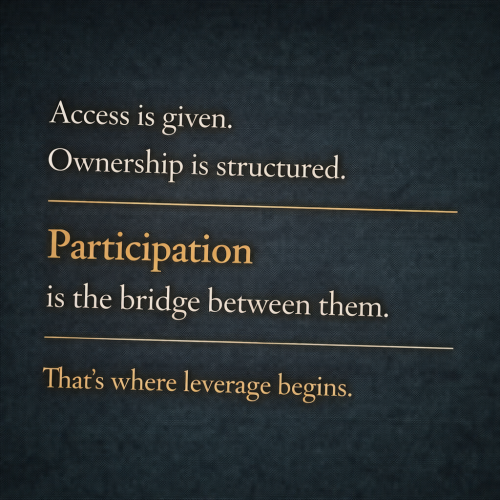
Real inclusion is not about access alone.
It is about position.
Being able to participate in value creation.
Being able to benefit from outcomes.
Being able to influence direction, even in small ways.
This does not require equal ownership for everyone.
But it does require meaningful pathways.
Clear connections between effort and outcome.
Systems that do not simply extract participation, but integrate it.
The transition toward participation-based economies will not happen overnight.
It will emerge through experimentation.
Some models will fail.
Others will evolve.
A few will scale.
The practical direction is already visible:
Lower barriers to entry.
Broader access to participation.
Better alignment between contribution and reward.
More transparent systems of value distribution.
These are not radical ideas.
They are structural adjustments.
But over time, they can produce very different economic outcomes.
For individuals, this shift offers both challenge and opportunity.
The challenge is that traditional pathways may become less predictable.
The opportunity is that new pathways are emerging.
Participation is no longer limited to employment alone.
People can engage with systems in multiple ways.
Through networks.
Through communities.
Through collaborative platforms.
Understanding how to position within these systems may become one of the most valuable skills of the coming decades.
The future economy will not be defined by contribution alone.
Nor by ownership alone.
It will be defined by the alignment between the two.
Where contribution leads nowhere, participation fades.
Where ownership is inaccessible, inequality grows.
But where contribution connects to ownership, something different becomes possible.
A system where people are not simply active…
…but included.
Not simply contributing…
…but participating in what they help to build.
This is not an idealistic vision.
It is a design challenge.
And like all design challenges, it will be solved gradually.
Through iteration.
Through experimentation.
Through people who recognise that the future economy is not just something to adapt to…
But something to help shape.
And those who understand that connection early will not just participate in the next economy.
They will help define it.