x



Why Contribution Alone Is Not Enough
The idea of a contribution-based economy is gaining quiet momentum.
It appeals on multiple levels.
It feels more human.
More collaborative.
More aligned with how digital networks actually function.
And in many ways, it represents a natural evolution beyond purely extractive systems.
But there is a risk in how this idea is sometimes interpreted.
A risk of oversimplification.
Because contribution alone does not automatically create economic security.
And without the right structures in place, contribution can easily be absorbed — rather than rewarded.
Digital platforms have already introduced millions of people to the idea of contribution.
People create content.
Share ideas.
Build communities.
Provide value to networks.
On the surface, this looks like a contribution economy in action.
But look more closely, and a different pattern often emerges.
The platforms themselves capture most of the economic value.
The contributors generate activity, attention, and engagement.
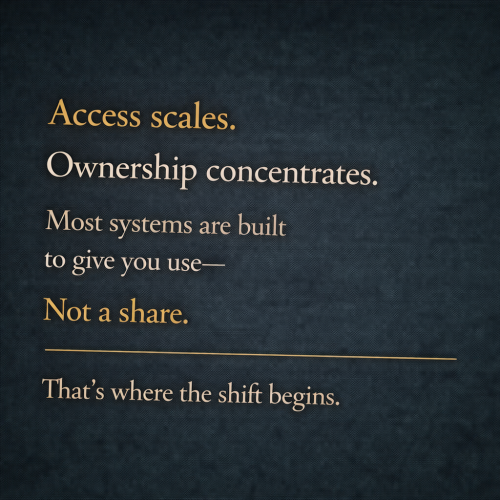
But ownership of the system — and therefore the majority of the financial upside — remains concentrated.
This creates a subtle imbalance.
People are participating.
But they are not always participating in the value created.
This is where the line between contribution and extraction begins to blur.
A system can appear collaborative on the surface…
…while still operating on extractive foundations underneath.
If individuals contribute time, energy, creativity, or data — but do not share in ownership or long-term value — then the system is still extracting from them.
It has simply changed the interface.
Instead of extracting labour in a traditional sense, it extracts participation without ownership.
This is one of the defining tensions of the current digital economy.
For contribution to translate into real economic participation, one element becomes essential.
Ownership.
Not necessarily in the traditional sense of large equity stakes.
But in some form that connects contribution to long-term value.
Without this connection, contribution remains incomplete.
It generates activity, but not security.
It creates engagement, but not stability.
Ownership is what transforms contribution into participation.
If ownership is so important, why has it not been more widely distributed?
There are several reasons.
Legal and financial systems were designed for centralised control.
Traditional investment structures require significant capital.
Regulatory environments can limit experimentation.
And existing institutions often benefit from maintaining current models.
As a result, many systems default to concentration rather than distribution.
Even in digital environments where participation is widespread.
Another challenge is scale.
It is relatively easy to create small, collaborative systems where contribution and ownership are aligned.
It is much harder to maintain that alignment as systems grow.
Large networks require coordination.
They require governance.
They require decision-making structures.
And as complexity increases, there is often a tendency to recentralise control.
This is not always intentional.
It is sometimes simply the path of least resistance.
But it creates a tension between efficiency and inclusivity.
There is also a human dimension to consider.
Not everyone wants to actively participate in complex economic systems.
Some prefer simplicity.
Some prefer stability.
Some prefer to focus on specific skills rather than navigating broader networks.
Any contribution-based economy must take this into account.
It must allow for different levels of participation.
Without assuming that everyone will engage in the same way.
Despite these challenges, new models are beginning to explore how contribution and ownership might be better aligned.
Some focus on cooperative structures.
Others explore tokenised participation.
Others look at community-based funding and shared value systems.
Concepts such as poolfunding.io are part of this broader exploration.
The idea is not simply to encourage contribution, but to connect participation with access to opportunity.
To create systems where individuals are not only involved…
…but are positioned to benefit from what they help support.
Similarly, initiatives like PMLcoin.app — described as a “Poverty Crusher” — are experimenting with ways to lower the barrier to entry into emerging financial ecosystems.
The goal is not just inclusion in activity.
But inclusion in potential outcomes.
If this transition is not handled carefully, there is a real risk.
A future where people are encouraged to contribute more than ever…
…but own less than ever.
Where participation is high, but economic influence remains concentrated.
Where systems appear open, but outcomes remain unequal.
This would not represent a true evolution.
It would simply be a more sophisticated form of the same underlying structure.
The key challenge, then, is design.
How do we build systems where:
Contribution is recognised
Participation is meaningful
Ownership is accessible
And value is shared in sustainable ways
This is not a simple technical problem.
It is a structural and philosophical one.
It requires rethinking how systems are built from the ground up.
Not just optimising for efficiency or growth.
But also for alignment between those who contribute and those who benefit.
As discussions around future economies continue, it may be important to bring more clarity to this issue.
Contribution is not enough on its own.
Participation is not enough on its own.
Even access is not enough on its own.
Without alignment between contribution and ownership, economic systems risk reproducing the very imbalances they aim to move beyond.
Recognising this early allows for better design.
And better design creates better outcomes over time.
The idea of a contribution-based economy is compelling.
It reflects the collaborative potential of digital systems.
It aligns with how value is increasingly created in networks.
But for it to work in practice, something more is required.
Contribution must connect to ownership.
Participation must connect to value.
Systems must be designed with alignment in mind.
Because without that connection, contribution risks becoming just another layer of extraction.
And with it, the opportunity for a more inclusive economic future begins to slip out of reach.
The real challenge is not simply encouraging people to contribute.
It is ensuring they are able to participate in what their contribution helps to create.