x





The Biggest Opportunity Shift in History Is Happening Quietly
History is full of moments that changed the structure of society.
The Industrial Revolution changed how people worked.
The internet changed how people communicated.
Digital technology changed how people access information.
But something else is happening now.
Quietly.
Gradually.
Almost invisibly to most people.
A shift in how opportunity itself is created and distributed.
And while many people are still focused on old models…
A new structure is beginning to emerge underneath them.
One of the strange things about major change is this:
While it’s happening, it rarely feels historic.
It just feels confusing.
Unclear.
Fragmented.
Unstable.
People often don’t realise the structure has changed until years later—when the new model already feels normal.
This has happened repeatedly throughout history.
When factories began replacing agricultural systems, many people thought the old world would continue forever.
When the internet first emerged, most people underestimated how deeply it would reshape business, communication, and everyday life.
And now, another shift is unfolding.
For most of modern history, opportunity was tightly controlled.
Access depended on:
If you wanted to participate in high-growth systems, you usually needed permission from existing power structures.
You needed access before you could create leverage.
But technology, networks, and distributed participation models are beginning to alter that reality.
Slowly, the barriers are changing.
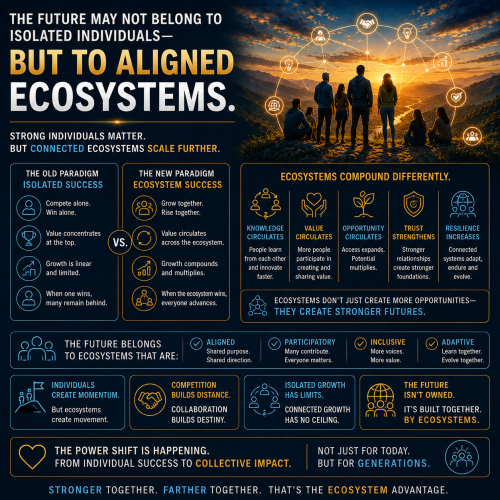
Traditional systems concentrated opportunity.
A small number of organisations controlled:
Most people entered the system only after value had already matured.
They became:
But now, new models are emerging where participation can happen earlier and more broadly.
This changes the structure of opportunity itself.
The earlier someone enters a growing system:
Historically, early-stage participation was limited to relatively small groups.
But distributed technologies and network-based ecosystems are beginning to expand access.
Not perfectly.
Not equally.
But significantly more than before.
And that matters.
Traditional economies often operated on scarcity logic.
Limited access.
Limited ownership.
Limited participation.
A small percentage of people captured most of the upside because they controlled entry points into systems.
The majority participated only after systems became established.
At that point:
This created the economic patterns many people still experience today.
Emerging systems work differently.
They grow through:
This doesn’t eliminate competition.
But it changes where value is created.
Value increasingly flows toward:
And those positioned within these systems early often gain advantages that compound over time.
Major shifts are difficult to recognise while they are forming.
Because people naturally interpret the future through the lens of the past.
If someone has spent decades believing opportunity works one way…
It becomes difficult to recognise when the underlying structure changes.
So many continue focusing exclusively on:
Even as the environment around them evolves.
The biggest barriers are often psychological rather than technical.
People hesitate because:
This is understandable.
But throughout history, early transitions have always felt uncomfortable before they became accepted.
When systems are still forming, they often appear:
That’s why most people ignore them.
But those early phases are often where the greatest leverage exists.
Because once a system becomes universally accepted…
Most of the asymmetrical opportunity has already passed.
One of the most important changes happening today is the shift from passive consumption to active participation.
For decades, many people interacted with economic systems mainly as:
But network-based systems increasingly allow people to become:
This changes the relationship between individuals and economic structures.
As opportunity structures evolve, positioning becomes critical.
Not just:
“What do I do?”
But:
Because in network-driven environments, position often matters more than isolated effort alone.
The people who benefit most from emerging systems are often not the most powerful initially.
They are the most aware.
Aware of:
Awareness allows positioning.
And positioning creates leverage.
Traditional systems are not disappearing tomorrow.
Jobs will continue to exist.
Institutions will continue to operate.
Conventional business models will remain important.
But alongside them, new structures are growing.
And over time, these structures may increasingly influence:
The shift is additive at first.
Then gradually transformative.
People who engage early in emerging systems gain something extremely valuable:
Experience inside the transition itself.
They learn:
This practical understanding compounds over time.
Meanwhile, people who remain entirely outside emerging systems may struggle to adapt later when those systems become more dominant.
What makes this moment so important is that the shift is happening quietly.
Without dramatic headlines.
Without a single defining event.
But underneath the surface:
And this may become one of the biggest redistributions of opportunity in modern history.
Not because wealth is simply handed out…
But because access to participation itself is expanding.
Every major transition creates windows of opportunity.
But windows eventually narrow.
As systems mature:
This is why timing matters so much.
Because being early in a growing system creates possibilities that may not exist later.
Most people think major historical shifts arrive loudly.
But often, they begin quietly.
Hidden inside small changes in behaviour, technology, participation, and connection.
And right now, a profound shift in opportunity is unfolding beneath the surface of the global economy.
A movement away from tightly controlled participation…
Toward more network-driven, distributed systems of value creation.
Not perfect systems.
Not fully formed systems.
But emerging systems.
And the people who recognise this shift early may not just experience different financial outcomes…
They may experience an entirely different relationship with opportunity itself.
So the real question is no longer simply:
“Where are the opportunities?”
It may now be:
“Am I close enough to the emerging systems where the future is being built?”